{"title":"Gradient layer arrangement for modulating the buried interface of inverted perovskite solar cells","authors":"Wenjing Miao, Ran Yin, Rongfei Wu, Weiwei Sun, Yansheng Sun, Kexiang Wang, Tingting You, Weichang Hao, Penggang Yin","doi":"10.1016/j.cej.2025.162942","DOIUrl":null,"url":null,"abstract":"The surface modification of transparent conductive oxides with self-assembled monolayers (SAM) based on carbazole has been demonstrated to be a workable strategy for the formation of efficient hole-selective contacts, thus significantly enhancing the power conversion efficiency (PCE) and stability of p-i-n perovskite solar cells (PSCs). While the inherent monolayer nature of SAM offers unique advantages, the buried interface poses a significant challenge to synergistic regulation for both perovskite (PVK) and SAM. In this study, an interfacial layer composed of an ionic compound, 3-(methylthio) propylamine hydroiodide (3MTPAI), is introduced between the PVK and SAM layers to enhance the photovoltaic performance of PSCs. 3MTPAI has been demonstrated to enhance the ion–dipole interactions of the SAM, facilitating a better-matched energy level between the PVK and hole transport layer (HTL). This, in turn, improves hole extraction/transport from the PVK layer to the HTL and reduces carrier recombination of the PSCs. Consequently, the PCE of the PSCs modified with 3MTPAI increases from 23.90 % to 25.30 %. Furthermore, devices treated with 3MTPAI exhibit enhanced stability, maintaining 90 % of the original PCE after 1000 h under conditions of 55 ± 5 % RH. Therefore, the buried interface modification strategy employing dual-role 3MTPAI molecules emerges as a viable approach to enhance the efficiency and stability of PSCs.","PeriodicalId":270,"journal":{"name":"Chemical Engineering Journal","volume":"21 1","pages":""},"PeriodicalIF":13.2000,"publicationDate":"2025-04-22","publicationTypes":"Journal Article","fieldsOfStudy":null,"isOpenAccess":false,"openAccessPdf":"","citationCount":"0","resultStr":null,"platform":"Semanticscholar","paperid":null,"PeriodicalName":"Chemical Engineering Journal","FirstCategoryId":"5","ListUrlMain":"https://doi.org/10.1016/j.cej.2025.162942","RegionNum":1,"RegionCategory":"工程技术","ArticlePicture":[],"TitleCN":null,"AbstractTextCN":null,"PMCID":null,"EPubDate":"","PubModel":"","JCR":"Q1","JCRName":"ENGINEERING, CHEMICAL","Score":null,"Total":0}
引用次数: 0
Abstract
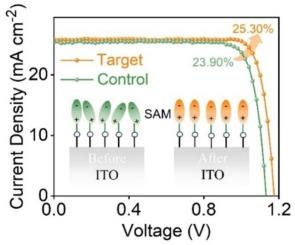
The surface modification of transparent conductive oxides with self-assembled monolayers (SAM) based on carbazole has been demonstrated to be a workable strategy for the formation of efficient hole-selective contacts, thus significantly enhancing the power conversion efficiency (PCE) and stability of p-i-n perovskite solar cells (PSCs). While the inherent monolayer nature of SAM offers unique advantages, the buried interface poses a significant challenge to synergistic regulation for both perovskite (PVK) and SAM. In this study, an interfacial layer composed of an ionic compound, 3-(methylthio) propylamine hydroiodide (3MTPAI), is introduced between the PVK and SAM layers to enhance the photovoltaic performance of PSCs. 3MTPAI has been demonstrated to enhance the ion–dipole interactions of the SAM, facilitating a better-matched energy level between the PVK and hole transport layer (HTL). This, in turn, improves hole extraction/transport from the PVK layer to the HTL and reduces carrier recombination of the PSCs. Consequently, the PCE of the PSCs modified with 3MTPAI increases from 23.90 % to 25.30 %. Furthermore, devices treated with 3MTPAI exhibit enhanced stability, maintaining 90 % of the original PCE after 1000 h under conditions of 55 ± 5 % RH. Therefore, the buried interface modification strategy employing dual-role 3MTPAI molecules emerges as a viable approach to enhance the efficiency and stability of PSCs.
期刊介绍:
The Chemical Engineering Journal is an international research journal that invites contributions of original and novel fundamental research. It aims to provide an international platform for presenting original fundamental research, interpretative reviews, and discussions on new developments in chemical engineering. The journal welcomes papers that describe novel theory and its practical application, as well as those that demonstrate the transfer of techniques from other disciplines. It also welcomes reports on carefully conducted experimental work that is soundly interpreted. The main focus of the journal is on original and rigorous research results that have broad significance. The Catalysis section within the Chemical Engineering Journal focuses specifically on Experimental and Theoretical studies in the fields of heterogeneous catalysis, molecular catalysis, and biocatalysis. These studies have industrial impact on various sectors such as chemicals, energy, materials, foods, healthcare, and environmental protection.



 京公网安备 11010802042870号
京ICP备2023020795号-1
京公网安备 11010802042870号
京ICP备2023020795号-1

 分享
分享
 求助内容:
求助内容: 应助结果提醒方式:
 扫码关注我们
