Quantitative study of ESBL and carbapenemase producers in wastewater treatment plants in Seville, Spain: a culture-based detection analysis of raw and treated water
Laura Monge-Olivares , Germán Peñalva , Marina R Pulido , Lara Garrudo , Miguel Ángel Doval , Sofía Ballesta , Nicolás Merchante , Pablo Rasero , Lucila Cuberos , Graciano Carpes , Lorena López-Cerero
{"title":"Quantitative study of ESBL and carbapenemase producers in wastewater treatment plants in Seville, Spain: a culture-based detection analysis of raw and treated water","authors":"Laura Monge-Olivares , Germán Peñalva , Marina R Pulido , Lara Garrudo , Miguel Ángel Doval , Sofía Ballesta , Nicolás Merchante , Pablo Rasero , Lucila Cuberos , Graciano Carpes , Lorena López-Cerero","doi":"10.1016/j.watres.2025.123706","DOIUrl":null,"url":null,"abstract":"<div><div>Antibiotics can modify populations of multidrug-resistant microorganism (MDRO) in urban wastewater. Our objectives were to quantify the differences in MDR Gram-negative bacteria between influents and effluents of WWTPs of a Spanish city and to evaluate the influence of human antibiotic prescriptions, as well as the persistence of these bacteria after treatment and their genetic relatedness to clinical isolates. The mean count of ESBL producers and carbapenemase producers were 3.77 and 2.74 log 10 CFU/ml, respectively. The reduction achieved by water treatment of ESBL-producing organisms was 1.4-log (96.11 %), whereas a 1.8-log reduction (98.36 %) was obtained regarding carbapenemase producing organisms. <em>Aeromonas</em> spp. predominated among MDROs and <em>bla</em><sub>KPC-2</sub> was the main carbapenemase detected in the influent wastewater samples. Among <em>Escherichia coli</em> and <em>Klebsiella pneumoniae</em> influent isolates, 44 % and 30 %, respectively, belonged to high-risk clones. Regarding Enterobacteriaceae, 10.6 % matched clinical isolates and one strain from an ongoing hospital outbreak was identified among raw samples. New MDROs and persistence of certain strains were detected in effluent samples. Quinolone and third-generation cephalosporin prescriptions, flow rate and population density were associated with higher OXA-48 producer counts. Despite reductions, additional technologies should be implemented in WWTPs receiving hospital discharges. Given the prevalence of environmental species, culture-based and metagenomic approaches should be combined to distinguish between human and sewage sources for antibiotic resistance monitoring. Overall, this study shows that WWTPs with secondary treatment are effective at removing MDRO, and antibiotic stewardship is a potential strategy to reduce the release of MDROs.</div></div>","PeriodicalId":443,"journal":{"name":"Water Research","volume":"281 ","pages":"Article 123706"},"PeriodicalIF":12.4000,"publicationDate":"2025-08-01","publicationTypes":"Journal Article","fieldsOfStudy":null,"isOpenAccess":false,"openAccessPdf":"","citationCount":"0","resultStr":null,"platform":"Semanticscholar","paperid":null,"PeriodicalName":"Water Research","FirstCategoryId":"93","ListUrlMain":"https://www.sciencedirect.com/science/article/pii/S0043135425006153","RegionNum":1,"RegionCategory":"环境科学与生态学","ArticlePicture":[],"TitleCN":null,"AbstractTextCN":null,"PMCID":null,"EPubDate":"2025/4/22 0:00:00","PubModel":"Epub","JCR":"Q1","JCRName":"ENGINEERING, ENVIRONMENTAL","Score":null,"Total":0}
引用次数: 0
Abstract
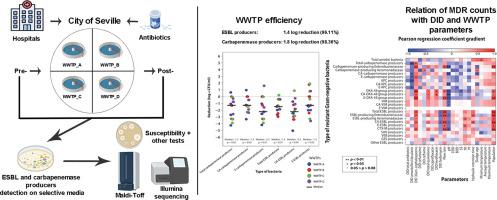
Antibiotics can modify populations of multidrug-resistant microorganism (MDRO) in urban wastewater. Our objectives were to quantify the differences in MDR Gram-negative bacteria between influents and effluents of WWTPs of a Spanish city and to evaluate the influence of human antibiotic prescriptions, as well as the persistence of these bacteria after treatment and their genetic relatedness to clinical isolates. The mean count of ESBL producers and carbapenemase producers were 3.77 and 2.74 log 10 CFU/ml, respectively. The reduction achieved by water treatment of ESBL-producing organisms was 1.4-log (96.11 %), whereas a 1.8-log reduction (98.36 %) was obtained regarding carbapenemase producing organisms. Aeromonas spp. predominated among MDROs and blaKPC-2 was the main carbapenemase detected in the influent wastewater samples. Among Escherichia coli and Klebsiella pneumoniae influent isolates, 44 % and 30 %, respectively, belonged to high-risk clones. Regarding Enterobacteriaceae, 10.6 % matched clinical isolates and one strain from an ongoing hospital outbreak was identified among raw samples. New MDROs and persistence of certain strains were detected in effluent samples. Quinolone and third-generation cephalosporin prescriptions, flow rate and population density were associated with higher OXA-48 producer counts. Despite reductions, additional technologies should be implemented in WWTPs receiving hospital discharges. Given the prevalence of environmental species, culture-based and metagenomic approaches should be combined to distinguish between human and sewage sources for antibiotic resistance monitoring. Overall, this study shows that WWTPs with secondary treatment are effective at removing MDRO, and antibiotic stewardship is a potential strategy to reduce the release of MDROs.
期刊介绍:
Water Research, along with its open access companion journal Water Research X, serves as a platform for publishing original research papers covering various aspects of the science and technology related to the anthropogenic water cycle, water quality, and its management worldwide. The audience targeted by the journal comprises biologists, chemical engineers, chemists, civil engineers, environmental engineers, limnologists, and microbiologists. The scope of the journal include:
•Treatment processes for water and wastewaters (municipal, agricultural, industrial, and on-site treatment), including resource recovery and residuals management;
•Urban hydrology including sewer systems, stormwater management, and green infrastructure;
•Drinking water treatment and distribution;
•Potable and non-potable water reuse;
•Sanitation, public health, and risk assessment;
•Anaerobic digestion, solid and hazardous waste management, including source characterization and the effects and control of leachates and gaseous emissions;
•Contaminants (chemical, microbial, anthropogenic particles such as nanoparticles or microplastics) and related water quality sensing, monitoring, fate, and assessment;
•Anthropogenic impacts on inland, tidal, coastal and urban waters, focusing on surface and ground waters, and point and non-point sources of pollution;
•Environmental restoration, linked to surface water, groundwater and groundwater remediation;
•Analysis of the interfaces between sediments and water, and between water and atmosphere, focusing specifically on anthropogenic impacts;
•Mathematical modelling, systems analysis, machine learning, and beneficial use of big data related to the anthropogenic water cycle;
•Socio-economic, policy, and regulations studies.




 京公网安备 11010802042870号
京ICP备2023020795号-1
京公网安备 11010802042870号
京ICP备2023020795号-1

 分享
分享
 求助内容:
求助内容: 应助结果提醒方式:
 扫码关注我们
