Chenchen Fan , Jingming Hou , Xuan Li , Gangfu Song , Yihui Yang , Xin Liang , Qingshi Zhou , Muhammad Imran , Guangzhao Chen , Ziyi Wang , Pinpin Lu
{"title":"Efficient urban flood control and drainage management framework based on digital twin technology and optimization scheduling algorithm","authors":"Chenchen Fan , Jingming Hou , Xuan Li , Gangfu Song , Yihui Yang , Xin Liang , Qingshi Zhou , Muhammad Imran , Guangzhao Chen , Ziyi Wang , Pinpin Lu","doi":"10.1016/j.watres.2025.123711","DOIUrl":null,"url":null,"abstract":"<div><div>Urban flood control and drainage systems often face significant challenges in coordinating municipal drainage with river-lake flood prevention during flood seasons. Rising river levels can create backwater effects, which substantially increase urban flood risks. Traditional water management approaches are limited by delayed monitoring data updates, slow flood forecasting processes, and inadequate decision support, making it difficult to address the complex, multi-objective demands of flood control. These limitations exacerbate flooding threats and hamper effective urban flood management. To address these challenges, a digital twin experimental platform for river and lake water systems was developed to enhance the comprehensive management of urban flood control and drainage. The platform integrates an engineering entity, a backend system, and a digital twin component. Real-time data acquisition and virtual-real interactions between physical facilities and the digital twin were achieved using Programmable Logic Controller (PLC) technology, while the Unity3D engine enabled advanced visualization and data rendering. Furthermore, a novel model incorporating deep learning and a multi-objective optimization algorithm was proposed to optimize drainage pump scheduling rules. A comparative analysis was conducted to evaluate flood risks and operation and maintenance costs before and after optimization. The results demonstrated that the platform was well-designed for comprehensive flood protection and drainage management. The NSE coefficients for river and lake water levels exceeded 95.18 %, and the relative error in pump operation times remained below 4.11 % across various scenarios involving river inflows and drainage operations. The backwater effect at drainage outlets was primarily driven by river flow and downstream lake levels. The optimization strategy effectively balanced water level control and operational objectives, reducing water level targets by 24.99 %, 40.36 %, and 51.61 % under different scenarios. This framework not only offers innovative solutions for urban flood management but also provides strong technical support for optimizing flood control and drainage system operations.</div></div>","PeriodicalId":443,"journal":{"name":"Water Research","volume":"282 ","pages":"Article 123711"},"PeriodicalIF":12.4000,"publicationDate":"2025-08-15","publicationTypes":"Journal Article","fieldsOfStudy":null,"isOpenAccess":false,"openAccessPdf":"","citationCount":"0","resultStr":null,"platform":"Semanticscholar","paperid":null,"PeriodicalName":"Water Research","FirstCategoryId":"93","ListUrlMain":"https://www.sciencedirect.com/science/article/pii/S0043135425006207","RegionNum":1,"RegionCategory":"环境科学与生态学","ArticlePicture":[],"TitleCN":null,"AbstractTextCN":null,"PMCID":null,"EPubDate":"2025/4/22 0:00:00","PubModel":"Epub","JCR":"Q1","JCRName":"ENGINEERING, ENVIRONMENTAL","Score":null,"Total":0}
引用次数: 0
Abstract
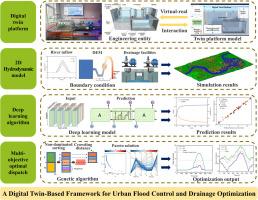
Urban flood control and drainage systems often face significant challenges in coordinating municipal drainage with river-lake flood prevention during flood seasons. Rising river levels can create backwater effects, which substantially increase urban flood risks. Traditional water management approaches are limited by delayed monitoring data updates, slow flood forecasting processes, and inadequate decision support, making it difficult to address the complex, multi-objective demands of flood control. These limitations exacerbate flooding threats and hamper effective urban flood management. To address these challenges, a digital twin experimental platform for river and lake water systems was developed to enhance the comprehensive management of urban flood control and drainage. The platform integrates an engineering entity, a backend system, and a digital twin component. Real-time data acquisition and virtual-real interactions between physical facilities and the digital twin were achieved using Programmable Logic Controller (PLC) technology, while the Unity3D engine enabled advanced visualization and data rendering. Furthermore, a novel model incorporating deep learning and a multi-objective optimization algorithm was proposed to optimize drainage pump scheduling rules. A comparative analysis was conducted to evaluate flood risks and operation and maintenance costs before and after optimization. The results demonstrated that the platform was well-designed for comprehensive flood protection and drainage management. The NSE coefficients for river and lake water levels exceeded 95.18 %, and the relative error in pump operation times remained below 4.11 % across various scenarios involving river inflows and drainage operations. The backwater effect at drainage outlets was primarily driven by river flow and downstream lake levels. The optimization strategy effectively balanced water level control and operational objectives, reducing water level targets by 24.99 %, 40.36 %, and 51.61 % under different scenarios. This framework not only offers innovative solutions for urban flood management but also provides strong technical support for optimizing flood control and drainage system operations.
期刊介绍:
Water Research, along with its open access companion journal Water Research X, serves as a platform for publishing original research papers covering various aspects of the science and technology related to the anthropogenic water cycle, water quality, and its management worldwide. The audience targeted by the journal comprises biologists, chemical engineers, chemists, civil engineers, environmental engineers, limnologists, and microbiologists. The scope of the journal include:
•Treatment processes for water and wastewaters (municipal, agricultural, industrial, and on-site treatment), including resource recovery and residuals management;
•Urban hydrology including sewer systems, stormwater management, and green infrastructure;
•Drinking water treatment and distribution;
•Potable and non-potable water reuse;
•Sanitation, public health, and risk assessment;
•Anaerobic digestion, solid and hazardous waste management, including source characterization and the effects and control of leachates and gaseous emissions;
•Contaminants (chemical, microbial, anthropogenic particles such as nanoparticles or microplastics) and related water quality sensing, monitoring, fate, and assessment;
•Anthropogenic impacts on inland, tidal, coastal and urban waters, focusing on surface and ground waters, and point and non-point sources of pollution;
•Environmental restoration, linked to surface water, groundwater and groundwater remediation;
•Analysis of the interfaces between sediments and water, and between water and atmosphere, focusing specifically on anthropogenic impacts;
•Mathematical modelling, systems analysis, machine learning, and beneficial use of big data related to the anthropogenic water cycle;
•Socio-economic, policy, and regulations studies.




 京公网安备 11010802042870号
京ICP备2023020795号-1
京公网安备 11010802042870号
京ICP备2023020795号-1

 分享
分享
 求助内容:
求助内容: 应助结果提醒方式:
 扫码关注我们
