Longjian Li, Ping Zhang, Reyila Tuerhong, Yongchong Yu, Keyi Chai, Lianbiao Zhao, Xiaoping Su, Lijuan Han
{"title":"Dipole-polarized Cu–Ni atomic interfaces for synergistic enhancement and steering of overall nitrogen photofixation","authors":"Longjian Li, Ping Zhang, Reyila Tuerhong, Yongchong Yu, Keyi Chai, Lianbiao Zhao, Xiaoping Su, Lijuan Han","doi":"10.1016/j.cej.2025.162976","DOIUrl":null,"url":null,"abstract":"Enabling the oxidation of ammonia (NH<sub>3</sub>), a product of nitrogen (N<sub>2</sub>) reduction, to nitric acid (HNO<sub>3</sub>) can boost the economic value of overall N<sub>2</sub> photofixation. In this work, we constructed a Cu doped NiO@C nanosheets photocatalyst with dipole polarization effect, achieving efficient overall N<sub>2</sub> photofixation (N<sub>2</sub> → NH<sub>3</sub> → HNO<sub>3</sub>) with a relatively high proportion of NO<sub>3</sub><sup>−</sup> (92.3 %). Mechanistic studies reveal that the band structure modulation of photocatalyst and thus enhanced the oxidation capacity, further significantly promoted the NH<sub>3</sub> → HNO<sub>3</sub> pathway and increased the proportion of NO<sub>3</sub><sup>−</sup> in the overall N<sub>2</sub> photofixation products. The local polarization brought along the Cu-Ni atomic interface, which promoted photo-excited charge transfer process, enhanced N<sub>2</sub> absorption/activation capability and promoted the N<sub>2</sub> → NH<sub>3</sub> pathway. First-principles density functional theory (DFT) calculations demonstrate that the Cu doping strategy reduce the N<sub>2</sub> reduction reaction (NRR) energy barrier. This work provides an approach for optimizing the overall N<sub>2</sub> photofixation through band structure modulation and dipole polarization effect.","PeriodicalId":270,"journal":{"name":"Chemical Engineering Journal","volume":"63 1","pages":""},"PeriodicalIF":13.2000,"publicationDate":"2025-04-22","publicationTypes":"Journal Article","fieldsOfStudy":null,"isOpenAccess":false,"openAccessPdf":"","citationCount":"0","resultStr":null,"platform":"Semanticscholar","paperid":null,"PeriodicalName":"Chemical Engineering Journal","FirstCategoryId":"5","ListUrlMain":"https://doi.org/10.1016/j.cej.2025.162976","RegionNum":1,"RegionCategory":"工程技术","ArticlePicture":[],"TitleCN":null,"AbstractTextCN":null,"PMCID":null,"EPubDate":"","PubModel":"","JCR":"Q1","JCRName":"ENGINEERING, CHEMICAL","Score":null,"Total":0}
引用次数: 0
Abstract
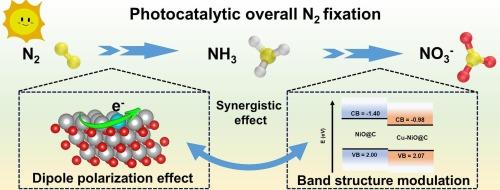
Enabling the oxidation of ammonia (NH3), a product of nitrogen (N2) reduction, to nitric acid (HNO3) can boost the economic value of overall N2 photofixation. In this work, we constructed a Cu doped NiO@C nanosheets photocatalyst with dipole polarization effect, achieving efficient overall N2 photofixation (N2 → NH3 → HNO3) with a relatively high proportion of NO3− (92.3 %). Mechanistic studies reveal that the band structure modulation of photocatalyst and thus enhanced the oxidation capacity, further significantly promoted the NH3 → HNO3 pathway and increased the proportion of NO3− in the overall N2 photofixation products. The local polarization brought along the Cu-Ni atomic interface, which promoted photo-excited charge transfer process, enhanced N2 absorption/activation capability and promoted the N2 → NH3 pathway. First-principles density functional theory (DFT) calculations demonstrate that the Cu doping strategy reduce the N2 reduction reaction (NRR) energy barrier. This work provides an approach for optimizing the overall N2 photofixation through band structure modulation and dipole polarization effect.
期刊介绍:
The Chemical Engineering Journal is an international research journal that invites contributions of original and novel fundamental research. It aims to provide an international platform for presenting original fundamental research, interpretative reviews, and discussions on new developments in chemical engineering. The journal welcomes papers that describe novel theory and its practical application, as well as those that demonstrate the transfer of techniques from other disciplines. It also welcomes reports on carefully conducted experimental work that is soundly interpreted. The main focus of the journal is on original and rigorous research results that have broad significance. The Catalysis section within the Chemical Engineering Journal focuses specifically on Experimental and Theoretical studies in the fields of heterogeneous catalysis, molecular catalysis, and biocatalysis. These studies have industrial impact on various sectors such as chemicals, energy, materials, foods, healthcare, and environmental protection.



 京公网安备 11010802042870号
京ICP备2023020795号-1
京公网安备 11010802042870号
京ICP备2023020795号-1

 分享
分享
 求助内容:
求助内容: 应助结果提醒方式:
 扫码关注我们
