Yadong Guo, Janak Lal Pathak, Yinyin Huang, Jingru Han, Junyan Zeng, Ling Chen, Yongshan Li, Wenbo Du, Liping Wang, Lan Yang
{"title":"PDLSCs-ApoEVs enhance bone regeneration through MAPK1/3-induced STC1 upregulation in endothelial cells via the FOS pathway","authors":"Yadong Guo, Janak Lal Pathak, Yinyin Huang, Jingru Han, Junyan Zeng, Ling Chen, Yongshan Li, Wenbo Du, Liping Wang, Lan Yang","doi":"10.1016/j.cej.2025.162927","DOIUrl":null,"url":null,"abstract":"Effective repair of severe bone defects is a significant challenge in clinical practice. Recent research has highlighted the potential of apoptotic vesicles derived from mesenchymal stem cells (MSC-ApoEVs) for tissue repair. This study specifically explored the use of ApoEVs derived from periodontal ligament stem cells (PDLSCs-ApoEVs) and their ability to treat localized bone defects. In a mouse model with cranial defects, PDLSCs-ApoEVs were found to stimulate bone regeneration effectively. However, in vitro studies showed that these vesicles had limited ability to promote osteogenic differentiation in bone marrow stromal cells (BMSCs). Further investigation revealed that PDLSCs-ApoEVs enhanced angiogenesis and osteogenesis by coupling these two processes. The mechanism involved is MAPK1/3 within PDLSCs-ApoEVs, which increased the expression of STC1 in endothelial cells through the MAPK1/3-FOS pathway. STC1, a secretory protein, promoted both angiogenesis and osteogenic differentiation, forming H-type blood vessels in the bone-forming environment. This combined effect of angiogenesis and osteogenesis significantly improved bone repair in the mouse model. Overall, this study sheds light on the role and mechanisms of PDLSCs-ApoEVs in bone formation, offering new perspectives on their potential for tissue regeneration therapy.","PeriodicalId":270,"journal":{"name":"Chemical Engineering Journal","volume":"24 1","pages":""},"PeriodicalIF":13.2000,"publicationDate":"2025-04-22","publicationTypes":"Journal Article","fieldsOfStudy":null,"isOpenAccess":false,"openAccessPdf":"","citationCount":"0","resultStr":null,"platform":"Semanticscholar","paperid":null,"PeriodicalName":"Chemical Engineering Journal","FirstCategoryId":"5","ListUrlMain":"https://doi.org/10.1016/j.cej.2025.162927","RegionNum":1,"RegionCategory":"工程技术","ArticlePicture":[],"TitleCN":null,"AbstractTextCN":null,"PMCID":null,"EPubDate":"","PubModel":"","JCR":"Q1","JCRName":"ENGINEERING, CHEMICAL","Score":null,"Total":0}
引用次数: 0
Abstract
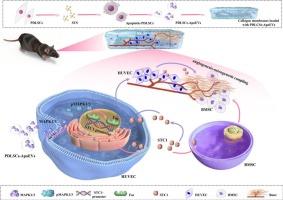
Effective repair of severe bone defects is a significant challenge in clinical practice. Recent research has highlighted the potential of apoptotic vesicles derived from mesenchymal stem cells (MSC-ApoEVs) for tissue repair. This study specifically explored the use of ApoEVs derived from periodontal ligament stem cells (PDLSCs-ApoEVs) and their ability to treat localized bone defects. In a mouse model with cranial defects, PDLSCs-ApoEVs were found to stimulate bone regeneration effectively. However, in vitro studies showed that these vesicles had limited ability to promote osteogenic differentiation in bone marrow stromal cells (BMSCs). Further investigation revealed that PDLSCs-ApoEVs enhanced angiogenesis and osteogenesis by coupling these two processes. The mechanism involved is MAPK1/3 within PDLSCs-ApoEVs, which increased the expression of STC1 in endothelial cells through the MAPK1/3-FOS pathway. STC1, a secretory protein, promoted both angiogenesis and osteogenic differentiation, forming H-type blood vessels in the bone-forming environment. This combined effect of angiogenesis and osteogenesis significantly improved bone repair in the mouse model. Overall, this study sheds light on the role and mechanisms of PDLSCs-ApoEVs in bone formation, offering new perspectives on their potential for tissue regeneration therapy.
期刊介绍:
The Chemical Engineering Journal is an international research journal that invites contributions of original and novel fundamental research. It aims to provide an international platform for presenting original fundamental research, interpretative reviews, and discussions on new developments in chemical engineering. The journal welcomes papers that describe novel theory and its practical application, as well as those that demonstrate the transfer of techniques from other disciplines. It also welcomes reports on carefully conducted experimental work that is soundly interpreted. The main focus of the journal is on original and rigorous research results that have broad significance. The Catalysis section within the Chemical Engineering Journal focuses specifically on Experimental and Theoretical studies in the fields of heterogeneous catalysis, molecular catalysis, and biocatalysis. These studies have industrial impact on various sectors such as chemicals, energy, materials, foods, healthcare, and environmental protection.



 京公网安备 11010802042870号
京ICP备2023020795号-1
京公网安备 11010802042870号
京ICP备2023020795号-1

 分享
分享
 求助内容:
求助内容: 应助结果提醒方式:
 扫码关注我们
