{"title":"An efficient and sustainable method for improved CO2 capture based on gas hydrate condensation","authors":"Junghoon Mok, Amadeu K. Sum","doi":"10.1016/j.cej.2025.162971","DOIUrl":null,"url":null,"abstract":"To reach carbon neutrality, Carbon Capture and Storage (CCS) technology has emerged as a critical solution. This research introduces an innovative and groundbreaking approach to gas capture, the “gas hydrate condensation” method specifically applied to CO<sub>2</sub> capture. We demonstrate that water vapor, efficiently supplied through controlled convection, can directly co-condense with CO<sub>2</sub> on cold surfaces to form gas hydrates. This novel method bypasses the mass/heat transfer limitations inherent in traditional approaches that utilize bulk water for gas hydrate formation, which is further enhanced with liquid CO<sub>2</sub> condensation/vaporization. In this context, condensed liquid CO<sub>2</sub> serves dual purpose: as a refrigerant, facilitating the transport of cold energy, and as a water carrier, significantly accelerating the gas hydrate condensation process. This enhanced method is shown to improve CO<sub>2</sub> capture rates by more than three-fold compared to conventional gas hydrate condensation strategies. Moreover, this work details the distribution and morphology of the gas hydrates formed, laying the groundwork for development and scale-up of this technology. These findings represent a significant advancement in the realm of gas hydrate-based CCS technologies, introducing a versatile, efficient and sustainable strategy for capturing CO<sub>2</sub> and other greenhouse gases.","PeriodicalId":270,"journal":{"name":"Chemical Engineering Journal","volume":"21 1","pages":""},"PeriodicalIF":13.2000,"publicationDate":"2025-04-22","publicationTypes":"Journal Article","fieldsOfStudy":null,"isOpenAccess":false,"openAccessPdf":"","citationCount":"0","resultStr":null,"platform":"Semanticscholar","paperid":null,"PeriodicalName":"Chemical Engineering Journal","FirstCategoryId":"5","ListUrlMain":"https://doi.org/10.1016/j.cej.2025.162971","RegionNum":1,"RegionCategory":"工程技术","ArticlePicture":[],"TitleCN":null,"AbstractTextCN":null,"PMCID":null,"EPubDate":"","PubModel":"","JCR":"Q1","JCRName":"ENGINEERING, CHEMICAL","Score":null,"Total":0}
引用次数: 0
Abstract
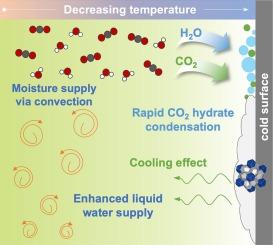
To reach carbon neutrality, Carbon Capture and Storage (CCS) technology has emerged as a critical solution. This research introduces an innovative and groundbreaking approach to gas capture, the “gas hydrate condensation” method specifically applied to CO2 capture. We demonstrate that water vapor, efficiently supplied through controlled convection, can directly co-condense with CO2 on cold surfaces to form gas hydrates. This novel method bypasses the mass/heat transfer limitations inherent in traditional approaches that utilize bulk water for gas hydrate formation, which is further enhanced with liquid CO2 condensation/vaporization. In this context, condensed liquid CO2 serves dual purpose: as a refrigerant, facilitating the transport of cold energy, and as a water carrier, significantly accelerating the gas hydrate condensation process. This enhanced method is shown to improve CO2 capture rates by more than three-fold compared to conventional gas hydrate condensation strategies. Moreover, this work details the distribution and morphology of the gas hydrates formed, laying the groundwork for development and scale-up of this technology. These findings represent a significant advancement in the realm of gas hydrate-based CCS technologies, introducing a versatile, efficient and sustainable strategy for capturing CO2 and other greenhouse gases.
期刊介绍:
The Chemical Engineering Journal is an international research journal that invites contributions of original and novel fundamental research. It aims to provide an international platform for presenting original fundamental research, interpretative reviews, and discussions on new developments in chemical engineering. The journal welcomes papers that describe novel theory and its practical application, as well as those that demonstrate the transfer of techniques from other disciplines. It also welcomes reports on carefully conducted experimental work that is soundly interpreted. The main focus of the journal is on original and rigorous research results that have broad significance. The Catalysis section within the Chemical Engineering Journal focuses specifically on Experimental and Theoretical studies in the fields of heterogeneous catalysis, molecular catalysis, and biocatalysis. These studies have industrial impact on various sectors such as chemicals, energy, materials, foods, healthcare, and environmental protection.



 京公网安备 11010802042870号
京ICP备2023020795号-1
京公网安备 11010802042870号
京ICP备2023020795号-1

 分享
分享
 求助内容:
求助内容: 应助结果提醒方式:
 扫码关注我们
