Nitrogen-doped carbon bilayer flow-through electrocatalytic membrane based on transition metal single atoms: Simultaneous generation and activation of H2O2 for ibuprofen degradation
{"title":"Nitrogen-doped carbon bilayer flow-through electrocatalytic membrane based on transition metal single atoms: Simultaneous generation and activation of H2O2 for ibuprofen degradation","authors":"Xiangting Hou, Hui Wang, Lumeng Jia, Mengxue Li, Wenchao Yu, Zhaoyong Bian","doi":"10.1016/j.cej.2025.162950","DOIUrl":null,"url":null,"abstract":"The development of highly active and selective cathode materials is important for the in-situ synthesis of hydrogen peroxide (H<sub>2</sub>O<sub>2</sub>) and its activation to radicals for the degradation of emerging contaminants. In this paper, a nitrogen-doped carbon bilayer catalyst based on transition metal single atoms (Co<sub>2</sub>-NC/Fe<sub>3</sub>-C<sub>3</sub>N<sub>4</sub>) was developed to construct a flow-through electrocatalytic membrane system as the cathode for the efficient removal of ibuprofen (IBP) from wastewater. The active sites of high-density transition metal single atoms and heteroatoms N synergistically enhanced O<sub>2</sub> adsorption and *OOH desorption to promote H<sub>2</sub>O<sub>2</sub> generation. The results showed that the actual contents of Fe and Co single atoms in the catalysts were 6.0 wt% and 4.2 wt%, which were higher than that of common single atoms < 3 wt%. The degradation rate of IBP in the Co<sub>2</sub>-NC/Fe<sub>3</sub>-C<sub>3</sub>N<sub>4</sub> bilayer electrocatalytic membrane system could reach 93.1 % at 60 min under optimal conditions. The Fe<sub>3</sub>-C<sub>3</sub>N<sub>4</sub> layer produced H<sub>2</sub>O<sub>2</sub> and further activated to hydroxyl radical (•OH) mainly through the three electron oxygen reduction reaction (3e<sup>-</sup>-ORR), whereas the Co<sub>2</sub>-NC layer produced H<sub>2</sub>O<sub>2</sub> through the 2e<sup>-</sup>-ORR to provide the precursors for the Fe<sub>3</sub>-C<sub>3</sub>N<sub>4</sub> layer for reactive oxygen species generation. The contribution of •OH was as high as 86.49 %, which was the main ROS for degrading IBP. The susceptible reaction sites of IBP were O9, O10, C1, and C11, and there were two main degradation pathways, and the toxicity of the degraded intermediates was reduced, which decreased the environmental risk generated by IBP.","PeriodicalId":270,"journal":{"name":"Chemical Engineering Journal","volume":"9 1","pages":""},"PeriodicalIF":13.2000,"publicationDate":"2025-04-22","publicationTypes":"Journal Article","fieldsOfStudy":null,"isOpenAccess":false,"openAccessPdf":"","citationCount":"0","resultStr":null,"platform":"Semanticscholar","paperid":null,"PeriodicalName":"Chemical Engineering Journal","FirstCategoryId":"5","ListUrlMain":"https://doi.org/10.1016/j.cej.2025.162950","RegionNum":1,"RegionCategory":"工程技术","ArticlePicture":[],"TitleCN":null,"AbstractTextCN":null,"PMCID":null,"EPubDate":"","PubModel":"","JCR":"Q1","JCRName":"ENGINEERING, CHEMICAL","Score":null,"Total":0}
引用次数: 0
Abstract
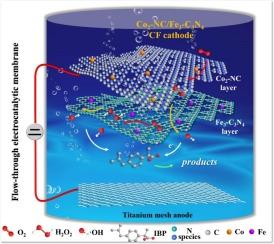
The development of highly active and selective cathode materials is important for the in-situ synthesis of hydrogen peroxide (H2O2) and its activation to radicals for the degradation of emerging contaminants. In this paper, a nitrogen-doped carbon bilayer catalyst based on transition metal single atoms (Co2-NC/Fe3-C3N4) was developed to construct a flow-through electrocatalytic membrane system as the cathode for the efficient removal of ibuprofen (IBP) from wastewater. The active sites of high-density transition metal single atoms and heteroatoms N synergistically enhanced O2 adsorption and *OOH desorption to promote H2O2 generation. The results showed that the actual contents of Fe and Co single atoms in the catalysts were 6.0 wt% and 4.2 wt%, which were higher than that of common single atoms < 3 wt%. The degradation rate of IBP in the Co2-NC/Fe3-C3N4 bilayer electrocatalytic membrane system could reach 93.1 % at 60 min under optimal conditions. The Fe3-C3N4 layer produced H2O2 and further activated to hydroxyl radical (•OH) mainly through the three electron oxygen reduction reaction (3e--ORR), whereas the Co2-NC layer produced H2O2 through the 2e--ORR to provide the precursors for the Fe3-C3N4 layer for reactive oxygen species generation. The contribution of •OH was as high as 86.49 %, which was the main ROS for degrading IBP. The susceptible reaction sites of IBP were O9, O10, C1, and C11, and there were two main degradation pathways, and the toxicity of the degraded intermediates was reduced, which decreased the environmental risk generated by IBP.
期刊介绍:
The Chemical Engineering Journal is an international research journal that invites contributions of original and novel fundamental research. It aims to provide an international platform for presenting original fundamental research, interpretative reviews, and discussions on new developments in chemical engineering. The journal welcomes papers that describe novel theory and its practical application, as well as those that demonstrate the transfer of techniques from other disciplines. It also welcomes reports on carefully conducted experimental work that is soundly interpreted. The main focus of the journal is on original and rigorous research results that have broad significance. The Catalysis section within the Chemical Engineering Journal focuses specifically on Experimental and Theoretical studies in the fields of heterogeneous catalysis, molecular catalysis, and biocatalysis. These studies have industrial impact on various sectors such as chemicals, energy, materials, foods, healthcare, and environmental protection.



 京公网安备 11010802042870号
京ICP备2023020795号-1
京公网安备 11010802042870号
京ICP备2023020795号-1

 分享
分享
 求助内容:
求助内容: 应助结果提醒方式:
 扫码关注我们
