Wei Liu , Chen Dai , Linheng He , Xingyu Liu , Zhiyang Zhao , Wenqian Yan , Man Yuan , Zihao Song , Sheng Cui
{"title":"Biomass aerogel: An emerging eco-friendly material for adsorbing pollutants in water","authors":"Wei Liu , Chen Dai , Linheng He , Xingyu Liu , Zhiyang Zhao , Wenqian Yan , Man Yuan , Zihao Song , Sheng Cui","doi":"10.1016/j.cej.2025.162977","DOIUrl":null,"url":null,"abstract":"<div><div>Water pollution has become one of the major environmental challenges due to the rapid development of industry and human activities. Heavy metals, oil, pesticides, antibiotics, and radionuclides have caused serious water pollution. Adsorption is a fast and simple method to remove these pollutants. Careful design and optimization of material properties is the key to improving adsorption efficiency. Biomass aerogels are manufactured from biomass materials, as a three-dimensional porous material, they exhibit high specific surface area, abundant active sites, low cost, and environmental friendliness. Therefore, it has attracted great attention in the field of water pollution treatment. Therefore, this paper summarizes the material types, preparation methods, adsorption properties, and adsorption mechanisms of biomass aerogels, highlights the modification methods of aerogels that adapt to the expected application of different pollutants, presents the recent progress of biomass aerogels in pollutant removal from different water bodies, and discusses the future potential of aerogels in water treatment applications.</div></div>","PeriodicalId":270,"journal":{"name":"Chemical Engineering Journal","volume":"513 ","pages":"Article 162977"},"PeriodicalIF":13.2000,"publicationDate":"2025-06-01","publicationTypes":"Journal Article","fieldsOfStudy":null,"isOpenAccess":false,"openAccessPdf":"","citationCount":"0","resultStr":null,"platform":"Semanticscholar","paperid":null,"PeriodicalName":"Chemical Engineering Journal","FirstCategoryId":"5","ListUrlMain":"https://www.sciencedirect.com/science/article/pii/S1385894725038112","RegionNum":1,"RegionCategory":"工程技术","ArticlePicture":[],"TitleCN":null,"AbstractTextCN":null,"PMCID":null,"EPubDate":"2025/4/22 0:00:00","PubModel":"Epub","JCR":"Q1","JCRName":"ENGINEERING, CHEMICAL","Score":null,"Total":0}
引用次数: 0
Abstract
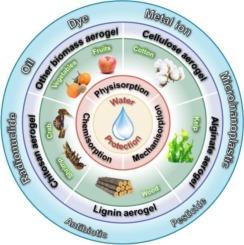
Water pollution has become one of the major environmental challenges due to the rapid development of industry and human activities. Heavy metals, oil, pesticides, antibiotics, and radionuclides have caused serious water pollution. Adsorption is a fast and simple method to remove these pollutants. Careful design and optimization of material properties is the key to improving adsorption efficiency. Biomass aerogels are manufactured from biomass materials, as a three-dimensional porous material, they exhibit high specific surface area, abundant active sites, low cost, and environmental friendliness. Therefore, it has attracted great attention in the field of water pollution treatment. Therefore, this paper summarizes the material types, preparation methods, adsorption properties, and adsorption mechanisms of biomass aerogels, highlights the modification methods of aerogels that adapt to the expected application of different pollutants, presents the recent progress of biomass aerogels in pollutant removal from different water bodies, and discusses the future potential of aerogels in water treatment applications.
期刊介绍:
The Chemical Engineering Journal is an international research journal that invites contributions of original and novel fundamental research. It aims to provide an international platform for presenting original fundamental research, interpretative reviews, and discussions on new developments in chemical engineering. The journal welcomes papers that describe novel theory and its practical application, as well as those that demonstrate the transfer of techniques from other disciplines. It also welcomes reports on carefully conducted experimental work that is soundly interpreted. The main focus of the journal is on original and rigorous research results that have broad significance. The Catalysis section within the Chemical Engineering Journal focuses specifically on Experimental and Theoretical studies in the fields of heterogeneous catalysis, molecular catalysis, and biocatalysis. These studies have industrial impact on various sectors such as chemicals, energy, materials, foods, healthcare, and environmental protection.




 京公网安备 11010802042870号
京ICP备2023020795号-1
京公网安备 11010802042870号
京ICP备2023020795号-1

 分享
分享
 求助内容:
求助内容: 应助结果提醒方式:
 扫码关注我们
