Yue Li, Kang Xu, Weijiang Hu, Ziling Huang, Qing Li, Liang Cao, Minjie Shi, Zhefei Wang, Huaixin Wei, Jun Yang
{"title":"In situ reconstructed dual-functional interfacial layer induced by spontaneous vanadium fluoride reaction for highly stable sodium metal batteries","authors":"Yue Li, Kang Xu, Weijiang Hu, Ziling Huang, Qing Li, Liang Cao, Minjie Shi, Zhefei Wang, Huaixin Wei, Jun Yang","doi":"10.1016/j.cej.2025.162786","DOIUrl":null,"url":null,"abstract":"To ensure even distribution of sodium ions in sodium-metal batteries, various components must be incorporated to strengthen the surface mechanically, suppress dendritic growth, and create an ideal solid electrolyte interphase (SEI) characterized by robust adhesion, superior electrical conductivity, and exceptional mechanical durability. A novel bifunctional artificial interfacial protective layer was first designed by in-situ deposition and reconfiguration of vanadium fluoride on the surface of sodium metal. This reaction produced two components, V and NaF, in a spontaneous manner. It has been demonstrated that NaF offers excellent ionic conductivity and electronic insulation, facilitating the rapid adsorption of Na<sup>+</sup> onto the electrode surface without reduction. In contrast, vanadium exhibits exceptional sodiophilicity, effectively regulating the uniform deposition of sodium ions to promote a stable deposition-stripping cycle. Additionally, the multiphase interfacial layer comprising NaF/V offers both chemical and electrochemical stability, along with a notably high Young’s modulus of 17.7 GPa, thus ensuring the long-term stability and safety of the device. Sodium metal anodes as inhibitors of dendrite growth, the VF<sub>x</sub>/Na demonstrates prolonged cycling stability of up to 1000 h at 0.5 mA cm<sup>−2</sup> and 1 mAh cm<sup>−2</sup> in symmetric cell. In the electrochemical test of a full battery with a Na<sub>3</sub>V<sub>2</sub>(PO<sub>4</sub>)<sub>3</sub> cathode, the VF<sub>x</sub>/Na electrode showed superior performance, maintaining a specific capacity of 76.3 mAh g<sup>−1</sup> at a current density of 5 A g<sup>−1</sup> for a stable cycle of 4000 turns.","PeriodicalId":270,"journal":{"name":"Chemical Engineering Journal","volume":"131 3 1","pages":""},"PeriodicalIF":12.5000,"publicationDate":"2025-04-22","publicationTypes":"Journal Article","fieldsOfStudy":null,"isOpenAccess":false,"openAccessPdf":"","citationCount":"0","resultStr":null,"platform":"Semanticscholar","paperid":null,"PeriodicalName":"Chemical Engineering Journal","FirstCategoryId":"5","ListUrlMain":"https://doi.org/10.1016/j.cej.2025.162786","RegionNum":1,"RegionCategory":"工程技术","ArticlePicture":[],"TitleCN":null,"AbstractTextCN":null,"PMCID":null,"EPubDate":"","PubModel":"","JCR":"Q1","JCRName":"ENGINEERING, CHEMICAL","Score":null,"Total":0}
引用次数: 0
Abstract
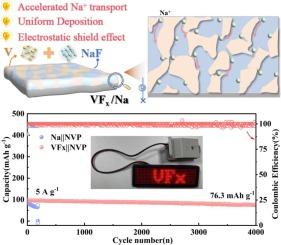
To ensure even distribution of sodium ions in sodium-metal batteries, various components must be incorporated to strengthen the surface mechanically, suppress dendritic growth, and create an ideal solid electrolyte interphase (SEI) characterized by robust adhesion, superior electrical conductivity, and exceptional mechanical durability. A novel bifunctional artificial interfacial protective layer was first designed by in-situ deposition and reconfiguration of vanadium fluoride on the surface of sodium metal. This reaction produced two components, V and NaF, in a spontaneous manner. It has been demonstrated that NaF offers excellent ionic conductivity and electronic insulation, facilitating the rapid adsorption of Na+ onto the electrode surface without reduction. In contrast, vanadium exhibits exceptional sodiophilicity, effectively regulating the uniform deposition of sodium ions to promote a stable deposition-stripping cycle. Additionally, the multiphase interfacial layer comprising NaF/V offers both chemical and electrochemical stability, along with a notably high Young’s modulus of 17.7 GPa, thus ensuring the long-term stability and safety of the device. Sodium metal anodes as inhibitors of dendrite growth, the VFx/Na demonstrates prolonged cycling stability of up to 1000 h at 0.5 mA cm−2 and 1 mAh cm−2 in symmetric cell. In the electrochemical test of a full battery with a Na3V2(PO4)3 cathode, the VFx/Na electrode showed superior performance, maintaining a specific capacity of 76.3 mAh g−1 at a current density of 5 A g−1 for a stable cycle of 4000 turns.
为了确保钠离子在钠金属电池中的均匀分布,必须加入各种成分来机械强化表面,抑制枝晶生长,并创造出理想的固体电解质界面(SEI),该界面具有强大的附着力,优越的导电性和卓越的机械耐久性。通过在金属钠表面原位沉积和重构氟化钒,首次设计了一种新型的双功能人工界面保护层。该反应自发产生V和NaF两种组分。研究表明,NaF具有优异的离子导电性和电子绝缘性,有利于Na+在电极表面的快速吸附而不还原。相反,钒表现出特殊的亲钠性,有效地调节钠离子的均匀沉积,促进稳定的沉积-剥离循环。此外,由NaF/V组成的多相界面层具有化学和电化学稳定性,杨氏模量高达17.7 GPa,从而确保了器件的长期稳定性和安全性。作为抑制枝晶生长的金属钠阳极,VFx/Na在对称电池中在0.5 mA cm - 2和1 mAh cm - 2下表现出高达1000 h的长周期稳定性。在以Na3V2(PO4)3为阴极的全电池电化学测试中,VFx/Na电极表现出优异的性能,在5 a g−1电流密度下保持76.3 mAh g−1的比容量,稳定循环4000匝。
期刊介绍:
The Chemical Engineering Journal is an international research journal that invites contributions of original and novel fundamental research. It aims to provide an international platform for presenting original fundamental research, interpretative reviews, and discussions on new developments in chemical engineering. The journal welcomes papers that describe novel theory and its practical application, as well as those that demonstrate the transfer of techniques from other disciplines. It also welcomes reports on carefully conducted experimental work that is soundly interpreted. The main focus of the journal is on original and rigorous research results that have broad significance. The Catalysis section within the Chemical Engineering Journal focuses specifically on Experimental and Theoretical studies in the fields of heterogeneous catalysis, molecular catalysis, and biocatalysis. These studies have industrial impact on various sectors such as chemicals, energy, materials, foods, healthcare, and environmental protection.




 京公网安备 11010802042870号
京ICP备2023020795号-1
京公网安备 11010802042870号
京ICP备2023020795号-1

 分享
分享
 求助内容:
求助内容: 应助结果提醒方式:
 扫码关注我们
