{"title":"Advancing gut microbiome insights: Graphene quantum dot nanobiosensors for microbial metabolite detection","authors":"Soheil Sadr , Shakiba Nazemian , Shiva Dianaty , Ashkan Hajjafari , Bita Fazel , Arezou Rezaei , Abbas Rahdar , Sonia Fathi-Karkan , Mansour Bayat , Sadanand Pandey , Octavio Luiz Franco , Luiz Fernando Romanholo Ferreira , Zelal Kharaba , Hassan Borji","doi":"10.1016/j.cej.2025.162954","DOIUrl":null,"url":null,"abstract":"<div><div>Graphene-based nanomaterials (GBNMs), which are tiny carbon-based materials with exceptional electrical and mechanical properties, have a wide range of applications in biological research due to their unique characteristics, including their elevated conductivity, substantial surface area, and adjustable fluorescence. However, the understanding of how GI microbiota affects such basic processes in GBNMs is far from complete. Hence, the current review is expected to highlight the revolutionary potential that graphene quantum dots (GQDs) and other GBNMs have in surging microbiome research; this includes their role in addressing critical challenges concerning precision medicine and applications in identifying microbial metabolites. GBNMs facilitate the accurate identification of essential metabolites in the gastrointestinal (GI) microbiome, including short-chain fatty acids (SCFAs) and indoles, offering insights into the intricate relationships between microbiome composition and GI disorders such as inflammatory bowel disease (IBD) and irritable bowel syndrome (IBS). Additionally, GBNMs play a crucial role in understanding antibiotic resistance by enabling the development of advanced biosensors that can rapidly detect bacterial pathogens, track resistance mechanisms, and monitor the effectiveness of antibiotics, thus providing valuable insights into the dynamics of resistance and aiding in the development of targeted therapeutic strategies. Moreover, GBNMs’ sensitivity and specificity are essential in creating tailored diagnostic platforms, enhancing precision medicine applications. This review highlights current accomplishments and outlines future research paths, emphasizing the revolutionary impact of GBNMs in microbiome research and personalized healthcare.</div></div>","PeriodicalId":270,"journal":{"name":"Chemical Engineering Journal","volume":"513 ","pages":"Article 162954"},"PeriodicalIF":13.2000,"publicationDate":"2025-06-01","publicationTypes":"Journal Article","fieldsOfStudy":null,"isOpenAccess":false,"openAccessPdf":"","citationCount":"0","resultStr":null,"platform":"Semanticscholar","paperid":null,"PeriodicalName":"Chemical Engineering Journal","FirstCategoryId":"5","ListUrlMain":"https://www.sciencedirect.com/science/article/pii/S138589472503788X","RegionNum":1,"RegionCategory":"工程技术","ArticlePicture":[],"TitleCN":null,"AbstractTextCN":null,"PMCID":null,"EPubDate":"2025/4/22 0:00:00","PubModel":"Epub","JCR":"Q1","JCRName":"ENGINEERING, CHEMICAL","Score":null,"Total":0}
引用次数: 0
Abstract
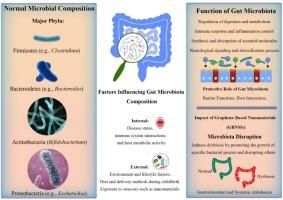
Graphene-based nanomaterials (GBNMs), which are tiny carbon-based materials with exceptional electrical and mechanical properties, have a wide range of applications in biological research due to their unique characteristics, including their elevated conductivity, substantial surface area, and adjustable fluorescence. However, the understanding of how GI microbiota affects such basic processes in GBNMs is far from complete. Hence, the current review is expected to highlight the revolutionary potential that graphene quantum dots (GQDs) and other GBNMs have in surging microbiome research; this includes their role in addressing critical challenges concerning precision medicine and applications in identifying microbial metabolites. GBNMs facilitate the accurate identification of essential metabolites in the gastrointestinal (GI) microbiome, including short-chain fatty acids (SCFAs) and indoles, offering insights into the intricate relationships between microbiome composition and GI disorders such as inflammatory bowel disease (IBD) and irritable bowel syndrome (IBS). Additionally, GBNMs play a crucial role in understanding antibiotic resistance by enabling the development of advanced biosensors that can rapidly detect bacterial pathogens, track resistance mechanisms, and monitor the effectiveness of antibiotics, thus providing valuable insights into the dynamics of resistance and aiding in the development of targeted therapeutic strategies. Moreover, GBNMs’ sensitivity and specificity are essential in creating tailored diagnostic platforms, enhancing precision medicine applications. This review highlights current accomplishments and outlines future research paths, emphasizing the revolutionary impact of GBNMs in microbiome research and personalized healthcare.
期刊介绍:
The Chemical Engineering Journal is an international research journal that invites contributions of original and novel fundamental research. It aims to provide an international platform for presenting original fundamental research, interpretative reviews, and discussions on new developments in chemical engineering. The journal welcomes papers that describe novel theory and its practical application, as well as those that demonstrate the transfer of techniques from other disciplines. It also welcomes reports on carefully conducted experimental work that is soundly interpreted. The main focus of the journal is on original and rigorous research results that have broad significance. The Catalysis section within the Chemical Engineering Journal focuses specifically on Experimental and Theoretical studies in the fields of heterogeneous catalysis, molecular catalysis, and biocatalysis. These studies have industrial impact on various sectors such as chemicals, energy, materials, foods, healthcare, and environmental protection.




 京公网安备 11010802042870号
京ICP备2023020795号-1
京公网安备 11010802042870号
京ICP备2023020795号-1

 分享
分享
 求助内容:
求助内容: 应助结果提醒方式:
 扫码关注我们
