Denny Gunawan, Tahlia Stern, Jiajun Zhang, Jodie A. Yuwono, Jian Pan, Qiyuan Li, Haolin Yu, Michael Gunawan, Rosalie K. Hocking, Cui Ying Toe, Jason Scott, Rose Amal
{"title":"Scalable solar-driven reforming of alcohol feedstock to H2 using Ni/Zn3In2S6 photocatalyst","authors":"Denny Gunawan, Tahlia Stern, Jiajun Zhang, Jodie A. Yuwono, Jian Pan, Qiyuan Li, Haolin Yu, Michael Gunawan, Rosalie K. Hocking, Cui Ying Toe, Jason Scott, Rose Amal","doi":"10.1016/j.cej.2025.162965","DOIUrl":null,"url":null,"abstract":"Organic photoreforming represents a promising pathway for solar H<sub>2</sub> generation with the coproduction of valuable byproducts. However, its development has been limited by separate studies on photocatalysts or photoreactors, with little focus on cost and scalability. Here we integrate photocatalyst design, upscaled photoreactor engineering, and cost analysis for the solar-driven reforming of alcohol feedstock to H<sub>2</sub>. The process was optimized by examining various alcohol compounds and Ni cocatalyst impact on Zn<sub>3</sub>In<sub>2</sub>S<sub>6</sub> photocatalytic activity. Strong interactions between Zn<sub>3</sub>In<sub>2</sub>S<sub>6</sub> and both aromatic benzyl alcohol substrate and Ni intensified H<sub>2</sub> evolution and benzaldehyde formation, achieving an apparent quantum yield of 63.8 % at 420 nm and an areal H<sub>2</sub> evolution activity of 278 mmol h<sup>−1</sup> m<sup>−2</sup> under simulated sunlight. Using the optimum conditions established in a laboratory environment, an upscaled slurry photoreactor prototype was designed and operated under natural sunlight with a 0.5 m<sup>2</sup> light receiving area. The upscaled solar-driven reforming of benzyl alcohol over Ni/Zn<sub>3</sub>In<sub>2</sub>S<sub>6</sub> delivered a H<sub>2</sub> production rate of 1.67 normal L h<sup>−1</sup>, corresponding to an areal H<sub>2</sub> evolution activity of 139 mmol h<sup>−1</sup> m<sup>−2</sup>, with benzaldehyde as the major organic byproduct. A pathway for commercially viable large-scale solar-driven organic reforming was defined through techno-economic assessment. The findings are a crucial advancement in scaling photoreforming towards commercialization.","PeriodicalId":270,"journal":{"name":"Chemical Engineering Journal","volume":"40 1","pages":""},"PeriodicalIF":13.2000,"publicationDate":"2025-04-22","publicationTypes":"Journal Article","fieldsOfStudy":null,"isOpenAccess":false,"openAccessPdf":"","citationCount":"0","resultStr":null,"platform":"Semanticscholar","paperid":null,"PeriodicalName":"Chemical Engineering Journal","FirstCategoryId":"5","ListUrlMain":"https://doi.org/10.1016/j.cej.2025.162965","RegionNum":1,"RegionCategory":"工程技术","ArticlePicture":[],"TitleCN":null,"AbstractTextCN":null,"PMCID":null,"EPubDate":"","PubModel":"","JCR":"Q1","JCRName":"ENGINEERING, CHEMICAL","Score":null,"Total":0}
引用次数: 0
Abstract
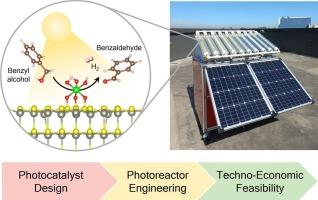
Organic photoreforming represents a promising pathway for solar H2 generation with the coproduction of valuable byproducts. However, its development has been limited by separate studies on photocatalysts or photoreactors, with little focus on cost and scalability. Here we integrate photocatalyst design, upscaled photoreactor engineering, and cost analysis for the solar-driven reforming of alcohol feedstock to H2. The process was optimized by examining various alcohol compounds and Ni cocatalyst impact on Zn3In2S6 photocatalytic activity. Strong interactions between Zn3In2S6 and both aromatic benzyl alcohol substrate and Ni intensified H2 evolution and benzaldehyde formation, achieving an apparent quantum yield of 63.8 % at 420 nm and an areal H2 evolution activity of 278 mmol h−1 m−2 under simulated sunlight. Using the optimum conditions established in a laboratory environment, an upscaled slurry photoreactor prototype was designed and operated under natural sunlight with a 0.5 m2 light receiving area. The upscaled solar-driven reforming of benzyl alcohol over Ni/Zn3In2S6 delivered a H2 production rate of 1.67 normal L h−1, corresponding to an areal H2 evolution activity of 139 mmol h−1 m−2, with benzaldehyde as the major organic byproduct. A pathway for commercially viable large-scale solar-driven organic reforming was defined through techno-economic assessment. The findings are a crucial advancement in scaling photoreforming towards commercialization.
期刊介绍:
The Chemical Engineering Journal is an international research journal that invites contributions of original and novel fundamental research. It aims to provide an international platform for presenting original fundamental research, interpretative reviews, and discussions on new developments in chemical engineering. The journal welcomes papers that describe novel theory and its practical application, as well as those that demonstrate the transfer of techniques from other disciplines. It also welcomes reports on carefully conducted experimental work that is soundly interpreted. The main focus of the journal is on original and rigorous research results that have broad significance. The Catalysis section within the Chemical Engineering Journal focuses specifically on Experimental and Theoretical studies in the fields of heterogeneous catalysis, molecular catalysis, and biocatalysis. These studies have industrial impact on various sectors such as chemicals, energy, materials, foods, healthcare, and environmental protection.




 京公网安备 11010802042870号
京ICP备2023020795号-1
京公网安备 11010802042870号
京ICP备2023020795号-1

 分享
分享
 求助内容:
求助内容: 应助结果提醒方式:
 扫码关注我们
