Emre Turan, Robert Dieckmann, Michael Geske, Raoul Naumann d’Alnoncourt, Michael Bender, Johannes Bode, Benjamin Frank, Dina Zakgeym, Grigorios Kolios, Frank Rosowski
{"title":"Direct resistive heating of a catalytic fixed-bed reactor for ethanol dehydration","authors":"Emre Turan, Robert Dieckmann, Michael Geske, Raoul Naumann d’Alnoncourt, Michael Bender, Johannes Bode, Benjamin Frank, Dina Zakgeym, Grigorios Kolios, Frank Rosowski","doi":"10.1016/j.cej.2025.162963","DOIUrl":null,"url":null,"abstract":"Direct resistive heating is an effective and sustainable method for supplying heat to endothermic reactions. Ethanol dehydration, a sustainable route for producing ethylene, was chosen as the test reaction. A physical mixture of graphitic carbon particles serving as conductors and γ-Al<sub>2</sub>O<sub>3</sub> as catalyst particles was prepared to create an electrically conductive fixed bed. A minimum of 33.4 vol% of conductive material ensured sufficient bed resistivity. Successful direct resistive heating was demonstrated, with near complete ethanol-to-ethylene conversion achieved at a bed temperature of 325 °C and a WHSV<sub>EtOH</sub> of 3.2 h<sup>−1</sup>. In contrast to the industrial process, which requires superheating to 470 °C with steam as the heat carrier gas, direct resistive heating operated at a lower temperature with 10 times higher productivity, without the need for a heat carrier gas. Upscaling in a 500 ml ceramic tubular reactor confirmed scalability, showcasing a sustainable method for ethylene production using green energy and renewable bio-ethanol.","PeriodicalId":270,"journal":{"name":"Chemical Engineering Journal","volume":"17 1","pages":""},"PeriodicalIF":13.2000,"publicationDate":"2025-04-22","publicationTypes":"Journal Article","fieldsOfStudy":null,"isOpenAccess":false,"openAccessPdf":"","citationCount":"0","resultStr":null,"platform":"Semanticscholar","paperid":null,"PeriodicalName":"Chemical Engineering Journal","FirstCategoryId":"5","ListUrlMain":"https://doi.org/10.1016/j.cej.2025.162963","RegionNum":1,"RegionCategory":"工程技术","ArticlePicture":[],"TitleCN":null,"AbstractTextCN":null,"PMCID":null,"EPubDate":"","PubModel":"","JCR":"Q1","JCRName":"ENGINEERING, CHEMICAL","Score":null,"Total":0}
引用次数: 0
Abstract
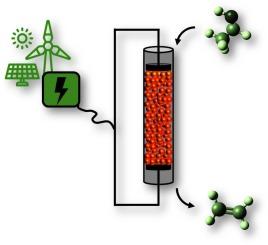
Direct resistive heating is an effective and sustainable method for supplying heat to endothermic reactions. Ethanol dehydration, a sustainable route for producing ethylene, was chosen as the test reaction. A physical mixture of graphitic carbon particles serving as conductors and γ-Al2O3 as catalyst particles was prepared to create an electrically conductive fixed bed. A minimum of 33.4 vol% of conductive material ensured sufficient bed resistivity. Successful direct resistive heating was demonstrated, with near complete ethanol-to-ethylene conversion achieved at a bed temperature of 325 °C and a WHSVEtOH of 3.2 h−1. In contrast to the industrial process, which requires superheating to 470 °C with steam as the heat carrier gas, direct resistive heating operated at a lower temperature with 10 times higher productivity, without the need for a heat carrier gas. Upscaling in a 500 ml ceramic tubular reactor confirmed scalability, showcasing a sustainable method for ethylene production using green energy and renewable bio-ethanol.
期刊介绍:
The Chemical Engineering Journal is an international research journal that invites contributions of original and novel fundamental research. It aims to provide an international platform for presenting original fundamental research, interpretative reviews, and discussions on new developments in chemical engineering. The journal welcomes papers that describe novel theory and its practical application, as well as those that demonstrate the transfer of techniques from other disciplines. It also welcomes reports on carefully conducted experimental work that is soundly interpreted. The main focus of the journal is on original and rigorous research results that have broad significance. The Catalysis section within the Chemical Engineering Journal focuses specifically on Experimental and Theoretical studies in the fields of heterogeneous catalysis, molecular catalysis, and biocatalysis. These studies have industrial impact on various sectors such as chemicals, energy, materials, foods, healthcare, and environmental protection.



 京公网安备 11010802042870号
京ICP备2023020795号-1
京公网安备 11010802042870号
京ICP备2023020795号-1

 分享
分享
 求助内容:
求助内容: 应助结果提醒方式:
 扫码关注我们
