Luca Regni , Paolo Sdringola , Biancamaria Torquati , Nicola Evangelisti , Massimo Chiorri , Livia Arcioni , Primo Proietti
{"title":"A multidimensional approach to the decarbonization of the olive oil sector: methodology proposal and case study","authors":"Luca Regni , Paolo Sdringola , Biancamaria Torquati , Nicola Evangelisti , Massimo Chiorri , Livia Arcioni , Primo Proietti","doi":"10.1016/j.scitotenv.2025.179460","DOIUrl":null,"url":null,"abstract":"<div><div>The productive sectors related to agriculture have the potential to contribute significantly to the energy transition. The paper describes an in-depth investigation on the extra virgin olive oil production towards the decarbonization of the sector. A multidimensional approach is applied, integrating surveys on environmental impacts through Life Cycle Assessment and Carbon Footprint, carbon sequestration, carbon balance associated to emissions and removals, and socio-economic impacts via Life Cycle Costing and consumer surveys. The assessment was performed in the different Mediterranean regions, and the paper includes the results from a representative case study in Italy. Focusing on the production of 1 l of olive oil as functional unit, the most impacting technical processes were identified, and cleaner alternatives proposed and implemented. The amount of CO<sub>2</sub> sequestered annually by olive trees was found 1.59 kg/l<sub>oil</sub>, comparable to the CO<sub>2eq</sub> emitted for oil production – i.e., 1.58 kg/l<sub>oil</sub> for a 0.75 l glass bottle, and 1.16 kg/l<sub>oil</sub> for a 5 l tin can – and then resulting in a neutral/negative carbon footprint product in the sustainable management scenario. In economic terms the introduction of the low-impact technical process allows to reduce production costs of 270 euros/ha; while the willingness to pay a premium price for the olive oil with Carbon Footprint certification is estimated around 3 € for a 0.75 l glass bottle. The proposed methodology could be extended to other agronomic sectors to reduce carbon emissions, enhance traditional techniques and promote sustainable practices, while also seeking to engage the consumer through transparent certification and communication.</div></div>","PeriodicalId":422,"journal":{"name":"Science of the Total Environment","volume":"979 ","pages":"Article 179460"},"PeriodicalIF":8.0000,"publicationDate":"2025-06-01","publicationTypes":"Journal Article","fieldsOfStudy":null,"isOpenAccess":false,"openAccessPdf":"","citationCount":"0","resultStr":null,"platform":"Semanticscholar","paperid":null,"PeriodicalName":"Science of the Total Environment","FirstCategoryId":"93","ListUrlMain":"https://www.sciencedirect.com/science/article/pii/S0048969725010976","RegionNum":1,"RegionCategory":"环境科学与生态学","ArticlePicture":[],"TitleCN":null,"AbstractTextCN":null,"PMCID":null,"EPubDate":"2025/4/24 0:00:00","PubModel":"Epub","JCR":"Q1","JCRName":"ENVIRONMENTAL SCIENCES","Score":null,"Total":0}
引用次数: 0
Abstract
The productive sectors related to agriculture have the potential to contribute significantly to the energy transition. The paper describes an in-depth investigation on the extra virgin olive oil production towards the decarbonization of the sector. A multidimensional approach is applied, integrating surveys on environmental impacts through Life Cycle Assessment and Carbon Footprint, carbon sequestration, carbon balance associated to emissions and removals, and socio-economic impacts via Life Cycle Costing and consumer surveys. The assessment was performed in the different Mediterranean regions, and the paper includes the results from a representative case study in Italy. Focusing on the production of 1 l of olive oil as functional unit, the most impacting technical processes were identified, and cleaner alternatives proposed and implemented. The amount of CO2 sequestered annually by olive trees was found 1.59 kg/loil, comparable to the CO2eq emitted for oil production – i.e., 1.58 kg/loil for a 0.75 l glass bottle, and 1.16 kg/loil for a 5 l tin can – and then resulting in a neutral/negative carbon footprint product in the sustainable management scenario. In economic terms the introduction of the low-impact technical process allows to reduce production costs of 270 euros/ha; while the willingness to pay a premium price for the olive oil with Carbon Footprint certification is estimated around 3 € for a 0.75 l glass bottle. The proposed methodology could be extended to other agronomic sectors to reduce carbon emissions, enhance traditional techniques and promote sustainable practices, while also seeking to engage the consumer through transparent certification and communication.
期刊介绍:
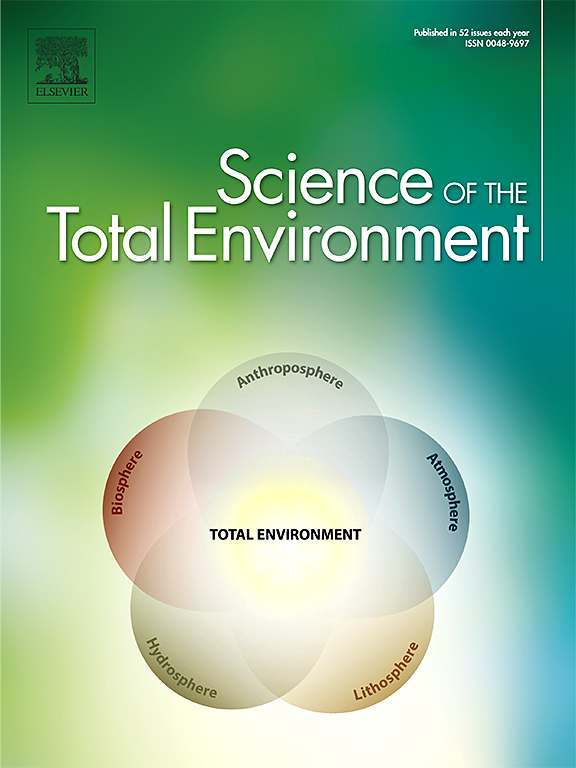
The Science of the Total Environment is an international journal dedicated to scientific research on the environment and its interaction with humanity. It covers a wide range of disciplines and seeks to publish innovative, hypothesis-driven, and impactful research that explores the entire environment, including the atmosphere, lithosphere, hydrosphere, biosphere, and anthroposphere.
The journal's updated Aims & Scope emphasizes the importance of interdisciplinary environmental research with broad impact. Priority is given to studies that advance fundamental understanding and explore the interconnectedness of multiple environmental spheres. Field studies are preferred, while laboratory experiments must demonstrate significant methodological advancements or mechanistic insights with direct relevance to the environment.




 京公网安备 11010802042870号
京ICP备2023020795号-1
京公网安备 11010802042870号
京ICP备2023020795号-1

 分享
分享
 求助内容:
求助内容: 应助结果提醒方式:
 扫码关注我们
