Thiago Soares Silva, Murielly Fernanda Ribeiro Bihain, Anna Karla dos Santos Pereira, Douglas Henrique Pereira
{"title":"Computational study of bisphenol A adsorption on reduced graphene oxide: interactions, energies, pH effects, and adsorption mechanisms","authors":"Thiago Soares Silva, Murielly Fernanda Ribeiro Bihain, Anna Karla dos Santos Pereira, Douglas Henrique Pereira","doi":"10.1007/s11051-025-06318-x","DOIUrl":null,"url":null,"abstract":"<div><p>Nanomaterials have numerous applications. One material that deserves to be highlighted is reduced graphite oxide (rGO) due to its excellent adsorption capacity. Among the emerging contaminants, bisphenol A (BPA) generates numerous problems for human health, such as hormonal changes, immune dysfunction, and type 2 diabetes mellitus. In this context, the adsorption of BPA and its form with an anionic oxygen and a protonated oxygen were studied to simulate the effect of pH on the adsorption process, elucidated through computational simulations using density functional theory. The binding energies (Δ<i>E</i><sub>Bind</sub>) and enthalpy variation (Δ<i>H</i>) for all complexes were less than zero, Δ<i>E</i><sub>Bind</sub> and Δ<i>H</i> < 0.00 kcal mol<sup>−1</sup>, showing that interactions can occur and that they are exothermic. The Gibbs energy values showed that only the interactions of anionic and protonated oxygen with the matrix were spontaneous. The structural parameters were identified, and the protonation or deprotonation of the BPA hydroxyl forms stronger bonds/interactions with the rGO matrix, showing a positive effect of pH on adsorption. From the analysis of the topological parameters of the quantum theory of atoms in molecules and the non-covalent interaction, it was possible to demonstrate that the interactions are electrostatic, with the exception of those that occur between the protonation or deprotonation of the BPA hydroxyl with the matrix that forms bonds. Finally, based on the theoretical results, it can be concluded that the rGO matrix can interact with BPA and that the effect of pH improves the adsorption process. Therefore, this study could support new experimental tests for removing this emerging contaminant from effluents.</p></div>","PeriodicalId":653,"journal":{"name":"Journal of Nanoparticle Research","volume":"27 5","pages":""},"PeriodicalIF":2.6000,"publicationDate":"2025-04-23","publicationTypes":"Journal Article","fieldsOfStudy":null,"isOpenAccess":false,"openAccessPdf":"","citationCount":"0","resultStr":null,"platform":"Semanticscholar","paperid":null,"PeriodicalName":"Journal of Nanoparticle Research","FirstCategoryId":"88","ListUrlMain":"https://link.springer.com/article/10.1007/s11051-025-06318-x","RegionNum":4,"RegionCategory":"材料科学","ArticlePicture":[],"TitleCN":null,"AbstractTextCN":null,"PMCID":null,"EPubDate":"","PubModel":"","JCR":"Q3","JCRName":"CHEMISTRY, MULTIDISCIPLINARY","Score":null,"Total":0}
引用次数: 0
Abstract
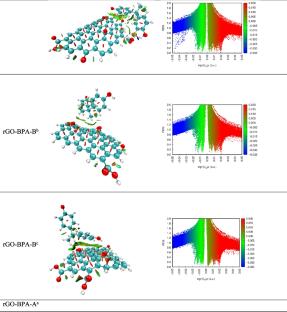
Nanomaterials have numerous applications. One material that deserves to be highlighted is reduced graphite oxide (rGO) due to its excellent adsorption capacity. Among the emerging contaminants, bisphenol A (BPA) generates numerous problems for human health, such as hormonal changes, immune dysfunction, and type 2 diabetes mellitus. In this context, the adsorption of BPA and its form with an anionic oxygen and a protonated oxygen were studied to simulate the effect of pH on the adsorption process, elucidated through computational simulations using density functional theory. The binding energies (ΔEBind) and enthalpy variation (ΔH) for all complexes were less than zero, ΔEBind and ΔH < 0.00 kcal mol−1, showing that interactions can occur and that they are exothermic. The Gibbs energy values showed that only the interactions of anionic and protonated oxygen with the matrix were spontaneous. The structural parameters were identified, and the protonation or deprotonation of the BPA hydroxyl forms stronger bonds/interactions with the rGO matrix, showing a positive effect of pH on adsorption. From the analysis of the topological parameters of the quantum theory of atoms in molecules and the non-covalent interaction, it was possible to demonstrate that the interactions are electrostatic, with the exception of those that occur between the protonation or deprotonation of the BPA hydroxyl with the matrix that forms bonds. Finally, based on the theoretical results, it can be concluded that the rGO matrix can interact with BPA and that the effect of pH improves the adsorption process. Therefore, this study could support new experimental tests for removing this emerging contaminant from effluents.
期刊介绍:
The objective of the Journal of Nanoparticle Research is to disseminate knowledge of the physical, chemical and biological phenomena and processes in structures that have at least one lengthscale ranging from molecular to approximately 100 nm (or submicron in some situations), and exhibit improved and novel properties that are a direct result of their small size.
Nanoparticle research is a key component of nanoscience, nanoengineering and nanotechnology.
The focus of the Journal is on the specific concepts, properties, phenomena, and processes related to particles, tubes, layers, macromolecules, clusters and other finite structures of the nanoscale size range. Synthesis, assembly, transport, reactivity, and stability of such structures are considered. Development of in-situ and ex-situ instrumentation for characterization of nanoparticles and their interfaces should be based on new principles for probing properties and phenomena not well understood at the nanometer scale. Modeling and simulation may include atom-based quantum mechanics; molecular dynamics; single-particle, multi-body and continuum based models; fractals; other methods suitable for modeling particle synthesis, assembling and interaction processes. Realization and application of systems, structures and devices with novel functions obtained via precursor nanoparticles is emphasized. Approaches may include gas-, liquid-, solid-, and vacuum-based processes, size reduction, chemical- and bio-self assembly. Contributions include utilization of nanoparticle systems for enhancing a phenomenon or process and particle assembling into hierarchical structures, as well as formulation and the administration of drugs. Synergistic approaches originating from different disciplines and technologies, and interaction between the research providers and users in this field, are encouraged.




 京公网安备 11010802042870号
京ICP备2023020795号-1
京公网安备 11010802042870号
京ICP备2023020795号-1

 分享
分享
 求助内容:
求助内容: 应助结果提醒方式:
 扫码关注我们
