Nadhem Missaoui, Abeer. M Beagan, Jassem Wannassi, Hamza Kahri, Houcine Barhoumi, Mohsen Ahmadipour
{"title":"Eco-Friendly Synthesis of ZnO Nanoparticles Using Zeolitic Imidazolate Framework-7 for Methylene Blue Removal: Experimental and Theoretical Analysis","authors":"Nadhem Missaoui, Abeer. M Beagan, Jassem Wannassi, Hamza Kahri, Houcine Barhoumi, Mohsen Ahmadipour","doi":"10.1002/slct.202500040","DOIUrl":null,"url":null,"abstract":"<p>Industrial dye contamination in water sources presents serious threats to both human health and the environment. Adsorption technology has gained popularity for wastewater treatment due to its simplicity, cost-effectiveness, and use of environmentally friendly materials. This study investigates the desorption of methylene blue (MB) dye using zinc oxide nanoparticles (ZnO-NPs) synthesized from ZIF-7 (Zn(BIM)₂; BIM = Benzimidazole) with a sodalite zeolitic topology. The green synthesis of ZnO-NPs was characterized using X-ray powder diffraction with Rietveld refinement (space group = P63/mmc, a = b = 3.252 (2) Å; c = 5.207 (4) Å, α = β = 90°, and γ = 120°), Fourier transform infrared spectroscopy (FTIR), X-ray diffraction (XRD), transmission electron microscopy (TEM), energy dispersive X-ray spectroscopy (EDS), thermogravimetric analysis (TGA), and Brunauer–Emmett–Teller (BET) techniques, revealing a surface area of (29.93 g/m<sup>2</sup>), nanoscale size (3 nm), and surface hydroxyls. Under optimal conditions (pH 7, 10 mg/L dye concentration, 0.02 g adsorbent dose), ZnO-NPs achieved an adsorption efficiency of 94.7% for MB. Adsorption capacity increased from 62.7 mg/g at 298 K to 85.16 mg/g at 328 K, with isotherm analysis showing physical adsorption as the primary mechanism (adsorption energies <40 kJ/mol). Modeling revealed MB molecules adsorbed nonparallel to the ZnO-NP surface.</p>","PeriodicalId":146,"journal":{"name":"ChemistrySelect","volume":"10 16","pages":""},"PeriodicalIF":2.0000,"publicationDate":"2025-04-24","publicationTypes":"Journal Article","fieldsOfStudy":null,"isOpenAccess":false,"openAccessPdf":"","citationCount":"0","resultStr":null,"platform":"Semanticscholar","paperid":null,"PeriodicalName":"ChemistrySelect","FirstCategoryId":"92","ListUrlMain":"https://chemistry-europe.onlinelibrary.wiley.com/doi/10.1002/slct.202500040","RegionNum":4,"RegionCategory":"化学","ArticlePicture":[],"TitleCN":null,"AbstractTextCN":null,"PMCID":null,"EPubDate":"","PubModel":"","JCR":"Q3","JCRName":"CHEMISTRY, MULTIDISCIPLINARY","Score":null,"Total":0}
引用次数: 0
Abstract
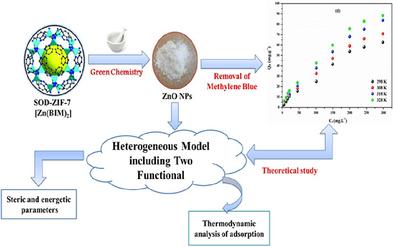
Industrial dye contamination in water sources presents serious threats to both human health and the environment. Adsorption technology has gained popularity for wastewater treatment due to its simplicity, cost-effectiveness, and use of environmentally friendly materials. This study investigates the desorption of methylene blue (MB) dye using zinc oxide nanoparticles (ZnO-NPs) synthesized from ZIF-7 (Zn(BIM)₂; BIM = Benzimidazole) with a sodalite zeolitic topology. The green synthesis of ZnO-NPs was characterized using X-ray powder diffraction with Rietveld refinement (space group = P63/mmc, a = b = 3.252 (2) Å; c = 5.207 (4) Å, α = β = 90°, and γ = 120°), Fourier transform infrared spectroscopy (FTIR), X-ray diffraction (XRD), transmission electron microscopy (TEM), energy dispersive X-ray spectroscopy (EDS), thermogravimetric analysis (TGA), and Brunauer–Emmett–Teller (BET) techniques, revealing a surface area of (29.93 g/m2), nanoscale size (3 nm), and surface hydroxyls. Under optimal conditions (pH 7, 10 mg/L dye concentration, 0.02 g adsorbent dose), ZnO-NPs achieved an adsorption efficiency of 94.7% for MB. Adsorption capacity increased from 62.7 mg/g at 298 K to 85.16 mg/g at 328 K, with isotherm analysis showing physical adsorption as the primary mechanism (adsorption energies <40 kJ/mol). Modeling revealed MB molecules adsorbed nonparallel to the ZnO-NP surface.
期刊介绍:
ChemistrySelect is the latest journal from ChemPubSoc Europe and Wiley-VCH. It offers researchers a quality society-owned journal in which to publish their work in all areas of chemistry. Manuscripts are evaluated by active researchers to ensure they add meaningfully to the scientific literature, and those accepted are processed quickly to ensure rapid online publication.






 京公网安备 11010802042870号
京ICP备2023020795号-1
京公网安备 11010802042870号
京ICP备2023020795号-1

 分享
分享
 求助内容:
求助内容: 应助结果提醒方式:
 扫码关注我们
