Tlou N. Moja, Zebron Phiri, Jemal F. Nure, Thabo T.I. Nkambule, Lueta-Ann de Kock
{"title":"Insights into Preparation of Polycaprolactone–Chitosan–Montmorillonite Composite for Pb(II) and Cd(II) Removal","authors":"Tlou N. Moja, Zebron Phiri, Jemal F. Nure, Thabo T.I. Nkambule, Lueta-Ann de Kock","doi":"10.1002/slct.202500798","DOIUrl":null,"url":null,"abstract":"<p>Industries frequently discharge elevated levels of lead and cadmium into the environment, posing significant threats to ecological balance and public health. This study developed a novel polycaprolactone–chitosan–montmorillonite (PCL/CS/MMT) composite to adsorb Pb(II) and Cd(II) from aqueous solutions. The composite was synthesized via twin-screw melt extrusion and subsequently characterized using X-ray diffraction (XRD), scanning electron microscopy (SEM), energy-dispersive X-ray spectroscopy (EDS), Fourier transform infrared spectroscopy (FTIR), and thermogravimetric analysis (TGA), revealing a crystalline structure, cracked surface morphology, functionalized surface groups, and thermal stability. Under optimal batch conditions, the adsorbent achieved maximum adsorption capacities of 12.35 mg/g for Pb(II) and 16.92 mg/g for Cd(II). Adsorption behavior followed the Langmuir isotherm model, and kinetic data aligned with the pseudo second-order model, indicating a chemisorption-driven mechanism. The composite demonstrated effective regeneration, retaining over 55% adsorption efficiency after seven desorption cycles with 0.1 M <span></span><math></math> (pH 8). These findings position the PCL/CS/MMT composite as a promising, sustainable adsorbent for wastewater treatment, offering a viable solution to heavy metal pollution and advancing the development of eco-friendly materials for environmental remediation.</p>","PeriodicalId":146,"journal":{"name":"ChemistrySelect","volume":"10 16","pages":""},"PeriodicalIF":2.0000,"publicationDate":"2025-04-24","publicationTypes":"Journal Article","fieldsOfStudy":null,"isOpenAccess":false,"openAccessPdf":"https://onlinelibrary.wiley.com/doi/epdf/10.1002/slct.202500798","citationCount":"0","resultStr":null,"platform":"Semanticscholar","paperid":null,"PeriodicalName":"ChemistrySelect","FirstCategoryId":"92","ListUrlMain":"https://chemistry-europe.onlinelibrary.wiley.com/doi/10.1002/slct.202500798","RegionNum":4,"RegionCategory":"化学","ArticlePicture":[],"TitleCN":null,"AbstractTextCN":null,"PMCID":null,"EPubDate":"","PubModel":"","JCR":"Q3","JCRName":"CHEMISTRY, MULTIDISCIPLINARY","Score":null,"Total":0}
引用次数: 0
Abstract
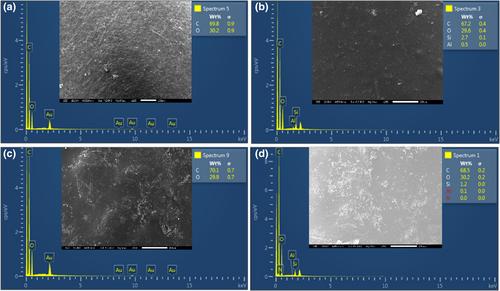
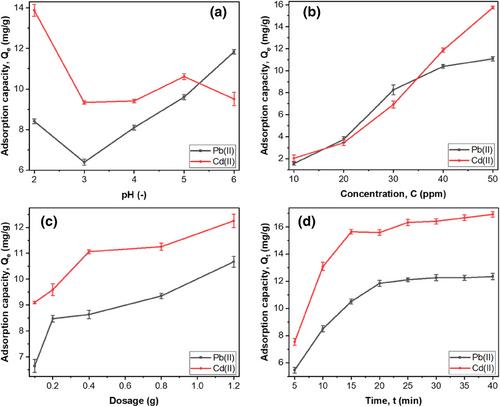
Industries frequently discharge elevated levels of lead and cadmium into the environment, posing significant threats to ecological balance and public health. This study developed a novel polycaprolactone–chitosan–montmorillonite (PCL/CS/MMT) composite to adsorb Pb(II) and Cd(II) from aqueous solutions. The composite was synthesized via twin-screw melt extrusion and subsequently characterized using X-ray diffraction (XRD), scanning electron microscopy (SEM), energy-dispersive X-ray spectroscopy (EDS), Fourier transform infrared spectroscopy (FTIR), and thermogravimetric analysis (TGA), revealing a crystalline structure, cracked surface morphology, functionalized surface groups, and thermal stability. Under optimal batch conditions, the adsorbent achieved maximum adsorption capacities of 12.35 mg/g for Pb(II) and 16.92 mg/g for Cd(II). Adsorption behavior followed the Langmuir isotherm model, and kinetic data aligned with the pseudo second-order model, indicating a chemisorption-driven mechanism. The composite demonstrated effective regeneration, retaining over 55% adsorption efficiency after seven desorption cycles with 0.1 M (pH 8). These findings position the PCL/CS/MMT composite as a promising, sustainable adsorbent for wastewater treatment, offering a viable solution to heavy metal pollution and advancing the development of eco-friendly materials for environmental remediation.
期刊介绍:
ChemistrySelect is the latest journal from ChemPubSoc Europe and Wiley-VCH. It offers researchers a quality society-owned journal in which to publish their work in all areas of chemistry. Manuscripts are evaluated by active researchers to ensure they add meaningfully to the scientific literature, and those accepted are processed quickly to ensure rapid online publication.





 京公网安备 11010802042870号
京ICP备2023020795号-1
京公网安备 11010802042870号
京ICP备2023020795号-1

 分享
分享
 求助内容:
求助内容: 应助结果提醒方式:
 扫码关注我们
