Paulina Alulema-Pullupaxi, Yi Zhang, Navid B. Saleh, Arjun Venkatesan, Onur G. Apul
{"title":"Analyzing the Release of Per- and Polyfluoroalkyl Substances from Spent Granular Activated Carbons by Standard Leaching Procedures","authors":"Paulina Alulema-Pullupaxi, Yi Zhang, Navid B. Saleh, Arjun Venkatesan, Onur G. Apul","doi":"10.1021/acs.est.4c12093","DOIUrl":null,"url":null,"abstract":"The recent national primary drinking water regulation for per- and polyfluoroalkyl substances (PFAS) is expected to drive a nationwide increase in granular activated carbon (GAC) usage in water treatment facilities across the United States. Proper management of PFAS-laden GAC waste streams is essential to prevent potential recontamination. This study systematically evaluates PFOA and PFOS leaching from four commercial GACs using three standard batch leaching procedures. Our findings indicate that PFOA leached 1–2 orders of magnitude more than PFOS across all GAC types and leaching procedures. In general, PFAS leaching was more notable for alkaline leaching conditions, especially for wood-based GAC. Additionally, real groundwater spiked with an 8 PFAS mixture was used to load GAC for leaching propensity demonstration, and similar conclusions were reached, where leaching was generally greater for shorter-chain and more hydrophilic PFAS. PFBA exhibited the highest leaching (10.4%), followed by GenX (0.91%) and PFBS (0.75%), while minimal desorption (<0.02%) was observed for long-chain PFOA, PFOS, PFOSA, and PFNA. The study concluded that a complex interplay of multiple interactions between the GAC surface, PFAS molecules, and constituents of leaching solutions controls leaching.","PeriodicalId":36,"journal":{"name":"环境科学与技术","volume":"31 1","pages":""},"PeriodicalIF":11.3000,"publicationDate":"2025-04-24","publicationTypes":"Journal Article","fieldsOfStudy":null,"isOpenAccess":false,"openAccessPdf":"","citationCount":"0","resultStr":null,"platform":"Semanticscholar","paperid":null,"PeriodicalName":"环境科学与技术","FirstCategoryId":"1","ListUrlMain":"https://doi.org/10.1021/acs.est.4c12093","RegionNum":1,"RegionCategory":"环境科学与生态学","ArticlePicture":[],"TitleCN":null,"AbstractTextCN":null,"PMCID":null,"EPubDate":"","PubModel":"","JCR":"Q1","JCRName":"ENGINEERING, ENVIRONMENTAL","Score":null,"Total":0}
引用次数: 0
Abstract
The recent national primary drinking water regulation for per- and polyfluoroalkyl substances (PFAS) is expected to drive a nationwide increase in granular activated carbon (GAC) usage in water treatment facilities across the United States. Proper management of PFAS-laden GAC waste streams is essential to prevent potential recontamination. This study systematically evaluates PFOA and PFOS leaching from four commercial GACs using three standard batch leaching procedures. Our findings indicate that PFOA leached 1–2 orders of magnitude more than PFOS across all GAC types and leaching procedures. In general, PFAS leaching was more notable for alkaline leaching conditions, especially for wood-based GAC. Additionally, real groundwater spiked with an 8 PFAS mixture was used to load GAC for leaching propensity demonstration, and similar conclusions were reached, where leaching was generally greater for shorter-chain and more hydrophilic PFAS. PFBA exhibited the highest leaching (10.4%), followed by GenX (0.91%) and PFBS (0.75%), while minimal desorption (<0.02%) was observed for long-chain PFOA, PFOS, PFOSA, and PFNA. The study concluded that a complex interplay of multiple interactions between the GAC surface, PFAS molecules, and constituents of leaching solutions controls leaching.
期刊介绍:
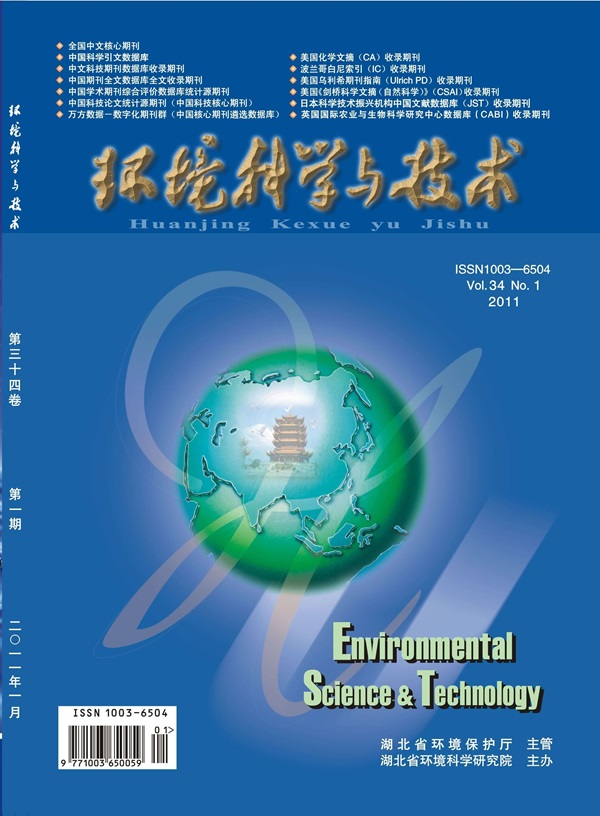
Environmental Science & Technology (ES&T) is a co-sponsored academic and technical magazine by the Hubei Provincial Environmental Protection Bureau and the Hubei Provincial Academy of Environmental Sciences.
Environmental Science & Technology (ES&T) holds the status of Chinese core journals, scientific papers source journals of China, Chinese Science Citation Database source journals, and Chinese Academic Journal Comprehensive Evaluation Database source journals. This publication focuses on the academic field of environmental protection, featuring articles related to environmental protection and technical advancements.




 京公网安备 11010802042870号
京ICP备2023020795号-1
京公网安备 11010802042870号
京ICP备2023020795号-1

 分享
分享
 求助内容:
求助内容: 应助结果提醒方式:
 扫码关注我们
