Leveraging counteractive temperature-dependent resistivity among components for temperature-insensitive electromagnetic characteristics in lightweight SiOCN ceramics
Weichao Wang, Liuying Wang, Jie Huang, Qi Gu, Yanyan Lu, Chaoqun Ge, Gu Liu
{"title":"Leveraging counteractive temperature-dependent resistivity among components for temperature-insensitive electromagnetic characteristics in lightweight SiOCN ceramics","authors":"Weichao Wang, Liuying Wang, Jie Huang, Qi Gu, Yanyan Lu, Chaoqun Ge, Gu Liu","doi":"10.1016/j.cej.2025.163011","DOIUrl":null,"url":null,"abstract":"The rapid advancement of aerospace technology has subjected high-speed aircraft to increasingly severe high-temperature conditions, thereby substantially increasing the demand for high-temperature electromagnetic wave (EMW) absorbing materials. However, due to the temperature dependence of the permittivity, high-temperature EMW absorbing materials still face the challenge of maintaining consistent impedance matching performance at different temperatures. This study proposes a novel approach by in-situ constructing Si-Co alloys in amorphous SiOCN ceramics, taking advantage of the inverse temperature-dependent resistivity behavior among components to dynamically equilibrate the overall conductivity of the ceramics, thereby achieving temperature-insensitive permittivity. This strategy significantly enhances the robustness of dielectric properties against temperature fluctuations and enables effective EMW absorption within a temperature range from ambient to 800 °C at low thickness. By using the self-sacrificing template method, a porous structure was formed while ensuring the precise shaping, thereby further achieving the lightweighting of the ceramics. This lightweight dielectric ceramic with temperature-insensitive permittivity provides novel perspectives for the development of wide-temperature-range EMW absorbing materials.","PeriodicalId":270,"journal":{"name":"Chemical Engineering Journal","volume":"35 1","pages":""},"PeriodicalIF":13.2000,"publicationDate":"2025-04-23","publicationTypes":"Journal Article","fieldsOfStudy":null,"isOpenAccess":false,"openAccessPdf":"","citationCount":"0","resultStr":null,"platform":"Semanticscholar","paperid":null,"PeriodicalName":"Chemical Engineering Journal","FirstCategoryId":"5","ListUrlMain":"https://doi.org/10.1016/j.cej.2025.163011","RegionNum":1,"RegionCategory":"工程技术","ArticlePicture":[],"TitleCN":null,"AbstractTextCN":null,"PMCID":null,"EPubDate":"","PubModel":"","JCR":"Q1","JCRName":"ENGINEERING, CHEMICAL","Score":null,"Total":0}
引用次数: 0
Abstract
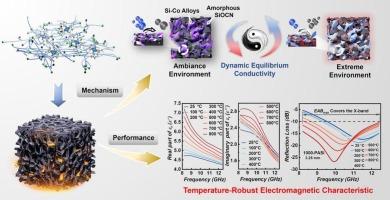
The rapid advancement of aerospace technology has subjected high-speed aircraft to increasingly severe high-temperature conditions, thereby substantially increasing the demand for high-temperature electromagnetic wave (EMW) absorbing materials. However, due to the temperature dependence of the permittivity, high-temperature EMW absorbing materials still face the challenge of maintaining consistent impedance matching performance at different temperatures. This study proposes a novel approach by in-situ constructing Si-Co alloys in amorphous SiOCN ceramics, taking advantage of the inverse temperature-dependent resistivity behavior among components to dynamically equilibrate the overall conductivity of the ceramics, thereby achieving temperature-insensitive permittivity. This strategy significantly enhances the robustness of dielectric properties against temperature fluctuations and enables effective EMW absorption within a temperature range from ambient to 800 °C at low thickness. By using the self-sacrificing template method, a porous structure was formed while ensuring the precise shaping, thereby further achieving the lightweighting of the ceramics. This lightweight dielectric ceramic with temperature-insensitive permittivity provides novel perspectives for the development of wide-temperature-range EMW absorbing materials.
期刊介绍:
The Chemical Engineering Journal is an international research journal that invites contributions of original and novel fundamental research. It aims to provide an international platform for presenting original fundamental research, interpretative reviews, and discussions on new developments in chemical engineering. The journal welcomes papers that describe novel theory and its practical application, as well as those that demonstrate the transfer of techniques from other disciplines. It also welcomes reports on carefully conducted experimental work that is soundly interpreted. The main focus of the journal is on original and rigorous research results that have broad significance. The Catalysis section within the Chemical Engineering Journal focuses specifically on Experimental and Theoretical studies in the fields of heterogeneous catalysis, molecular catalysis, and biocatalysis. These studies have industrial impact on various sectors such as chemicals, energy, materials, foods, healthcare, and environmental protection.



 京公网安备 11010802042870号
京ICP备2023020795号-1
京公网安备 11010802042870号
京ICP备2023020795号-1

 分享
分享
 求助内容:
求助内容: 应助结果提醒方式:
 扫码关注我们
