{"title":"p-π Conjugated quinone-amine polymer metal-free anode for high-performance reversible NH4+ charge storage","authors":"Fuyao Huang, Yuhang Jia, Wenkai Zhao, Yongqi Mi, Yujia Guo, Sehrish Gull, Guankui Long, Pengcheng Du","doi":"10.1016/j.cej.2025.163027","DOIUrl":null,"url":null,"abstract":"Ammonium ion batteries (AIBs) have emerged as a promising technology for large-scale energy storage due to their low cost, high safety, and excellent electrochemical performance. However, the development of suitable anode materials has been a major challenge. In this study, we report a novel p-π conjugated cross-linked quinone-amine polymer (PQDAB) that exhibits remarkable capacity and cycling stability as an anode material for reversible storage of NH<sub>4</sub><sup>+</sup>. The p-π conjugated polymer framework creates an internal electric field at heteroatom sites, facilitating efficient electron transfer during charge and discharge processes, achieving a high capacity of 158.85mAh g<sup>−1</sup> at 0.5 A g<sup>−1</sup> and an excellent cycle stability of 77.1 % capacity retention over 16,000 cycles. Additionally, a “rocking-chair” AIB based on PQDAB//CuFe-PBA delivers a high capacity of 124.75mAh g<sup>−1</sup> at 0.5 A g<sup>−1</sup> and excellent cycle stability over 3,000 cycles at 3 A g<sup>−1</sup>. Furthermore, we also explore the NH<sub>4</sub><sup>+</sup> storage process through a novel reversibly carbonyl conversion reaction using in-situ/ex-situ characterization and theoretical simulation. Molecular Dynamics (MD) simulations reveal that the solvation layer structures of PQDAB in (NH<sub>4</sub>)<sub>2</sub>SO<sub>4</sub> electrolyte contribute to its superior stability. This work provides valuable insights for designing high-capacity and stable anode materials for AIBs.","PeriodicalId":270,"journal":{"name":"Chemical Engineering Journal","volume":"70 1","pages":""},"PeriodicalIF":13.2000,"publicationDate":"2025-04-23","publicationTypes":"Journal Article","fieldsOfStudy":null,"isOpenAccess":false,"openAccessPdf":"","citationCount":"0","resultStr":null,"platform":"Semanticscholar","paperid":null,"PeriodicalName":"Chemical Engineering Journal","FirstCategoryId":"5","ListUrlMain":"https://doi.org/10.1016/j.cej.2025.163027","RegionNum":1,"RegionCategory":"工程技术","ArticlePicture":[],"TitleCN":null,"AbstractTextCN":null,"PMCID":null,"EPubDate":"","PubModel":"","JCR":"Q1","JCRName":"ENGINEERING, CHEMICAL","Score":null,"Total":0}
引用次数: 0
Abstract
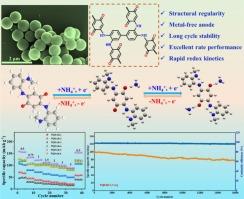
Ammonium ion batteries (AIBs) have emerged as a promising technology for large-scale energy storage due to their low cost, high safety, and excellent electrochemical performance. However, the development of suitable anode materials has been a major challenge. In this study, we report a novel p-π conjugated cross-linked quinone-amine polymer (PQDAB) that exhibits remarkable capacity and cycling stability as an anode material for reversible storage of NH4+. The p-π conjugated polymer framework creates an internal electric field at heteroatom sites, facilitating efficient electron transfer during charge and discharge processes, achieving a high capacity of 158.85mAh g−1 at 0.5 A g−1 and an excellent cycle stability of 77.1 % capacity retention over 16,000 cycles. Additionally, a “rocking-chair” AIB based on PQDAB//CuFe-PBA delivers a high capacity of 124.75mAh g−1 at 0.5 A g−1 and excellent cycle stability over 3,000 cycles at 3 A g−1. Furthermore, we also explore the NH4+ storage process through a novel reversibly carbonyl conversion reaction using in-situ/ex-situ characterization and theoretical simulation. Molecular Dynamics (MD) simulations reveal that the solvation layer structures of PQDAB in (NH4)2SO4 electrolyte contribute to its superior stability. This work provides valuable insights for designing high-capacity and stable anode materials for AIBs.
铵离子电池(AIBs)由于其低成本、高安全性和优异的电化学性能而成为一种有前景的大规模储能技术。然而,开发合适的阳极材料一直是一个重大挑战。在这项研究中,我们报道了一种新型的p-π共轭交联醌胺聚合物(PQDAB),它作为NH4+可逆存储的阳极材料具有显着的容量和循环稳定性。p-π共轭聚合物框架在杂原子位置产生内部电场,在充放电过程中促进有效的电子转移,在0.5 a g - 1下获得158.85mAh g - 1的高容量,并在16,000次循环中获得77.1 %的优异循环稳定性。此外,基于PQDAB//CuFe-PBA的“摇椅式”AIB在0.5 a g- 1下可提供124.75mAh g- 1的高容量,在3a g- 1下可提供超过3,000次循环的优异循环稳定性。此外,我们还通过原位/非原位表征和理论模拟,通过一种新的可逆羰基转化反应探索了NH4+的储存过程。分子动力学(MD)模拟表明,PQDAB在(NH4)2SO4电解质中的溶剂化层结构有助于其优异的稳定性。这项工作为设计高容量和稳定的aib阳极材料提供了有价值的见解。
期刊介绍:
The Chemical Engineering Journal is an international research journal that invites contributions of original and novel fundamental research. It aims to provide an international platform for presenting original fundamental research, interpretative reviews, and discussions on new developments in chemical engineering. The journal welcomes papers that describe novel theory and its practical application, as well as those that demonstrate the transfer of techniques from other disciplines. It also welcomes reports on carefully conducted experimental work that is soundly interpreted. The main focus of the journal is on original and rigorous research results that have broad significance. The Catalysis section within the Chemical Engineering Journal focuses specifically on Experimental and Theoretical studies in the fields of heterogeneous catalysis, molecular catalysis, and biocatalysis. These studies have industrial impact on various sectors such as chemicals, energy, materials, foods, healthcare, and environmental protection.



 京公网安备 11010802042870号
京ICP备2023020795号-1
京公网安备 11010802042870号
京ICP备2023020795号-1

 分享
分享
 求助内容:
求助内容: 应助结果提醒方式:
 扫码关注我们
