Ionic liquid‐based surfactants-mediated turing patterning in nanofiltration membranes via bidirectional diffusion control of piperazine and trimesoyl chloride for synergistic permselectivity enhancement
Xin Zhao, Jun Xiao, Dingxian Jia, Pengfei Qi, Mingjie Wei, Shuang Hao, Yunxia Hu
{"title":"Ionic liquid‐based surfactants-mediated turing patterning in nanofiltration membranes via bidirectional diffusion control of piperazine and trimesoyl chloride for synergistic permselectivity enhancement","authors":"Xin Zhao, Jun Xiao, Dingxian Jia, Pengfei Qi, Mingjie Wei, Shuang Hao, Yunxia Hu","doi":"10.1016/j.cej.2025.162917","DOIUrl":null,"url":null,"abstract":"Thin-film composite (TFC) nanofiltration (NF) membranes fabricated <em>via</em> conventional interfacial polymerization (IP) inherently suffer from the permeability-selectivity trade-off due to diffusion-limited monomer transport. Here, we unveil an ionic liquid (IL)-based surfactants ([C<sub>12</sub>mim][Cl]) as a dynamic bidirectional regulator of piperazine (PIP) and trimesoyl chloride (TMC) that uniquely reengineers IP kinetics to fabricate high-performance NF membranes with simultaneous enhancement in both water permeability and ion selectivity. Unlike existing additives that often passively decelerate amine diffusion, [C<sub>12</sub>mim][Cl] establishes a critical diffusion asymmetry (<em>D</em><sub>TMC</sub> > <em>D</em><sub>PIP</sub>) by simultaneously accelerating TMC mobility while spatially confining PIP through intermolecular binding and viscosity modulation. This diffusion-driven instability triggers spontaneous Turing patterning, yielding an ultrathin (≈24 nm) polyamide (PA) layer with a loosely packed hierarchical network and enhanced carboxyl density (59.8 mM m<sup>−2</sup>). The synergistic interplay of Turing structure and intensified Donnan exclusion achieves unprecedented performance of NF membrane: water permeance (19.3 LMH bar<sup>−1</sup>, +210 %) and mono-/divalent ion selectivity (83), surpassing over current leading benchmarks. This work establishes a universal strategy to fabricate high-performance NF membranes with large permeable surface and enhanced carboxyl density through an ionic liquid‐based surfactants-mediated IP, breaking the permeability-selectivity trade-off and offering transformative potential for precision separations.","PeriodicalId":270,"journal":{"name":"Chemical Engineering Journal","volume":"261 1","pages":""},"PeriodicalIF":13.2000,"publicationDate":"2025-04-23","publicationTypes":"Journal Article","fieldsOfStudy":null,"isOpenAccess":false,"openAccessPdf":"","citationCount":"0","resultStr":null,"platform":"Semanticscholar","paperid":null,"PeriodicalName":"Chemical Engineering Journal","FirstCategoryId":"5","ListUrlMain":"https://doi.org/10.1016/j.cej.2025.162917","RegionNum":1,"RegionCategory":"工程技术","ArticlePicture":[],"TitleCN":null,"AbstractTextCN":null,"PMCID":null,"EPubDate":"","PubModel":"","JCR":"Q1","JCRName":"ENGINEERING, CHEMICAL","Score":null,"Total":0}
引用次数: 0
Abstract
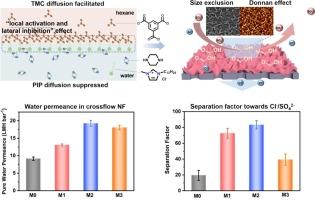
Thin-film composite (TFC) nanofiltration (NF) membranes fabricated via conventional interfacial polymerization (IP) inherently suffer from the permeability-selectivity trade-off due to diffusion-limited monomer transport. Here, we unveil an ionic liquid (IL)-based surfactants ([C12mim][Cl]) as a dynamic bidirectional regulator of piperazine (PIP) and trimesoyl chloride (TMC) that uniquely reengineers IP kinetics to fabricate high-performance NF membranes with simultaneous enhancement in both water permeability and ion selectivity. Unlike existing additives that often passively decelerate amine diffusion, [C12mim][Cl] establishes a critical diffusion asymmetry (DTMC > DPIP) by simultaneously accelerating TMC mobility while spatially confining PIP through intermolecular binding and viscosity modulation. This diffusion-driven instability triggers spontaneous Turing patterning, yielding an ultrathin (≈24 nm) polyamide (PA) layer with a loosely packed hierarchical network and enhanced carboxyl density (59.8 mM m−2). The synergistic interplay of Turing structure and intensified Donnan exclusion achieves unprecedented performance of NF membrane: water permeance (19.3 LMH bar−1, +210 %) and mono-/divalent ion selectivity (83), surpassing over current leading benchmarks. This work establishes a universal strategy to fabricate high-performance NF membranes with large permeable surface and enhanced carboxyl density through an ionic liquid‐based surfactants-mediated IP, breaking the permeability-selectivity trade-off and offering transformative potential for precision separations.
期刊介绍:
The Chemical Engineering Journal is an international research journal that invites contributions of original and novel fundamental research. It aims to provide an international platform for presenting original fundamental research, interpretative reviews, and discussions on new developments in chemical engineering. The journal welcomes papers that describe novel theory and its practical application, as well as those that demonstrate the transfer of techniques from other disciplines. It also welcomes reports on carefully conducted experimental work that is soundly interpreted. The main focus of the journal is on original and rigorous research results that have broad significance. The Catalysis section within the Chemical Engineering Journal focuses specifically on Experimental and Theoretical studies in the fields of heterogeneous catalysis, molecular catalysis, and biocatalysis. These studies have industrial impact on various sectors such as chemicals, energy, materials, foods, healthcare, and environmental protection.




 京公网安备 11010802042870号
京ICP备2023020795号-1
京公网安备 11010802042870号
京ICP备2023020795号-1

 分享
分享
 求助内容:
求助内容: 应助结果提醒方式:
 扫码关注我们
