{"title":"Electrostatic supramolecular self-assembly of vanadium oxide and conductive polymer for highly efficient zinc ion storage","authors":"Yiran Zhu, Yida Wang, Tianchi Li, Kuo Cao, Yunyong Hu, Bicai Pan, Chunhua Chen","doi":"10.1016/j.cej.2025.163002","DOIUrl":null,"url":null,"abstract":"Despite the widespread use of lithium-ion batteries (LIBs), the constraints of limited lithium sources and safety concerns persist. Aqueous zinc-ion batteries (ZIBs) are a promising alternative, leveraging abundant resources, non-flammable electrolytes, high safety, and cost-effectiveness. However, challenges remain due to inadequate cathode materials. Layered vanadium oxide (LVO) holds promise but suffers from cyclic stability issues. Introducing conductive polymers into LVO interlayers can enhance structural integrity, prolong lifespan, and increase electronic conductivity simultaneously. Here, we focus on V<sub>10</sub>O<sub>24</sub>·nH<sub>2</sub>O (VOH) with a large interlayer spacing and utilize the supramolecular self-assembly of poly(3,4-ethylenedioxythiophene) (PEDOT) and VOH to obtain 2D VOH/PEDOT (PVOH) cathodes for ZIBs. Thanks to the reinforced layer structure and a conductive layer of hydrophobic PEDOT coating which reduces vanadium dissolution and promotes electronic conductivity, the optimized PVOH-M exhibits a high capacity of 452.14 mA h g<sup>−1</sup> at 100 mA g<sup>−1</sup> and a significant energy density of 316.08 Wh kg<sup>−1</sup>, along with 91.78 % capacity retention after 3000 cycles at 10 A g<sup>−1</sup>. Density Functional Theory (DFT) calculations further prove the unique three-step self-assembly model and explain the enhanced performances theoretically. This study demonstrates the efficacy of electrostatic supramolecular self-assembly as a strategy in modifying cathodes, offering insights into layered cathode design.","PeriodicalId":270,"journal":{"name":"Chemical Engineering Journal","volume":"6 1","pages":""},"PeriodicalIF":13.2000,"publicationDate":"2025-04-23","publicationTypes":"Journal Article","fieldsOfStudy":null,"isOpenAccess":false,"openAccessPdf":"","citationCount":"0","resultStr":null,"platform":"Semanticscholar","paperid":null,"PeriodicalName":"Chemical Engineering Journal","FirstCategoryId":"5","ListUrlMain":"https://doi.org/10.1016/j.cej.2025.163002","RegionNum":1,"RegionCategory":"工程技术","ArticlePicture":[],"TitleCN":null,"AbstractTextCN":null,"PMCID":null,"EPubDate":"","PubModel":"","JCR":"Q1","JCRName":"ENGINEERING, CHEMICAL","Score":null,"Total":0}
引用次数: 0
Abstract
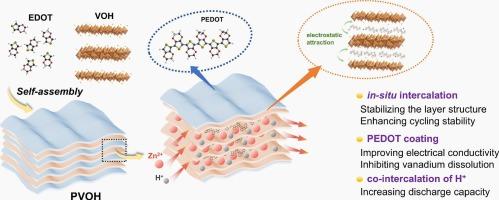
Despite the widespread use of lithium-ion batteries (LIBs), the constraints of limited lithium sources and safety concerns persist. Aqueous zinc-ion batteries (ZIBs) are a promising alternative, leveraging abundant resources, non-flammable electrolytes, high safety, and cost-effectiveness. However, challenges remain due to inadequate cathode materials. Layered vanadium oxide (LVO) holds promise but suffers from cyclic stability issues. Introducing conductive polymers into LVO interlayers can enhance structural integrity, prolong lifespan, and increase electronic conductivity simultaneously. Here, we focus on V10O24·nH2O (VOH) with a large interlayer spacing and utilize the supramolecular self-assembly of poly(3,4-ethylenedioxythiophene) (PEDOT) and VOH to obtain 2D VOH/PEDOT (PVOH) cathodes for ZIBs. Thanks to the reinforced layer structure and a conductive layer of hydrophobic PEDOT coating which reduces vanadium dissolution and promotes electronic conductivity, the optimized PVOH-M exhibits a high capacity of 452.14 mA h g−1 at 100 mA g−1 and a significant energy density of 316.08 Wh kg−1, along with 91.78 % capacity retention after 3000 cycles at 10 A g−1. Density Functional Theory (DFT) calculations further prove the unique three-step self-assembly model and explain the enhanced performances theoretically. This study demonstrates the efficacy of electrostatic supramolecular self-assembly as a strategy in modifying cathodes, offering insights into layered cathode design.
期刊介绍:
The Chemical Engineering Journal is an international research journal that invites contributions of original and novel fundamental research. It aims to provide an international platform for presenting original fundamental research, interpretative reviews, and discussions on new developments in chemical engineering. The journal welcomes papers that describe novel theory and its practical application, as well as those that demonstrate the transfer of techniques from other disciplines. It also welcomes reports on carefully conducted experimental work that is soundly interpreted. The main focus of the journal is on original and rigorous research results that have broad significance. The Catalysis section within the Chemical Engineering Journal focuses specifically on Experimental and Theoretical studies in the fields of heterogeneous catalysis, molecular catalysis, and biocatalysis. These studies have industrial impact on various sectors such as chemicals, energy, materials, foods, healthcare, and environmental protection.



 京公网安备 11010802042870号
京ICP备2023020795号-1
京公网安备 11010802042870号
京ICP备2023020795号-1

 分享
分享
 求助内容:
求助内容: 应助结果提醒方式:
 扫码关注我们
