{"title":"Neural Network-Based Model Predictive Control Framework Incorporating First-Principles Knowledge for Process Systems","authors":"Rahul Patel, Sharad Bhartiya, Ravindra D. Gudi","doi":"10.1021/acs.iecr.4c04305","DOIUrl":null,"url":null,"abstract":"Model-based control approaches rely on computationally efficient prediction models to capture system dynamics for real-time decision-making. Traditional methods, such as reduced-order models derived from first-principles, offer real-time feasibility but often involve trade-offs among complexity, accuracy, and computational cost. On the other hand, data-driven models can efficiently capture system behavior but seldom utilize physics-based knowledge while training. Physics-informed neural networks (PINNs) address this gap by incorporating governing physical equations into the loss function while leveraging measurement data for enhanced accuracy. In this study, we evaluate the effectiveness of a PINN-based approach (PINND) for the control-oriented modeling of process systems by integrating approximate plant models with noisy measurement data. We apply PINND to three case studies: a solid oxide fuel cell, the autocatalytic Schlögl system, and a nonisothermal plug flow reactor─systems governed by ordinary and partial differential equations. The proposed approach is systematically compared against mechanistic models, purely data-driven models, and standard PINNs, considering both interpolation and extrapolation scenarios. Furthermore, we assess its application in model predictive control (MPC) for servo and regulatory tasks. Our results demonstrate that PINND achieves up to a 63% reduction in mean absolute percentage error in extrapolation scenarios compared to data-driven deep neural networks while reducing MPC computation time by 74% compared to first-principles models, highlighting its potential for real-time control applications.","PeriodicalId":39,"journal":{"name":"Industrial & Engineering Chemistry Research","volume":"138 1","pages":""},"PeriodicalIF":3.9000,"publicationDate":"2025-04-24","publicationTypes":"Journal Article","fieldsOfStudy":null,"isOpenAccess":false,"openAccessPdf":"","citationCount":"0","resultStr":null,"platform":"Semanticscholar","paperid":null,"PeriodicalName":"Industrial & Engineering Chemistry Research","FirstCategoryId":"5","ListUrlMain":"https://doi.org/10.1021/acs.iecr.4c04305","RegionNum":3,"RegionCategory":"工程技术","ArticlePicture":[],"TitleCN":null,"AbstractTextCN":null,"PMCID":null,"EPubDate":"","PubModel":"","JCR":"Q2","JCRName":"ENGINEERING, CHEMICAL","Score":null,"Total":0}
引用次数: 0
Abstract
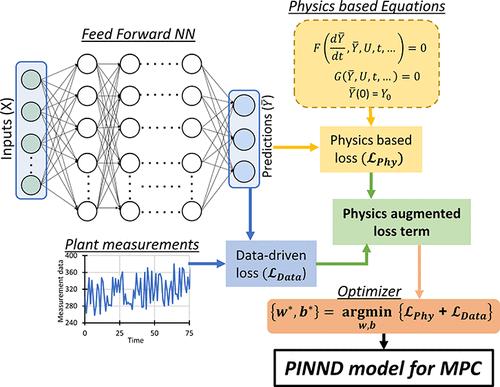
Model-based control approaches rely on computationally efficient prediction models to capture system dynamics for real-time decision-making. Traditional methods, such as reduced-order models derived from first-principles, offer real-time feasibility but often involve trade-offs among complexity, accuracy, and computational cost. On the other hand, data-driven models can efficiently capture system behavior but seldom utilize physics-based knowledge while training. Physics-informed neural networks (PINNs) address this gap by incorporating governing physical equations into the loss function while leveraging measurement data for enhanced accuracy. In this study, we evaluate the effectiveness of a PINN-based approach (PINND) for the control-oriented modeling of process systems by integrating approximate plant models with noisy measurement data. We apply PINND to three case studies: a solid oxide fuel cell, the autocatalytic Schlögl system, and a nonisothermal plug flow reactor─systems governed by ordinary and partial differential equations. The proposed approach is systematically compared against mechanistic models, purely data-driven models, and standard PINNs, considering both interpolation and extrapolation scenarios. Furthermore, we assess its application in model predictive control (MPC) for servo and regulatory tasks. Our results demonstrate that PINND achieves up to a 63% reduction in mean absolute percentage error in extrapolation scenarios compared to data-driven deep neural networks while reducing MPC computation time by 74% compared to first-principles models, highlighting its potential for real-time control applications.
期刊介绍:
ndustrial & Engineering Chemistry, with variations in title and format, has been published since 1909 by the American Chemical Society. Industrial & Engineering Chemistry Research is a weekly publication that reports industrial and academic research in the broad fields of applied chemistry and chemical engineering with special focus on fundamentals, processes, and products.



 京公网安备 11010802042870号
京ICP备2023020795号-1
京公网安备 11010802042870号
京ICP备2023020795号-1

 分享
分享
 求助内容:
求助内容: 应助结果提醒方式:
 扫码关注我们
