Seon Yeong Chae, Geun Young Kim, Hyun-Seok Choe, Young Woo Kwon, Suck Won Hong, Jae-Hyuk Kim
{"title":"Photothermal cancer treatment with laser-activated yolk-shell nanoparticles and synergistic combination of chemotherapy","authors":"Seon Yeong Chae, Geun Young Kim, Hyun-Seok Choe, Young Woo Kwon, Suck Won Hong, Jae-Hyuk Kim","doi":"10.1016/j.cej.2025.162919","DOIUrl":null,"url":null,"abstract":"Synergistic chemo-photothermal therapy is a robust and reliable strategy for the effective elimination of cancer cells. In this study, we introduce a developed therapeutic approach that integrates photothermal therapy (PTT) via yolk-shell gold nanoparticles (YS-GNP) with doxorubicin (DOX)-mediated chemotherapy to enhance anticancer efficacy. YS-GNP was meticulously engineered as a highly efficient photothermal agent, utilizing the localized surface plasmon resonance of gold nanoparticles within the yolk-shell structure. Upon near-infrared laser irradiation, YS-GNP effectively induced cancer cell death under mild hyperthermic condition. In vitro studies on HeLa and YD10B cancer cell lines demonstrated that the combination therapy (YS-GNP/DOX/Laser) significantly improved therapeutic outcomes compared to monotherapies, selectively targeting cancer cells while minimizing damage to normal cells. The enhanced anticancer effects were attributed to the complementary mechanisms of DOX-induced reactive oxygen species generation and YS-GNP-mediated lysosomal disruption. Furthermore, inhibition of heat shock proteins (HSPs) substantially amplified cancer cell death, highlighting the multifaceted mechanisms underlying the PTT approach. In particular, significant reductions in HSP70 expression (1.45-fold in YD10B, 1.96-fold in HeLa) and HSP90 expression (1.58-fold in YD10B, 5.88-fold in HeLa), support the synergistic anticancer effect and mechanism of DOX and PTT. This dual approach, which combines photothermal therapy and chemotherapy, enhances treatment precision and pathological site-specific accumulation, presenting strong potential for clinical translation.","PeriodicalId":270,"journal":{"name":"Chemical Engineering Journal","volume":"153 1","pages":""},"PeriodicalIF":13.2000,"publicationDate":"2025-04-23","publicationTypes":"Journal Article","fieldsOfStudy":null,"isOpenAccess":false,"openAccessPdf":"","citationCount":"0","resultStr":null,"platform":"Semanticscholar","paperid":null,"PeriodicalName":"Chemical Engineering Journal","FirstCategoryId":"5","ListUrlMain":"https://doi.org/10.1016/j.cej.2025.162919","RegionNum":1,"RegionCategory":"工程技术","ArticlePicture":[],"TitleCN":null,"AbstractTextCN":null,"PMCID":null,"EPubDate":"","PubModel":"","JCR":"Q1","JCRName":"ENGINEERING, CHEMICAL","Score":null,"Total":0}
引用次数: 0
Abstract
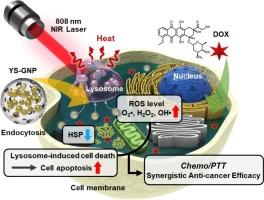
Synergistic chemo-photothermal therapy is a robust and reliable strategy for the effective elimination of cancer cells. In this study, we introduce a developed therapeutic approach that integrates photothermal therapy (PTT) via yolk-shell gold nanoparticles (YS-GNP) with doxorubicin (DOX)-mediated chemotherapy to enhance anticancer efficacy. YS-GNP was meticulously engineered as a highly efficient photothermal agent, utilizing the localized surface plasmon resonance of gold nanoparticles within the yolk-shell structure. Upon near-infrared laser irradiation, YS-GNP effectively induced cancer cell death under mild hyperthermic condition. In vitro studies on HeLa and YD10B cancer cell lines demonstrated that the combination therapy (YS-GNP/DOX/Laser) significantly improved therapeutic outcomes compared to monotherapies, selectively targeting cancer cells while minimizing damage to normal cells. The enhanced anticancer effects were attributed to the complementary mechanisms of DOX-induced reactive oxygen species generation and YS-GNP-mediated lysosomal disruption. Furthermore, inhibition of heat shock proteins (HSPs) substantially amplified cancer cell death, highlighting the multifaceted mechanisms underlying the PTT approach. In particular, significant reductions in HSP70 expression (1.45-fold in YD10B, 1.96-fold in HeLa) and HSP90 expression (1.58-fold in YD10B, 5.88-fold in HeLa), support the synergistic anticancer effect and mechanism of DOX and PTT. This dual approach, which combines photothermal therapy and chemotherapy, enhances treatment precision and pathological site-specific accumulation, presenting strong potential for clinical translation.
期刊介绍:
The Chemical Engineering Journal is an international research journal that invites contributions of original and novel fundamental research. It aims to provide an international platform for presenting original fundamental research, interpretative reviews, and discussions on new developments in chemical engineering. The journal welcomes papers that describe novel theory and its practical application, as well as those that demonstrate the transfer of techniques from other disciplines. It also welcomes reports on carefully conducted experimental work that is soundly interpreted. The main focus of the journal is on original and rigorous research results that have broad significance. The Catalysis section within the Chemical Engineering Journal focuses specifically on Experimental and Theoretical studies in the fields of heterogeneous catalysis, molecular catalysis, and biocatalysis. These studies have industrial impact on various sectors such as chemicals, energy, materials, foods, healthcare, and environmental protection.



 京公网安备 11010802042870号
京ICP备2023020795号-1
京公网安备 11010802042870号
京ICP备2023020795号-1

 分享
分享
 求助内容:
求助内容: 应助结果提醒方式:
 扫码关注我们
