Dual-Stage Supercritical CO2 Foaming for Sequential Structural Conversion in High-Performance Reentrant Foam with Reversible Thermal-Induced Transformation
{"title":"Dual-Stage Supercritical CO2 Foaming for Sequential Structural Conversion in High-Performance Reentrant Foam with Reversible Thermal-Induced Transformation","authors":"Shaozhe Shi, Xiaohan Wang, Bo Wang, Yishen Zhao, Guangxian Li, Xia Liao","doi":"10.1021/acsami.5c03611","DOIUrl":null,"url":null,"abstract":"The controllable design and optimization of porous structures can endow the foam with unique functionalities and expand its application domains. In this work, we propose a dual-stage supercritical carbon dioxide foaming technology that leverages the synergistic effects of the pressure difference inside and outside the cells and the surface tension between the polymer matrix and gas, enabling direct conversion from engineering plastic polymer with a rigid molecular chain to the closed-cell reentrant foam. Using polycarbonate siloxane copolymer (Si-PC) resin as a matrix, we successfully prepared the reentrant concave angle Si-PC foam (R-PCF) with various transformation degrees by adjusting key process parameters in both first and second stages. R-PCF features a unique reversible thermal-induced structural transformation, excellent thermal insulation performance (the final temperature is 68 °C lower than the hot table and 17 °C lower than the Si-PC foam under stable heat source conditions), and chemical resistance. Additionally, the introduction of the reentrant concave angle structure effectively optimizes energy transfer pathways, making the R-PCF have superior energy absorption properties, improving the competitiveness of R-PCF for potential applications in thermal switches, intelligent thermal-drive devices, and protective and thermal management fields.","PeriodicalId":5,"journal":{"name":"ACS Applied Materials & Interfaces","volume":"70 1","pages":""},"PeriodicalIF":8.2000,"publicationDate":"2025-04-24","publicationTypes":"Journal Article","fieldsOfStudy":null,"isOpenAccess":false,"openAccessPdf":"","citationCount":"0","resultStr":null,"platform":"Semanticscholar","paperid":null,"PeriodicalName":"ACS Applied Materials & Interfaces","FirstCategoryId":"88","ListUrlMain":"https://doi.org/10.1021/acsami.5c03611","RegionNum":2,"RegionCategory":"材料科学","ArticlePicture":[],"TitleCN":null,"AbstractTextCN":null,"PMCID":null,"EPubDate":"","PubModel":"","JCR":"Q1","JCRName":"MATERIALS SCIENCE, MULTIDISCIPLINARY","Score":null,"Total":0}
引用次数: 0
Abstract
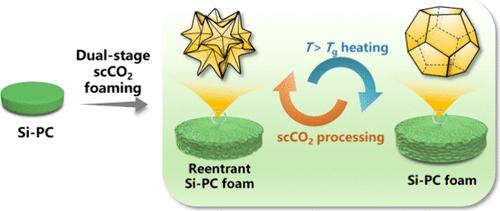
The controllable design and optimization of porous structures can endow the foam with unique functionalities and expand its application domains. In this work, we propose a dual-stage supercritical carbon dioxide foaming technology that leverages the synergistic effects of the pressure difference inside and outside the cells and the surface tension between the polymer matrix and gas, enabling direct conversion from engineering plastic polymer with a rigid molecular chain to the closed-cell reentrant foam. Using polycarbonate siloxane copolymer (Si-PC) resin as a matrix, we successfully prepared the reentrant concave angle Si-PC foam (R-PCF) with various transformation degrees by adjusting key process parameters in both first and second stages. R-PCF features a unique reversible thermal-induced structural transformation, excellent thermal insulation performance (the final temperature is 68 °C lower than the hot table and 17 °C lower than the Si-PC foam under stable heat source conditions), and chemical resistance. Additionally, the introduction of the reentrant concave angle structure effectively optimizes energy transfer pathways, making the R-PCF have superior energy absorption properties, improving the competitiveness of R-PCF for potential applications in thermal switches, intelligent thermal-drive devices, and protective and thermal management fields.
期刊介绍:
ACS Applied Materials & Interfaces is a leading interdisciplinary journal that brings together chemists, engineers, physicists, and biologists to explore the development and utilization of newly-discovered materials and interfacial processes for specific applications. Our journal has experienced remarkable growth since its establishment in 2009, both in terms of the number of articles published and the impact of the research showcased. We are proud to foster a truly global community, with the majority of published articles originating from outside the United States, reflecting the rapid growth of applied research worldwide.



 京公网安备 11010802042870号
京ICP备2023020795号-1
京公网安备 11010802042870号
京ICP备2023020795号-1

 分享
分享
 求助内容:
求助内容: 应助结果提醒方式:
 扫码关注我们
