Di Zhang , Shaohua Guo , Changyong Liu , Shen Qu , Hongbin Cao , He Zhao
{"title":"Industrial zero liquid discharge strategy in the water-scarce regions of China triggering the antagonism tradeoff of pollution and carbon emissions","authors":"Di Zhang , Shaohua Guo , Changyong Liu , Shen Qu , Hongbin Cao , He Zhao","doi":"10.1016/j.jclepro.2025.145506","DOIUrl":null,"url":null,"abstract":"<div><div>Due to limited water resources, zero liquid discharge is the environmental impact assessment admittance threshold for new coal chemical projects in China. However, it is unknown whether the application of zero liquid discharge technologies will actually change environmental impacts, carbon emissions, or costs. In this paper, a comprehensive evaluation model was developed to analyze unintended non-synergistic of pollution and carbon emissions and to perform a cost-benefit analysis of mainstream zero liquid discharge technologies. Two zero liquid discharge and two non-zero liquid discharge processes covering mainstream brine treatment technologies of coal chemical industry in China were compared. The results showed that some mainstream zero liquid discharge technologies had unintended consequences in terms of their environmental impact, carbon footprint, and cost. The high-salinity water treatment units using evaporative crystallization are key components during coal-to-olefin water treatment methods. Because energy-intensive equipment is used to evaporate water, the processes utilizing an evaporative crystallization unit incurred nearly two times the cost, with a 24.3 %–117.4 % increase in carbon footprint, compared to those not using the unit. The benefits of salt products such as sodium chloride obtained from the evaporation process are far lower than their costs and they generate salt-containing organic pollution, which increases the environmental risks. Due to carbon neutrality goals, zero liquid discharge technologies must solve the two major problems of waste salt generation and high energy consumption. Up to 196–423 kt of carbon emissions can be eliminated by 2050 by using green energy substitutes, technological innovation, and regent reduction. This provides a direction for the future development of zero liquid discharge technologies for coal chemical industry in water-scarce regions.</div></div>","PeriodicalId":349,"journal":{"name":"Journal of Cleaner Production","volume":"508 ","pages":"Article 145506"},"PeriodicalIF":10.0000,"publicationDate":"2025-05-25","publicationTypes":"Journal Article","fieldsOfStudy":null,"isOpenAccess":false,"openAccessPdf":"","citationCount":"0","resultStr":null,"platform":"Semanticscholar","paperid":null,"PeriodicalName":"Journal of Cleaner Production","FirstCategoryId":"93","ListUrlMain":"https://www.sciencedirect.com/science/article/pii/S095965262500856X","RegionNum":1,"RegionCategory":"环境科学与生态学","ArticlePicture":[],"TitleCN":null,"AbstractTextCN":null,"PMCID":null,"EPubDate":"2025/4/23 0:00:00","PubModel":"Epub","JCR":"Q1","JCRName":"ENGINEERING, ENVIRONMENTAL","Score":null,"Total":0}
引用次数: 0
Abstract
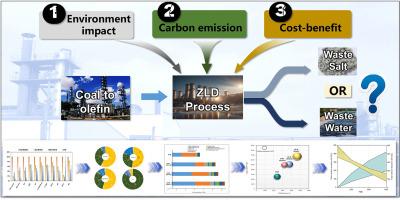
Due to limited water resources, zero liquid discharge is the environmental impact assessment admittance threshold for new coal chemical projects in China. However, it is unknown whether the application of zero liquid discharge technologies will actually change environmental impacts, carbon emissions, or costs. In this paper, a comprehensive evaluation model was developed to analyze unintended non-synergistic of pollution and carbon emissions and to perform a cost-benefit analysis of mainstream zero liquid discharge technologies. Two zero liquid discharge and two non-zero liquid discharge processes covering mainstream brine treatment technologies of coal chemical industry in China were compared. The results showed that some mainstream zero liquid discharge technologies had unintended consequences in terms of their environmental impact, carbon footprint, and cost. The high-salinity water treatment units using evaporative crystallization are key components during coal-to-olefin water treatment methods. Because energy-intensive equipment is used to evaporate water, the processes utilizing an evaporative crystallization unit incurred nearly two times the cost, with a 24.3 %–117.4 % increase in carbon footprint, compared to those not using the unit. The benefits of salt products such as sodium chloride obtained from the evaporation process are far lower than their costs and they generate salt-containing organic pollution, which increases the environmental risks. Due to carbon neutrality goals, zero liquid discharge technologies must solve the two major problems of waste salt generation and high energy consumption. Up to 196–423 kt of carbon emissions can be eliminated by 2050 by using green energy substitutes, technological innovation, and regent reduction. This provides a direction for the future development of zero liquid discharge technologies for coal chemical industry in water-scarce regions.
期刊介绍:
The Journal of Cleaner Production is an international, transdisciplinary journal that addresses and discusses theoretical and practical Cleaner Production, Environmental, and Sustainability issues. It aims to help societies become more sustainable by focusing on the concept of 'Cleaner Production', which aims at preventing waste production and increasing efficiencies in energy, water, resources, and human capital use. The journal serves as a platform for corporations, governments, education institutions, regions, and societies to engage in discussions and research related to Cleaner Production, environmental, and sustainability practices.




 京公网安备 11010802042870号
京ICP备2023020795号-1
京公网安备 11010802042870号
京ICP备2023020795号-1

 分享
分享
 求助内容:
求助内容: 应助结果提醒方式:
 扫码关注我们
