Preparation of an ammonia-responsive sensor based on bacterial cellulose film with enhanced AIE/ESIPT emission of fluorescent molecules bound to europium-based metal–organic framework
{"title":"Preparation of an ammonia-responsive sensor based on bacterial cellulose film with enhanced AIE/ESIPT emission of fluorescent molecules bound to europium-based metal–organic framework","authors":"Yanlan Ma, Yuehui Li, Tianran Huang, Xinyi Yang, Jichao Huang, Ming Huang","doi":"10.1016/j.cej.2025.163034","DOIUrl":null,"url":null,"abstract":"At present, selecting suitable fluorescent molecules to design low-cost, stable and sensitive ammonia response sensors is an important topic in the field of meat quality detection. In this work, a solid–liquid applicable ammonia-responsive fluorescent molecule (2-(benzo[<em>d</em>]thiazol-2-yl)-4-chlorophenol acetate, BTCP-Ac), was designed by enhancing the aggregation-induced emission (AIE)/excited state intramolecular proton transfer (ESIPT) luminescence properties of 2-(Benzo[<em>d</em>]thiazol-2-yl) phenol (HBT) molecules. BTCP-Ac combined the advantages of the red luminescence (colorimetric intrinsic parameter) and the confinement effect (enhanced aggregation of fluorescent molecules) of the metal–organic framework (Eu-MOF) to prepare fluorescent probes (BTCP-Ac@Eu-MOF). The sensor (BTCP-Ac@Eu-MOF film) was prepared using bacterial cellulose (BC) as a fluorescent probe loading platform. The sensor achieves specific detection of amines by “switching: the intramolecular proton transfer process of fluorescent molecules. The experimental results showed that the sensor reacted significantly with ammonia compared to BTCP-Ac (LOD = 2.24 ppm), with a low detection limit (LOD = 0.68 ppm) and stable luminescence (no decay for 30 d). The sensor with high temperature resistance and strong hydrophobicity (121.64°) successfully monitored the freshness of chicken meat, which changed color from red to blue-green and was easily visible to the consumer’s eye. This method encapsulates specially designed AIE molecules in a luminescent metal–organic framework to prepare ammonia-responsive sensors with selectivity, high sensitivity and stability, providing a novel and practical strategy for designing gas-responsive solid-state sensors.","PeriodicalId":270,"journal":{"name":"Chemical Engineering Journal","volume":"53 1","pages":""},"PeriodicalIF":13.2000,"publicationDate":"2025-04-23","publicationTypes":"Journal Article","fieldsOfStudy":null,"isOpenAccess":false,"openAccessPdf":"","citationCount":"0","resultStr":null,"platform":"Semanticscholar","paperid":null,"PeriodicalName":"Chemical Engineering Journal","FirstCategoryId":"5","ListUrlMain":"https://doi.org/10.1016/j.cej.2025.163034","RegionNum":1,"RegionCategory":"工程技术","ArticlePicture":[],"TitleCN":null,"AbstractTextCN":null,"PMCID":null,"EPubDate":"","PubModel":"","JCR":"Q1","JCRName":"ENGINEERING, CHEMICAL","Score":null,"Total":0}
引用次数: 0
Abstract
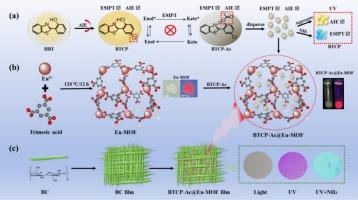
At present, selecting suitable fluorescent molecules to design low-cost, stable and sensitive ammonia response sensors is an important topic in the field of meat quality detection. In this work, a solid–liquid applicable ammonia-responsive fluorescent molecule (2-(benzo[d]thiazol-2-yl)-4-chlorophenol acetate, BTCP-Ac), was designed by enhancing the aggregation-induced emission (AIE)/excited state intramolecular proton transfer (ESIPT) luminescence properties of 2-(Benzo[d]thiazol-2-yl) phenol (HBT) molecules. BTCP-Ac combined the advantages of the red luminescence (colorimetric intrinsic parameter) and the confinement effect (enhanced aggregation of fluorescent molecules) of the metal–organic framework (Eu-MOF) to prepare fluorescent probes (BTCP-Ac@Eu-MOF). The sensor (BTCP-Ac@Eu-MOF film) was prepared using bacterial cellulose (BC) as a fluorescent probe loading platform. The sensor achieves specific detection of amines by “switching: the intramolecular proton transfer process of fluorescent molecules. The experimental results showed that the sensor reacted significantly with ammonia compared to BTCP-Ac (LOD = 2.24 ppm), with a low detection limit (LOD = 0.68 ppm) and stable luminescence (no decay for 30 d). The sensor with high temperature resistance and strong hydrophobicity (121.64°) successfully monitored the freshness of chicken meat, which changed color from red to blue-green and was easily visible to the consumer’s eye. This method encapsulates specially designed AIE molecules in a luminescent metal–organic framework to prepare ammonia-responsive sensors with selectivity, high sensitivity and stability, providing a novel and practical strategy for designing gas-responsive solid-state sensors.
期刊介绍:
The Chemical Engineering Journal is an international research journal that invites contributions of original and novel fundamental research. It aims to provide an international platform for presenting original fundamental research, interpretative reviews, and discussions on new developments in chemical engineering. The journal welcomes papers that describe novel theory and its practical application, as well as those that demonstrate the transfer of techniques from other disciplines. It also welcomes reports on carefully conducted experimental work that is soundly interpreted. The main focus of the journal is on original and rigorous research results that have broad significance. The Catalysis section within the Chemical Engineering Journal focuses specifically on Experimental and Theoretical studies in the fields of heterogeneous catalysis, molecular catalysis, and biocatalysis. These studies have industrial impact on various sectors such as chemicals, energy, materials, foods, healthcare, and environmental protection.



 京公网安备 11010802042870号
京ICP备2023020795号-1
京公网安备 11010802042870号
京ICP备2023020795号-1

 分享
分享
 求助内容:
求助内容: 应助结果提醒方式:
 扫码关注我们
