Xiaoming Wang, Zehua Huang, Mengge Li, Hongzheng Lu, Mengting Sun, Yuanmei Song, Xiaolin Wang, Huifang Li, Yan He, Fei Wang
{"title":"Re-evaluation of using carbon nanotubes as the kinetic promoters for methane hydrate formation","authors":"Xiaoming Wang, Zehua Huang, Mengge Li, Hongzheng Lu, Mengting Sun, Yuanmei Song, Xiaolin Wang, Huifang Li, Yan He, Fei Wang","doi":"10.1016/j.cej.2025.162937","DOIUrl":null,"url":null,"abstract":"The use of carbon nanotubes (CNTs) to enhance methane hydrate formation for energy storage has garnered attention. However, their promotion efficiency remains inferior to that of traditional promoters (<em>e.g.</em>, surfactants), highlighting the necessity of re-evaluation on the feasibility of CNTs as effective promoters for methane hydrate formation. Here, the promotion of CNTs to methane hydrate formation was comprehensively evaluated via both experimental and simulation methods, with the scales from macro to micro and status from suspension, to serum and water-saturated powder. It was revealed for the first time that there was a contradiction between the CNTs status and the promotion efficiency in different periods (nucleation and growth). With the increase in CNTs concentration, transitioning from suspension to serum and water-saturated powder, the enhancement of hydrate nucleation was attributed to the increase in nucleation sites within the liquid phase. The initial stage of hydrate formation was significantly shortened, dropping from 148 min to 14 min, and nearly to 0 min. However, the promotion of hydrate growth was reduced, as the final methane storage capacity decreased from 141 to 132 and then to 90 v/v. This reduction was due to the high dosage of CNTs, which adsorbed water and hindered its migration during the hydrate growth period. Regarding the inner cavity of CNTs, molecular simulations confirmed that methane hydrates could not form in this special space, indicating that pristine CNTs have limited potential as standalone methane hydrate promoters. Therefore, promising research directions may include the combination of CNTs with other promoters, the functionalization of CNT surfaces with active groups, the synergistic enhancement of heat and mass transfer in CNT-based fluids, and the application of CNTs in the industrialization of hydrate-based technologies.","PeriodicalId":270,"journal":{"name":"Chemical Engineering Journal","volume":"40 1","pages":""},"PeriodicalIF":13.2000,"publicationDate":"2025-04-23","publicationTypes":"Journal Article","fieldsOfStudy":null,"isOpenAccess":false,"openAccessPdf":"","citationCount":"0","resultStr":null,"platform":"Semanticscholar","paperid":null,"PeriodicalName":"Chemical Engineering Journal","FirstCategoryId":"5","ListUrlMain":"https://doi.org/10.1016/j.cej.2025.162937","RegionNum":1,"RegionCategory":"工程技术","ArticlePicture":[],"TitleCN":null,"AbstractTextCN":null,"PMCID":null,"EPubDate":"","PubModel":"","JCR":"Q1","JCRName":"ENGINEERING, CHEMICAL","Score":null,"Total":0}
引用次数: 0
Abstract
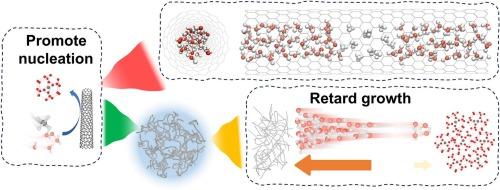
The use of carbon nanotubes (CNTs) to enhance methane hydrate formation for energy storage has garnered attention. However, their promotion efficiency remains inferior to that of traditional promoters (e.g., surfactants), highlighting the necessity of re-evaluation on the feasibility of CNTs as effective promoters for methane hydrate formation. Here, the promotion of CNTs to methane hydrate formation was comprehensively evaluated via both experimental and simulation methods, with the scales from macro to micro and status from suspension, to serum and water-saturated powder. It was revealed for the first time that there was a contradiction between the CNTs status and the promotion efficiency in different periods (nucleation and growth). With the increase in CNTs concentration, transitioning from suspension to serum and water-saturated powder, the enhancement of hydrate nucleation was attributed to the increase in nucleation sites within the liquid phase. The initial stage of hydrate formation was significantly shortened, dropping from 148 min to 14 min, and nearly to 0 min. However, the promotion of hydrate growth was reduced, as the final methane storage capacity decreased from 141 to 132 and then to 90 v/v. This reduction was due to the high dosage of CNTs, which adsorbed water and hindered its migration during the hydrate growth period. Regarding the inner cavity of CNTs, molecular simulations confirmed that methane hydrates could not form in this special space, indicating that pristine CNTs have limited potential as standalone methane hydrate promoters. Therefore, promising research directions may include the combination of CNTs with other promoters, the functionalization of CNT surfaces with active groups, the synergistic enhancement of heat and mass transfer in CNT-based fluids, and the application of CNTs in the industrialization of hydrate-based technologies.
期刊介绍:
The Chemical Engineering Journal is an international research journal that invites contributions of original and novel fundamental research. It aims to provide an international platform for presenting original fundamental research, interpretative reviews, and discussions on new developments in chemical engineering. The journal welcomes papers that describe novel theory and its practical application, as well as those that demonstrate the transfer of techniques from other disciplines. It also welcomes reports on carefully conducted experimental work that is soundly interpreted. The main focus of the journal is on original and rigorous research results that have broad significance. The Catalysis section within the Chemical Engineering Journal focuses specifically on Experimental and Theoretical studies in the fields of heterogeneous catalysis, molecular catalysis, and biocatalysis. These studies have industrial impact on various sectors such as chemicals, energy, materials, foods, healthcare, and environmental protection.



 京公网安备 11010802042870号
京ICP备2023020795号-1
京公网安备 11010802042870号
京ICP备2023020795号-1

 分享
分享
 求助内容:
求助内容: 应助结果提醒方式:
 扫码关注我们
