Jennifer Hoponick Redmon, Nicole M. DeLuca, Evan Thorp, Chamindu Liyanapatirana, Laura Allen, Andrew J. Kondash
{"title":"Hold My Beer: The Linkage between Municipal Water and Brewing Location on PFAS in Popular Beverages","authors":"Jennifer Hoponick Redmon, Nicole M. DeLuca, Evan Thorp, Chamindu Liyanapatirana, Laura Allen, Andrew J. Kondash","doi":"10.1021/acs.est.4c11265","DOIUrl":null,"url":null,"abstract":"Beer has been a popular beverage for millennia. As water is a main component of beer and the brewing process, we surmised that the polyfluoroalkyl substances (PFAS) presence and spatial variability in drinking water systems are a PFAS source in beers. This is the first study to adapt EPA Method 533 to measure PFAS in beer from various regions, brewery types, and water sources. Statistical analyses were conducted to correlate PFAS in state-reported drinking water, and beers were analyzed by brewing location. PFAS were detected in most beers, particularly from smaller scale breweries located near drinking water sources with known PFAS. Perfluorosulfonic acids, particularly PFOS, were frequently detected, with PFOA or PFOS above U.S. EPA’s Maximum Contaminant Limits in some beers. There was also a county–level correlation between the total PFAS, PFOA, and PFBS concentrations in drinking water and beers. Given that approximately 18% of U.S. breweries are located within zip codes with detectable PFAS in municipal drinking water, our findings, which link PFAS in beer to the brewery water source, are intended to help inform data-driven policies on PFAS in beverages for governmental agencies, provide insights for brewers and water utilities on treatment needs, and support informed decision-making for consumers.","PeriodicalId":36,"journal":{"name":"环境科学与技术","volume":"35 1","pages":""},"PeriodicalIF":11.3000,"publicationDate":"2025-04-24","publicationTypes":"Journal Article","fieldsOfStudy":null,"isOpenAccess":false,"openAccessPdf":"","citationCount":"0","resultStr":null,"platform":"Semanticscholar","paperid":null,"PeriodicalName":"环境科学与技术","FirstCategoryId":"1","ListUrlMain":"https://doi.org/10.1021/acs.est.4c11265","RegionNum":1,"RegionCategory":"环境科学与生态学","ArticlePicture":[],"TitleCN":null,"AbstractTextCN":null,"PMCID":null,"EPubDate":"","PubModel":"","JCR":"Q1","JCRName":"ENGINEERING, ENVIRONMENTAL","Score":null,"Total":0}
引用次数: 0
Abstract
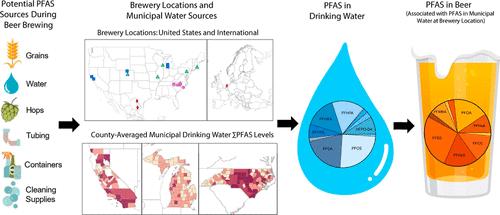
Beer has been a popular beverage for millennia. As water is a main component of beer and the brewing process, we surmised that the polyfluoroalkyl substances (PFAS) presence and spatial variability in drinking water systems are a PFAS source in beers. This is the first study to adapt EPA Method 533 to measure PFAS in beer from various regions, brewery types, and water sources. Statistical analyses were conducted to correlate PFAS in state-reported drinking water, and beers were analyzed by brewing location. PFAS were detected in most beers, particularly from smaller scale breweries located near drinking water sources with known PFAS. Perfluorosulfonic acids, particularly PFOS, were frequently detected, with PFOA or PFOS above U.S. EPA’s Maximum Contaminant Limits in some beers. There was also a county–level correlation between the total PFAS, PFOA, and PFBS concentrations in drinking water and beers. Given that approximately 18% of U.S. breweries are located within zip codes with detectable PFAS in municipal drinking water, our findings, which link PFAS in beer to the brewery water source, are intended to help inform data-driven policies on PFAS in beverages for governmental agencies, provide insights for brewers and water utilities on treatment needs, and support informed decision-making for consumers.
期刊介绍:
Environmental Science & Technology (ES&T) is a co-sponsored academic and technical magazine by the Hubei Provincial Environmental Protection Bureau and the Hubei Provincial Academy of Environmental Sciences.
Environmental Science & Technology (ES&T) holds the status of Chinese core journals, scientific papers source journals of China, Chinese Science Citation Database source journals, and Chinese Academic Journal Comprehensive Evaluation Database source journals. This publication focuses on the academic field of environmental protection, featuring articles related to environmental protection and technical advancements.



 京公网安备 11010802042870号
京ICP备2023020795号-1
京公网安备 11010802042870号
京ICP备2023020795号-1

 分享
分享
 求助内容:
求助内容: 应助结果提醒方式:
 扫码关注我们
