Guang-Ping Yi , Hong Liu , Yi-Ping Zhao , Tiger H. Tao , Qiang Wang , Peng-Yi Tang
{"title":"Revealing the new role of surface states in interfacial charge transfer at zinc ferrite photoanodes for efficient photoelectrochemical water splitting","authors":"Guang-Ping Yi , Hong Liu , Yi-Ping Zhao , Tiger H. Tao , Qiang Wang , Peng-Yi Tang","doi":"10.1016/j.nanoen.2025.111066","DOIUrl":null,"url":null,"abstract":"<div><div>Surface states (SS) as the charge trapping sites play an extremely important role in designing high-performance photoelectrodes, which are generally thought to cause adverse surface charge recombination for zinc ferrite (ZnFe<sub>2</sub>O<sub>4</sub>, ZFO) photoanodes. However, the in-depth understanding of the relationship between SS and photoelectrochemical performance is still ambiguous. Herein, the modification of SS energy level and density at ZFO photoanodes was achieved via surface NaBH<sub>4</sub> chemical reduction and NiFeOOH co-catalysts loading. Combined with advanced spectroelectrochemical techniques, a new type of SS was discovered. Specifically, after optimizing surface structures of ZFO photoanodes via the surface modification, the SS would transform from the traditional intrinsic SS as the unfavorable recombination center to the non-intrinsic SS as the beneficial “charge storage station”, allowing for an impressively steep increase in the surface charge transfer efficiency and achieving a record high photocurrent of 1.70 mA/cm<sup>2</sup> at 1.50 V<sub>RHE</sub>. This work presents comprehensive analysis about the controversial role of ZFO photoanodes’ SS and establishes the detailed response laws between SS and PEC water splitting performance. It is expected to guide future photoelectrode design via surface modification strategies.</div></div>","PeriodicalId":394,"journal":{"name":"Nano Energy","volume":"140 ","pages":"Article 111066"},"PeriodicalIF":17.1000,"publicationDate":"2025-07-01","publicationTypes":"Journal Article","fieldsOfStudy":null,"isOpenAccess":false,"openAccessPdf":"","citationCount":"0","resultStr":null,"platform":"Semanticscholar","paperid":null,"PeriodicalName":"Nano Energy","FirstCategoryId":"88","ListUrlMain":"https://www.sciencedirect.com/science/article/pii/S2211285525004252","RegionNum":1,"RegionCategory":"材料科学","ArticlePicture":[],"TitleCN":null,"AbstractTextCN":null,"PMCID":null,"EPubDate":"2025/4/24 0:00:00","PubModel":"Epub","JCR":"Q1","JCRName":"CHEMISTRY, PHYSICAL","Score":null,"Total":0}
引用次数: 0
Abstract
Surface states (SS) as the charge trapping sites play an extremely important role in designing high-performance photoelectrodes, which are generally thought to cause adverse surface charge recombination for zinc ferrite (ZnFe2O4, ZFO) photoanodes. However, the in-depth understanding of the relationship between SS and photoelectrochemical performance is still ambiguous. Herein, the modification of SS energy level and density at ZFO photoanodes was achieved via surface NaBH4 chemical reduction and NiFeOOH co-catalysts loading. Combined with advanced spectroelectrochemical techniques, a new type of SS was discovered. Specifically, after optimizing surface structures of ZFO photoanodes via the surface modification, the SS would transform from the traditional intrinsic SS as the unfavorable recombination center to the non-intrinsic SS as the beneficial “charge storage station”, allowing for an impressively steep increase in the surface charge transfer efficiency and achieving a record high photocurrent of 1.70 mA/cm2 at 1.50 VRHE. This work presents comprehensive analysis about the controversial role of ZFO photoanodes’ SS and establishes the detailed response laws between SS and PEC water splitting performance. It is expected to guide future photoelectrode design via surface modification strategies.
期刊介绍:
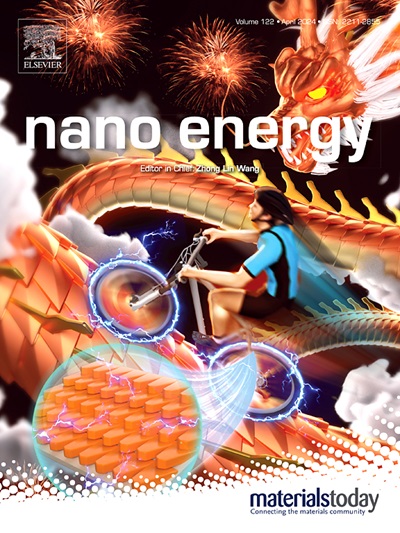
Nano Energy is a multidisciplinary, rapid-publication forum of original peer-reviewed contributions on the science and engineering of nanomaterials and nanodevices used in all forms of energy harvesting, conversion, storage, utilization and policy. Through its mixture of articles, reviews, communications, research news, and information on key developments, Nano Energy provides a comprehensive coverage of this exciting and dynamic field which joins nanoscience and nanotechnology with energy science. The journal is relevant to all those who are interested in nanomaterials solutions to the energy problem.
Nano Energy publishes original experimental and theoretical research on all aspects of energy-related research which utilizes nanomaterials and nanotechnology. Manuscripts of four types are considered: review articles which inform readers of the latest research and advances in energy science; rapid communications which feature exciting research breakthroughs in the field; full-length articles which report comprehensive research developments; and news and opinions which comment on topical issues or express views on the developments in related fields.




 京公网安备 11010802042870号
京ICP备2023020795号-1
京公网安备 11010802042870号
京ICP备2023020795号-1

 分享
分享
 求助内容:
求助内容: 应助结果提醒方式:
 扫码关注我们
