Zhichao Yu, Lun Li, Keyu An, Hongling Liu, Xingshuai Lv, Weng Fai Ip, Hui Pan
{"title":"Inverted Trends of the Brønsted–Evans–Polanyi Relation in N2 Dissociation Originated from a Bonding-Dependent Adsorption Mechanism","authors":"Zhichao Yu, Lun Li, Keyu An, Hongling Liu, Xingshuai Lv, Weng Fai Ip, Hui Pan","doi":"10.1021/acsami.4c21214","DOIUrl":null,"url":null,"abstract":"The search for efficient Haber–Bosch catalysts toward ammonia production under mild conditions is never-ending, which is greatly limited by the Brønsted–Evans–Polanyi (BEP) relationship. Great efforts have been put into optimizing the BEP relations and achieving the Sabatier optimum, which requires a balance between the dissociation and hydrogenation of nitrogen. However, challenges in this field inspire us to believe that completely breaking the linear BEP relations is indeed the final target although out of sight in such a holy grail reaction. Here, based on the first-principles calculations, we discover inverted trends of BEP relation of N<sub>2</sub> dissociation to approach the kinetic optimum of ammonia synthesis on Fe-based single-atom alloys. It is found that the adsorption characteristic of N–N transition states follows the 10-electron count rule, while that of the final states mimics the d-band model, which accounts for the inversion. Crystal orbital Hamiltonian populations (COHP) and Bader charge analysis further corroborate that a bonding-dependent adsorption mechanism lies at the root of the inverted trends of the BEP relation. Our finding not only paves the way for the milder Haber–Bosch process but also promotes explorations of breaking the linear BEP relations of the critical steps in various chemical reactions.","PeriodicalId":5,"journal":{"name":"ACS Applied Materials & Interfaces","volume":"261 1","pages":""},"PeriodicalIF":8.2000,"publicationDate":"2025-04-24","publicationTypes":"Journal Article","fieldsOfStudy":null,"isOpenAccess":false,"openAccessPdf":"","citationCount":"0","resultStr":null,"platform":"Semanticscholar","paperid":null,"PeriodicalName":"ACS Applied Materials & Interfaces","FirstCategoryId":"88","ListUrlMain":"https://doi.org/10.1021/acsami.4c21214","RegionNum":2,"RegionCategory":"材料科学","ArticlePicture":[],"TitleCN":null,"AbstractTextCN":null,"PMCID":null,"EPubDate":"","PubModel":"","JCR":"Q1","JCRName":"MATERIALS SCIENCE, MULTIDISCIPLINARY","Score":null,"Total":0}
引用次数: 0
Abstract
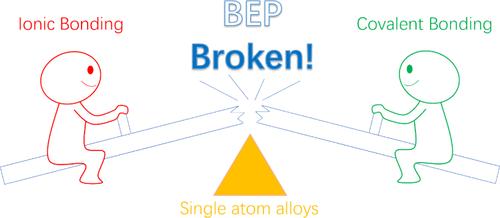
The search for efficient Haber–Bosch catalysts toward ammonia production under mild conditions is never-ending, which is greatly limited by the Brønsted–Evans–Polanyi (BEP) relationship. Great efforts have been put into optimizing the BEP relations and achieving the Sabatier optimum, which requires a balance between the dissociation and hydrogenation of nitrogen. However, challenges in this field inspire us to believe that completely breaking the linear BEP relations is indeed the final target although out of sight in such a holy grail reaction. Here, based on the first-principles calculations, we discover inverted trends of BEP relation of N2 dissociation to approach the kinetic optimum of ammonia synthesis on Fe-based single-atom alloys. It is found that the adsorption characteristic of N–N transition states follows the 10-electron count rule, while that of the final states mimics the d-band model, which accounts for the inversion. Crystal orbital Hamiltonian populations (COHP) and Bader charge analysis further corroborate that a bonding-dependent adsorption mechanism lies at the root of the inverted trends of the BEP relation. Our finding not only paves the way for the milder Haber–Bosch process but also promotes explorations of breaking the linear BEP relations of the critical steps in various chemical reactions.
期刊介绍:
ACS Applied Materials & Interfaces is a leading interdisciplinary journal that brings together chemists, engineers, physicists, and biologists to explore the development and utilization of newly-discovered materials and interfacial processes for specific applications. Our journal has experienced remarkable growth since its establishment in 2009, both in terms of the number of articles published and the impact of the research showcased. We are proud to foster a truly global community, with the majority of published articles originating from outside the United States, reflecting the rapid growth of applied research worldwide.



 京公网安备 11010802042870号
京ICP备2023020795号-1
京公网安备 11010802042870号
京ICP备2023020795号-1

 分享
分享
 求助内容:
求助内容: 应助结果提醒方式:
 扫码关注我们
