Xiaoyu Huang, Luyao Sun, Xianjin Tang and Yanyan Gong
{"title":"Structure-dependent mercury sequestration and microbial methylation mediated by FeS nanoparticles in contaminated groundwater†","authors":"Xiaoyu Huang, Luyao Sun, Xianjin Tang and Yanyan Gong","doi":"10.1039/D5EN00212E","DOIUrl":null,"url":null,"abstract":"<p >Iron sulfide nanoparticles (CMC-FeS) have demonstrated great potential for selective and effective <em>in situ</em> mercury (Hg) immobilization in soil and groundwater through sorption, coprecipitation, or precipitation. Yet, the relative contributions of these immobilization mechanisms on Hg removal and their impacts on microbial mercury methylation in groundwater remain unknown. Here, we revealed that the Hg removal efficiency is ranked sorption (82.2%) > coprecipitation (75.2%) > chemical precipitation (22.3%). Conversely, the net MeHg production exhibited an inverse trend: sorption (46.73 nM) < coprecipitation (50.67 nM) < chemical precipitation (59.82 nM). Other than dissolved Hg(<small>II</small>), the particulate Hg species including sorbed (Hg-CMC-FeS<small><sub>sorp</sub></small>), coprecipitated (Hg-CMC-FeS<small><sub>cpt</sub></small>), and precipitated (Hg-CMC-FeS<small><sub>pre</sub></small>) were bioavailable to <em>Geobacter sulfurreducens</em> PCA and contributed to MeHg production following the order dissolved Hg(<small>II</small>) > Hg-CMC-FeS<small><sub>cpt</sub></small> > Hg-CMC-FeS<small><sub>sorp</sub></small> > Hg-CMC-FeS<small><sub>pre</sub></small>. Particulate Hg effectively prevented the microbial reduction of Hg(<small>II</small>) and thus, the production of Hg(0) during Hg methylation. Methylation potential of particulate Hg was probably correlated with the Hg–S coordination configuration. Hg-CMC-FeS<small><sub>sorp</sub></small> and Hg-CMC-FeS<small><sub>pre</sub></small> displayed tetrahedral Hg–S<small><sub>4</sub></small> coordination whereas Hg-CMC-FeS<small><sub>cpt</sub></small> exhibited linear Hg–S<small><sub>2</sub></small> coordination. MeHg production correlated linearly with Hg removal efficiency, and the produced MeHg can be predicted based on the known Hg removal performance. The findings highlight the paramount role of Hg speciation and coordination chemistry in controlling microbial methylation and provided a mechanistic basis for developing next-generation Hg sorbents through structural modulation to achieve enhanced Hg immobilization and inhibited bioavailability.</p>","PeriodicalId":73,"journal":{"name":"Environmental Science: Nano","volume":" 6","pages":" 3072-3081"},"PeriodicalIF":5.1000,"publicationDate":"2025-04-23","publicationTypes":"Journal Article","fieldsOfStudy":null,"isOpenAccess":false,"openAccessPdf":"","citationCount":"0","resultStr":null,"platform":"Semanticscholar","paperid":null,"PeriodicalName":"Environmental Science: Nano","FirstCategoryId":"6","ListUrlMain":"https://pubs.rsc.org/en/content/articlelanding/2025/en/d5en00212e","RegionNum":2,"RegionCategory":"环境科学与生态学","ArticlePicture":[],"TitleCN":null,"AbstractTextCN":null,"PMCID":null,"EPubDate":"","PubModel":"","JCR":"Q1","JCRName":"CHEMISTRY, MULTIDISCIPLINARY","Score":null,"Total":0}
引用次数: 0
Abstract
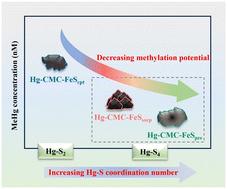
Iron sulfide nanoparticles (CMC-FeS) have demonstrated great potential for selective and effective in situ mercury (Hg) immobilization in soil and groundwater through sorption, coprecipitation, or precipitation. Yet, the relative contributions of these immobilization mechanisms on Hg removal and their impacts on microbial mercury methylation in groundwater remain unknown. Here, we revealed that the Hg removal efficiency is ranked sorption (82.2%) > coprecipitation (75.2%) > chemical precipitation (22.3%). Conversely, the net MeHg production exhibited an inverse trend: sorption (46.73 nM) < coprecipitation (50.67 nM) < chemical precipitation (59.82 nM). Other than dissolved Hg(II), the particulate Hg species including sorbed (Hg-CMC-FeSsorp), coprecipitated (Hg-CMC-FeScpt), and precipitated (Hg-CMC-FeSpre) were bioavailable to Geobacter sulfurreducens PCA and contributed to MeHg production following the order dissolved Hg(II) > Hg-CMC-FeScpt > Hg-CMC-FeSsorp > Hg-CMC-FeSpre. Particulate Hg effectively prevented the microbial reduction of Hg(II) and thus, the production of Hg(0) during Hg methylation. Methylation potential of particulate Hg was probably correlated with the Hg–S coordination configuration. Hg-CMC-FeSsorp and Hg-CMC-FeSpre displayed tetrahedral Hg–S4 coordination whereas Hg-CMC-FeScpt exhibited linear Hg–S2 coordination. MeHg production correlated linearly with Hg removal efficiency, and the produced MeHg can be predicted based on the known Hg removal performance. The findings highlight the paramount role of Hg speciation and coordination chemistry in controlling microbial methylation and provided a mechanistic basis for developing next-generation Hg sorbents through structural modulation to achieve enhanced Hg immobilization and inhibited bioavailability.
期刊介绍:
Environmental Science: Nano serves as a comprehensive and high-impact peer-reviewed source of information on the design and demonstration of engineered nanomaterials for environment-based applications. It also covers the interactions between engineered, natural, and incidental nanomaterials with biological and environmental systems. This scope includes, but is not limited to, the following topic areas:
Novel nanomaterial-based applications for water, air, soil, food, and energy sustainability
Nanomaterial interactions with biological systems and nanotoxicology
Environmental fate, reactivity, and transformations of nanoscale materials
Nanoscale processes in the environment
Sustainable nanotechnology including rational nanomaterial design, life cycle assessment, risk/benefit analysis



 京公网安备 11010802042870号
京ICP备2023020795号-1
京公网安备 11010802042870号
京ICP备2023020795号-1

 分享
分享
 求助内容:
求助内容: 应助结果提醒方式:
 扫码关注我们
