Jeonguk Hwang, Seong Hwan Lee, Jinsu Kim, Geonho Lee, Jinwoo Park, Yunseok Choi, Jinhoon Lee, Jin Hong Lee, Jae Ryung Choi, Cheol-Min Yang, Il Jin Kim, Bo-In Park, Shu Yang, Seung-Yeol Jeon, Dong Woog Lee, Seunggun Yu
{"title":"Mechanophysical Synthesis of Core/Shell Hybrid Supraparticles","authors":"Jeonguk Hwang, Seong Hwan Lee, Jinsu Kim, Geonho Lee, Jinwoo Park, Yunseok Choi, Jinhoon Lee, Jin Hong Lee, Jae Ryung Choi, Cheol-Min Yang, Il Jin Kim, Bo-In Park, Shu Yang, Seung-Yeol Jeon, Dong Woog Lee, Seunggun Yu","doi":"10.1002/adma.202502718","DOIUrl":null,"url":null,"abstract":"<p>Surface modification of polymer microparticles (MPs) is often essential to impart functionalities beyond their inherent properties. However, decorating these surfaces typically requires complex, multi-step wet chemistry processes to direct assembly and bonding between surfaces, which are not only challenging to control and scale up but also pose significant environmental concerns. Inspired by asteroid impact events, assembly of core/shell hybrid supraparticles (HSPs) is demonstrated via collision-driven, one-step dry mixing of inorganic nanoparticles (NPs) and polymer MPs with a significant contrast in elastic moduli— a process termed “mechanophysical synthesis.” Through the interplay of interfacial energy and collision energy, NPs are stably embedded onto the MP surface. The degree of surface coverage depends on mixing velocity and duration, aligning with results from particle collision simulations. HSPs can be created from a diverse combination of MPs and NPs, regardless of their shapes or chemistry. Furthermore, different types of functional NPs—such as magnetic, photocatalytic, and ion-adsorptive—can be simultaneously introduced onto the MPs. The resulting HSPs can not only remove toxic water pollutants, but also be easily recovered and reused. The mechanophysical synthesis approach opens a new direction for sustainable and versatile self-assembly of heterogeneous MPs, minimizing the use of excessive chemicals and solvents.</p>","PeriodicalId":114,"journal":{"name":"Advanced Materials","volume":"37 28","pages":""},"PeriodicalIF":26.8000,"publicationDate":"2025-04-24","publicationTypes":"Journal Article","fieldsOfStudy":null,"isOpenAccess":false,"openAccessPdf":"https://onlinelibrary.wiley.com/doi/epdf/10.1002/adma.202502718","citationCount":"0","resultStr":null,"platform":"Semanticscholar","paperid":null,"PeriodicalName":"Advanced Materials","FirstCategoryId":"88","ListUrlMain":"https://advanced.onlinelibrary.wiley.com/doi/10.1002/adma.202502718","RegionNum":1,"RegionCategory":"材料科学","ArticlePicture":[],"TitleCN":null,"AbstractTextCN":null,"PMCID":null,"EPubDate":"","PubModel":"","JCR":"Q1","JCRName":"CHEMISTRY, MULTIDISCIPLINARY","Score":null,"Total":0}
引用次数: 0
Abstract
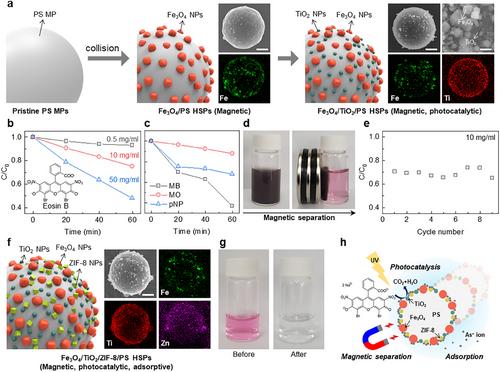
Surface modification of polymer microparticles (MPs) is often essential to impart functionalities beyond their inherent properties. However, decorating these surfaces typically requires complex, multi-step wet chemistry processes to direct assembly and bonding between surfaces, which are not only challenging to control and scale up but also pose significant environmental concerns. Inspired by asteroid impact events, assembly of core/shell hybrid supraparticles (HSPs) is demonstrated via collision-driven, one-step dry mixing of inorganic nanoparticles (NPs) and polymer MPs with a significant contrast in elastic moduli— a process termed “mechanophysical synthesis.” Through the interplay of interfacial energy and collision energy, NPs are stably embedded onto the MP surface. The degree of surface coverage depends on mixing velocity and duration, aligning with results from particle collision simulations. HSPs can be created from a diverse combination of MPs and NPs, regardless of their shapes or chemistry. Furthermore, different types of functional NPs—such as magnetic, photocatalytic, and ion-adsorptive—can be simultaneously introduced onto the MPs. The resulting HSPs can not only remove toxic water pollutants, but also be easily recovered and reused. The mechanophysical synthesis approach opens a new direction for sustainable and versatile self-assembly of heterogeneous MPs, minimizing the use of excessive chemicals and solvents.
期刊介绍:
Advanced Materials, one of the world's most prestigious journals and the foundation of the Advanced portfolio, is the home of choice for best-in-class materials science for more than 30 years. Following this fast-growing and interdisciplinary field, we are considering and publishing the most important discoveries on any and all materials from materials scientists, chemists, physicists, engineers as well as health and life scientists and bringing you the latest results and trends in modern materials-related research every week.





 京公网安备 11010802042870号
京ICP备2023020795号-1
京公网安备 11010802042870号
京ICP备2023020795号-1

 分享
分享
 求助内容:
求助内容: 应助结果提醒方式:
 扫码关注我们
