{"title":"Bimetallic nanozymes with robust antibacterial effects for infected wound healing through diverse metal-precise regulation strategies","authors":"Ziyi Li, Xiaolong Zhu, Jiamu Xiao, Wei Lu, Donglin Gan, Jian Shen, Xuefeng Jiang, Mingqian Wang","doi":"10.1016/j.cej.2025.163016","DOIUrl":null,"url":null,"abstract":"The misuse of antibiotics exacerbates the problems of bacterial resistance, rendering antibiotic treatment ineffective and, in severe cases, posing life-threatening risks. Therefore, the development of novel antimicrobial materials and their clinical applications have garnered significant attention from healthcare professionals. Bimetallic nanozymes hold significant potential for treating clinical bacterial infections, owing to their superior antimicrobial activity and excellent biocompatibility. In this study, PdZn and PdCu bimetallic nanozymes with folded structures were synthesized using a one-step hydrothermal method. Their photothermal and peroxidase-like catalytic activities were compared, and the underlying causes of the variations in their catalytic performance were analyzed through computational studies. Additionally, the antimicrobial efficacy and wound-healing potential of these two nanozymes were evaluated. Experimental results demonstrated that PdCu exhibited superior catalytic performance compared to PdZn, which aligned with density functional theory calculations confirming its enhanced catalytic ability. <em>In vitro</em> antimicrobial experiments have successfully demonstrated that PdZn and PdCu can effectively inhibit the survival of <em>Escherichia coli</em> and <em>Staphylococcus aureus</em> down to less than 2 % by utilising the synergistic effect of photo-thermal catalysis at 980 nm near-infrared laser. Antibacterial experiments <em>in vivo</em> demonstrated that PdZn and PdCu nanozymes could promote wound healing and slow down the inflammatory response. PdCu exhibited a superior ability to promote wound healing compared with PdZn. PdCu + H<sub>2</sub>O<sub>2</sub> + NIR and PdZn + H<sub>2</sub>O<sub>2</sub> + NIR decreased the trauma area to 9.37 % and 6.04 % respectively, whereas the control group decreased it to only 41.21 %. Overall, this study further explores the potential of Pd-based nanozymes for biological applications and provides guidance for the synthesis of highly efficient Pd-based 2D nanobiomaterials.","PeriodicalId":270,"journal":{"name":"Chemical Engineering Journal","volume":"71 1","pages":""},"PeriodicalIF":13.2000,"publicationDate":"2025-04-23","publicationTypes":"Journal Article","fieldsOfStudy":null,"isOpenAccess":false,"openAccessPdf":"","citationCount":"0","resultStr":null,"platform":"Semanticscholar","paperid":null,"PeriodicalName":"Chemical Engineering Journal","FirstCategoryId":"5","ListUrlMain":"https://doi.org/10.1016/j.cej.2025.163016","RegionNum":1,"RegionCategory":"工程技术","ArticlePicture":[],"TitleCN":null,"AbstractTextCN":null,"PMCID":null,"EPubDate":"","PubModel":"","JCR":"Q1","JCRName":"ENGINEERING, CHEMICAL","Score":null,"Total":0}
引用次数: 0
Abstract
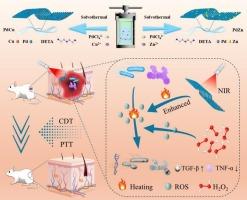
The misuse of antibiotics exacerbates the problems of bacterial resistance, rendering antibiotic treatment ineffective and, in severe cases, posing life-threatening risks. Therefore, the development of novel antimicrobial materials and their clinical applications have garnered significant attention from healthcare professionals. Bimetallic nanozymes hold significant potential for treating clinical bacterial infections, owing to their superior antimicrobial activity and excellent biocompatibility. In this study, PdZn and PdCu bimetallic nanozymes with folded structures were synthesized using a one-step hydrothermal method. Their photothermal and peroxidase-like catalytic activities were compared, and the underlying causes of the variations in their catalytic performance were analyzed through computational studies. Additionally, the antimicrobial efficacy and wound-healing potential of these two nanozymes were evaluated. Experimental results demonstrated that PdCu exhibited superior catalytic performance compared to PdZn, which aligned with density functional theory calculations confirming its enhanced catalytic ability. In vitro antimicrobial experiments have successfully demonstrated that PdZn and PdCu can effectively inhibit the survival of Escherichia coli and Staphylococcus aureus down to less than 2 % by utilising the synergistic effect of photo-thermal catalysis at 980 nm near-infrared laser. Antibacterial experiments in vivo demonstrated that PdZn and PdCu nanozymes could promote wound healing and slow down the inflammatory response. PdCu exhibited a superior ability to promote wound healing compared with PdZn. PdCu + H2O2 + NIR and PdZn + H2O2 + NIR decreased the trauma area to 9.37 % and 6.04 % respectively, whereas the control group decreased it to only 41.21 %. Overall, this study further explores the potential of Pd-based nanozymes for biological applications and provides guidance for the synthesis of highly efficient Pd-based 2D nanobiomaterials.
期刊介绍:
The Chemical Engineering Journal is an international research journal that invites contributions of original and novel fundamental research. It aims to provide an international platform for presenting original fundamental research, interpretative reviews, and discussions on new developments in chemical engineering. The journal welcomes papers that describe novel theory and its practical application, as well as those that demonstrate the transfer of techniques from other disciplines. It also welcomes reports on carefully conducted experimental work that is soundly interpreted. The main focus of the journal is on original and rigorous research results that have broad significance. The Catalysis section within the Chemical Engineering Journal focuses specifically on Experimental and Theoretical studies in the fields of heterogeneous catalysis, molecular catalysis, and biocatalysis. These studies have industrial impact on various sectors such as chemicals, energy, materials, foods, healthcare, and environmental protection.



 京公网安备 11010802042870号
京ICP备2023020795号-1
京公网安备 11010802042870号
京ICP备2023020795号-1

 分享
分享
 求助内容:
求助内容: 应助结果提醒方式:
 扫码关注我们
