{"title":"Mass transfer analysis of a concentration-regulated metal-assisted chemical etching system and its application in Si nanohole fabrication","authors":"Jiecai Long, Xuan Zhang, Haojun Zhang, Haoya Wang, Congkai Xie, Xun Chen, Guohuai Lin, Yun Chen, Xin Chen, Huitao Liu, Renquan Lu","doi":"10.1016/j.cej.2025.162997","DOIUrl":null,"url":null,"abstract":"This study aims to characterize the mass transfer characteristics of a novel concentration-regulated metal-assisted chemical etching (MACE) system and investigate its application in the controllable fabrication of ∼ 600 nm diameter silicon (Si) nanohole arrays. A concentration-regulated MACE system for Si nanohole etching is established, and the CFD simulations of fluid flow, mass fraction evolution, and mass transfer are conducted. Results reveal that the mass fraction distributions from simulations and experiments are in good agreement. As the inlet velocity increases, the average velocity and vorticity significantly increase, the mass fraction approaches the target concentration more quickly, and the mass transfer coefficient increases by 1.51 to 6.72 times compared to conventional MACE. The concentration-regulated MACE system with a fine pore array demonstrates good concentration regulation performance due to its stable mass fraction evolution process, minimal standard deviation of mass fraction, and uniform mass transfer coefficient. Utilizing the concentration-regulated MACE system, the etching rate of Si nanoholes increases by approximately 27.78 % under mass transfer enhancement, and large-area, uniform, high aspect ratio, and controllable tortuous Si nanohole arrays are successfully fabricated for the first time.","PeriodicalId":270,"journal":{"name":"Chemical Engineering Journal","volume":"70 1","pages":""},"PeriodicalIF":13.2000,"publicationDate":"2025-04-23","publicationTypes":"Journal Article","fieldsOfStudy":null,"isOpenAccess":false,"openAccessPdf":"","citationCount":"0","resultStr":null,"platform":"Semanticscholar","paperid":null,"PeriodicalName":"Chemical Engineering Journal","FirstCategoryId":"5","ListUrlMain":"https://doi.org/10.1016/j.cej.2025.162997","RegionNum":1,"RegionCategory":"工程技术","ArticlePicture":[],"TitleCN":null,"AbstractTextCN":null,"PMCID":null,"EPubDate":"","PubModel":"","JCR":"Q1","JCRName":"ENGINEERING, CHEMICAL","Score":null,"Total":0}
引用次数: 0
Abstract
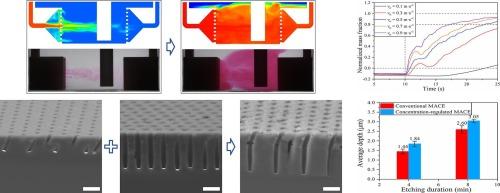
This study aims to characterize the mass transfer characteristics of a novel concentration-regulated metal-assisted chemical etching (MACE) system and investigate its application in the controllable fabrication of ∼ 600 nm diameter silicon (Si) nanohole arrays. A concentration-regulated MACE system for Si nanohole etching is established, and the CFD simulations of fluid flow, mass fraction evolution, and mass transfer are conducted. Results reveal that the mass fraction distributions from simulations and experiments are in good agreement. As the inlet velocity increases, the average velocity and vorticity significantly increase, the mass fraction approaches the target concentration more quickly, and the mass transfer coefficient increases by 1.51 to 6.72 times compared to conventional MACE. The concentration-regulated MACE system with a fine pore array demonstrates good concentration regulation performance due to its stable mass fraction evolution process, minimal standard deviation of mass fraction, and uniform mass transfer coefficient. Utilizing the concentration-regulated MACE system, the etching rate of Si nanoholes increases by approximately 27.78 % under mass transfer enhancement, and large-area, uniform, high aspect ratio, and controllable tortuous Si nanohole arrays are successfully fabricated for the first time.
期刊介绍:
The Chemical Engineering Journal is an international research journal that invites contributions of original and novel fundamental research. It aims to provide an international platform for presenting original fundamental research, interpretative reviews, and discussions on new developments in chemical engineering. The journal welcomes papers that describe novel theory and its practical application, as well as those that demonstrate the transfer of techniques from other disciplines. It also welcomes reports on carefully conducted experimental work that is soundly interpreted. The main focus of the journal is on original and rigorous research results that have broad significance. The Catalysis section within the Chemical Engineering Journal focuses specifically on Experimental and Theoretical studies in the fields of heterogeneous catalysis, molecular catalysis, and biocatalysis. These studies have industrial impact on various sectors such as chemicals, energy, materials, foods, healthcare, and environmental protection.



 京公网安备 11010802042870号
京ICP备2023020795号-1
京公网安备 11010802042870号
京ICP备2023020795号-1

 分享
分享
 求助内容:
求助内容: 应助结果提醒方式:
 扫码关注我们
