Xiuzhen Zhang, Xiyu Wang, Xiaohuan Zhang, Yuanyuan Zhang, Yongxiu Sun, Lili Liu, Wei Yan, Ning Zhang, Changyuan Zhang, Linxing Shi
{"title":"Additive strategy toward PbI2 film modifications for efficient perovskite solar cells fabricated in an air environment","authors":"Xiuzhen Zhang, Xiyu Wang, Xiaohuan Zhang, Yuanyuan Zhang, Yongxiu Sun, Lili Liu, Wei Yan, Ning Zhang, Changyuan Zhang, Linxing Shi","doi":"10.1016/j.cej.2025.163006","DOIUrl":null,"url":null,"abstract":"In the two-step method for perovskite film fabrication, insufficient reaction between organic ammonium salts and PbI<sub>2</sub> affects the active layer quality, resulting in poor power conversion efficiency (PCE). In this work, we introduce pentanamine acetic acid (PenAAc) and 5-aminovaleric acid iodine (5-AVAI) as two efficient additives to modify PbI<sub>2</sub> layer during perovskite films fabrication via the two-step method in an air environment. After additive modifications, the quality of both PbI<sub>2</sub> layers is improved: PenAAc enhances crystallinity and increases PbI<sub>2</sub> grain size, while 5-AVAI induces a uniform and smooth PbI<sub>2</sub> layer. The optimized PbI<sub>2</sub> films facilitate the reaction between PbI<sub>2</sub> and organic salts, yielding a high-quality perovskite layer with enhanced crystallinity and reduced defect density. In contrast, the macromolecule structure of 5-AVAI does not diffuse after annealing, remaining in the PbI<sub>2</sub> layer and exerting minimal influence on the perovskite surface. However, dissociative CH<sub>3</sub>COO<sup>−</sup> groups in PenAAc molecules diffuse from the PbI<sub>2</sub> layer to the perovskite surface during annealing, forming strong interactions between I<sup>-</sup> and Pb<sup>2+</sup> with CH<sub>3</sub>COO<sup>−</sup> groups. This further improves perovskite film quality and accelerates charge carrier extraction/transport in devices. Consequently, additive-modified perovskite solar cells achieve excellent PCEs of 24.50 % (5-AVAI) and 24.65 % (PenAAc), significantly surpassing the control device (22.84 %). Moreover, hysteresis index is reduced from 4.20 % (control) to 0.33 % (5-AVAI) and 0.08 % (PenAAc). Additionally, the modified devices also demonstrated enhanced environmental stability across humidity, light, and thermal stress conditions.","PeriodicalId":270,"journal":{"name":"Chemical Engineering Journal","volume":"22 1","pages":""},"PeriodicalIF":13.2000,"publicationDate":"2025-04-23","publicationTypes":"Journal Article","fieldsOfStudy":null,"isOpenAccess":false,"openAccessPdf":"","citationCount":"0","resultStr":null,"platform":"Semanticscholar","paperid":null,"PeriodicalName":"Chemical Engineering Journal","FirstCategoryId":"5","ListUrlMain":"https://doi.org/10.1016/j.cej.2025.163006","RegionNum":1,"RegionCategory":"工程技术","ArticlePicture":[],"TitleCN":null,"AbstractTextCN":null,"PMCID":null,"EPubDate":"","PubModel":"","JCR":"Q1","JCRName":"ENGINEERING, CHEMICAL","Score":null,"Total":0}
引用次数: 0
Abstract
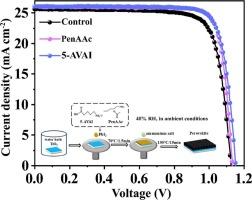
In the two-step method for perovskite film fabrication, insufficient reaction between organic ammonium salts and PbI2 affects the active layer quality, resulting in poor power conversion efficiency (PCE). In this work, we introduce pentanamine acetic acid (PenAAc) and 5-aminovaleric acid iodine (5-AVAI) as two efficient additives to modify PbI2 layer during perovskite films fabrication via the two-step method in an air environment. After additive modifications, the quality of both PbI2 layers is improved: PenAAc enhances crystallinity and increases PbI2 grain size, while 5-AVAI induces a uniform and smooth PbI2 layer. The optimized PbI2 films facilitate the reaction between PbI2 and organic salts, yielding a high-quality perovskite layer with enhanced crystallinity and reduced defect density. In contrast, the macromolecule structure of 5-AVAI does not diffuse after annealing, remaining in the PbI2 layer and exerting minimal influence on the perovskite surface. However, dissociative CH3COO− groups in PenAAc molecules diffuse from the PbI2 layer to the perovskite surface during annealing, forming strong interactions between I- and Pb2+ with CH3COO− groups. This further improves perovskite film quality and accelerates charge carrier extraction/transport in devices. Consequently, additive-modified perovskite solar cells achieve excellent PCEs of 24.50 % (5-AVAI) and 24.65 % (PenAAc), significantly surpassing the control device (22.84 %). Moreover, hysteresis index is reduced from 4.20 % (control) to 0.33 % (5-AVAI) and 0.08 % (PenAAc). Additionally, the modified devices also demonstrated enhanced environmental stability across humidity, light, and thermal stress conditions.
期刊介绍:
The Chemical Engineering Journal is an international research journal that invites contributions of original and novel fundamental research. It aims to provide an international platform for presenting original fundamental research, interpretative reviews, and discussions on new developments in chemical engineering. The journal welcomes papers that describe novel theory and its practical application, as well as those that demonstrate the transfer of techniques from other disciplines. It also welcomes reports on carefully conducted experimental work that is soundly interpreted. The main focus of the journal is on original and rigorous research results that have broad significance. The Catalysis section within the Chemical Engineering Journal focuses specifically on Experimental and Theoretical studies in the fields of heterogeneous catalysis, molecular catalysis, and biocatalysis. These studies have industrial impact on various sectors such as chemicals, energy, materials, foods, healthcare, and environmental protection.



 京公网安备 11010802042870号
京ICP备2023020795号-1
京公网安备 11010802042870号
京ICP备2023020795号-1

 分享
分享
 求助内容:
求助内容: 应助结果提醒方式:
 扫码关注我们
