{"title":"Design and Characterization of Tannic Acid-Iron and Metal Oxides Functionalized Aluminum Powders for Improved Ignition and Combustion Efficiency","authors":"Yunxiang Ma, Peize Yang, Shiyao Shao, Daokun Wen, Mengyao Wu, Xiaoshuang Li, Bing Geng, Guanghui Cui, Jinxuan He, Wen Ao","doi":"10.1021/acs.iecr.4c04983","DOIUrl":null,"url":null,"abstract":"A dense tannic acid-iron (TA-Fe) and metal oxide layer was successfully encapsulated on the surface of spherical aluminum powder via in situ polymerization and liquid-phase deposition. This process yielded core–shell composites (Al@TA-Fe@M<sub><i>x</i></sub>O<sub><i>y</i></sub>) designed to address the challenges of poor combustion performance and extended ignition delays associated with raw aluminum powder. After characterization, it was found that the Al@TA-Fe@M<sub><i>x</i></sub>O<sub><i>y</i></sub> composites exhibit a well-defined core–shell structure with uniform and compact cladding layers. These composites displayed lower activation energies (1.925 × 10<sup>5</sup> and 2.021 × 10<sup>5</sup> J/mol for Al@TA-Fe@CoO and Al@TA-Fe@CuO, respectively) than that of raw aluminum (3.326 × 10<sup>5</sup> J/mol), alongside reduced initial reaction temperatures (400–470 °C), no ignition delay, and smaller condensed-phase residues. Collectively, these attributes significantly enhanced the ignition and combustion performance of aluminum powder. This study underscores the potential of functionalized aluminum-based fuels in solid propellants, offering promising applications in energetic material systems.","PeriodicalId":39,"journal":{"name":"Industrial & Engineering Chemistry Research","volume":"91 1","pages":""},"PeriodicalIF":3.9000,"publicationDate":"2025-04-24","publicationTypes":"Journal Article","fieldsOfStudy":null,"isOpenAccess":false,"openAccessPdf":"","citationCount":"0","resultStr":null,"platform":"Semanticscholar","paperid":null,"PeriodicalName":"Industrial & Engineering Chemistry Research","FirstCategoryId":"5","ListUrlMain":"https://doi.org/10.1021/acs.iecr.4c04983","RegionNum":3,"RegionCategory":"工程技术","ArticlePicture":[],"TitleCN":null,"AbstractTextCN":null,"PMCID":null,"EPubDate":"","PubModel":"","JCR":"Q2","JCRName":"ENGINEERING, CHEMICAL","Score":null,"Total":0}
引用次数: 0
Abstract
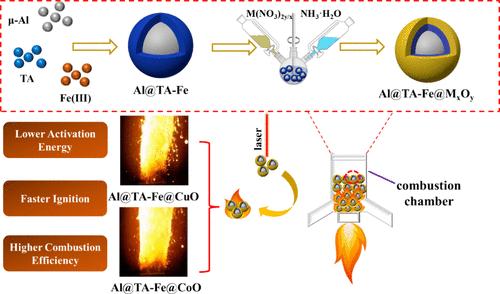
A dense tannic acid-iron (TA-Fe) and metal oxide layer was successfully encapsulated on the surface of spherical aluminum powder via in situ polymerization and liquid-phase deposition. This process yielded core–shell composites (Al@TA-Fe@MxOy) designed to address the challenges of poor combustion performance and extended ignition delays associated with raw aluminum powder. After characterization, it was found that the Al@TA-Fe@MxOy composites exhibit a well-defined core–shell structure with uniform and compact cladding layers. These composites displayed lower activation energies (1.925 × 10⁵ and 2.021 × 10⁵ J/mol for Al@TA-Fe@CoO and Al@TA-Fe@CuO, respectively) than that of raw aluminum (3.326 × 10⁵ J/mol), alongside reduced initial reaction temperatures (400–470 °C), no ignition delay, and smaller condensed-phase residues. Collectively, these attributes significantly enhanced the ignition and combustion performance of aluminum powder. This study underscores the potential of functionalized aluminum-based fuels in solid propellants, offering promising applications in energetic material systems.
期刊介绍:
ndustrial & Engineering Chemistry, with variations in title and format, has been published since 1909 by the American Chemical Society. Industrial & Engineering Chemistry Research is a weekly publication that reports industrial and academic research in the broad fields of applied chemistry and chemical engineering with special focus on fundamentals, processes, and products.



 京公网安备 11010802042870号
京ICP备2023020795号-1
京公网安备 11010802042870号
京ICP备2023020795号-1

 分享
分享
 求助内容:
求助内容: 应助结果提醒方式:
 扫码关注我们
