{"title":"Modeling Analysis of Oxygen Transfer Efficiency in Rest Cell Catalysis for Extra High-Titer Xylonic Acid Bioproduction","authors":"Xia Hua, Yong Xu","doi":"10.1002/bit.29004","DOIUrl":null,"url":null,"abstract":"<div>\n \n <p>The conflict arising from high-titer products and substantial oxygen requirements in aerobic bioconversion results in high-viscosity and oxygen transfer bottlenecks in dynamically changing biosystems. Currently, in the bioproduction of xylonic acid (XA), strategies to address the oxygen transfer bottleneck predominantly focus on macro-level modifications of the bioreactor. In this study, aiming at the high-viscosity biosystem, the optimal rotational speed equation was established at the fluid level by quantitatively investigating the variations and limitations of fluid rheological characteristics, gas holdup, cell respiration rate, and volume transfer coefficient of broth under different concentrations and rotational speeds. Based on the cell respiration rate under the optimal rotation speed, the theoretical production performance was calculated, and 679.3 g/L XA was achieved with the productivity of 14.2 g/L/h by batch feeding mode. Verified using actual production under the same conditions as a control, 649.3 g/L XA was finally accumulated with a productivity of 13.5 g/L/h, which was equivalent to 95.8% of the theoretical production. The intensification strategy for oxygen transfer provided insightful ideas to overcome the stubborn obstacles of obligate aerobic catalysis. Moreover, the study offered technical assistance and application potential for the production of high-titer XA from high-viscosity sugar-rich lignocellulosic hydrolysate.</p></div>","PeriodicalId":9168,"journal":{"name":"Biotechnology and Bioengineering","volume":"122 7","pages":"1724-1734"},"PeriodicalIF":3.6000,"publicationDate":"2025-04-24","publicationTypes":"Journal Article","fieldsOfStudy":null,"isOpenAccess":false,"openAccessPdf":"","citationCount":"0","resultStr":null,"platform":"Semanticscholar","paperid":null,"PeriodicalName":"Biotechnology and Bioengineering","FirstCategoryId":"5","ListUrlMain":"https://analyticalsciencejournals.onlinelibrary.wiley.com/doi/10.1002/bit.29004","RegionNum":2,"RegionCategory":"生物学","ArticlePicture":[],"TitleCN":null,"AbstractTextCN":null,"PMCID":null,"EPubDate":"","PubModel":"","JCR":"Q2","JCRName":"BIOTECHNOLOGY & APPLIED MICROBIOLOGY","Score":null,"Total":0}
引用次数: 0
Abstract
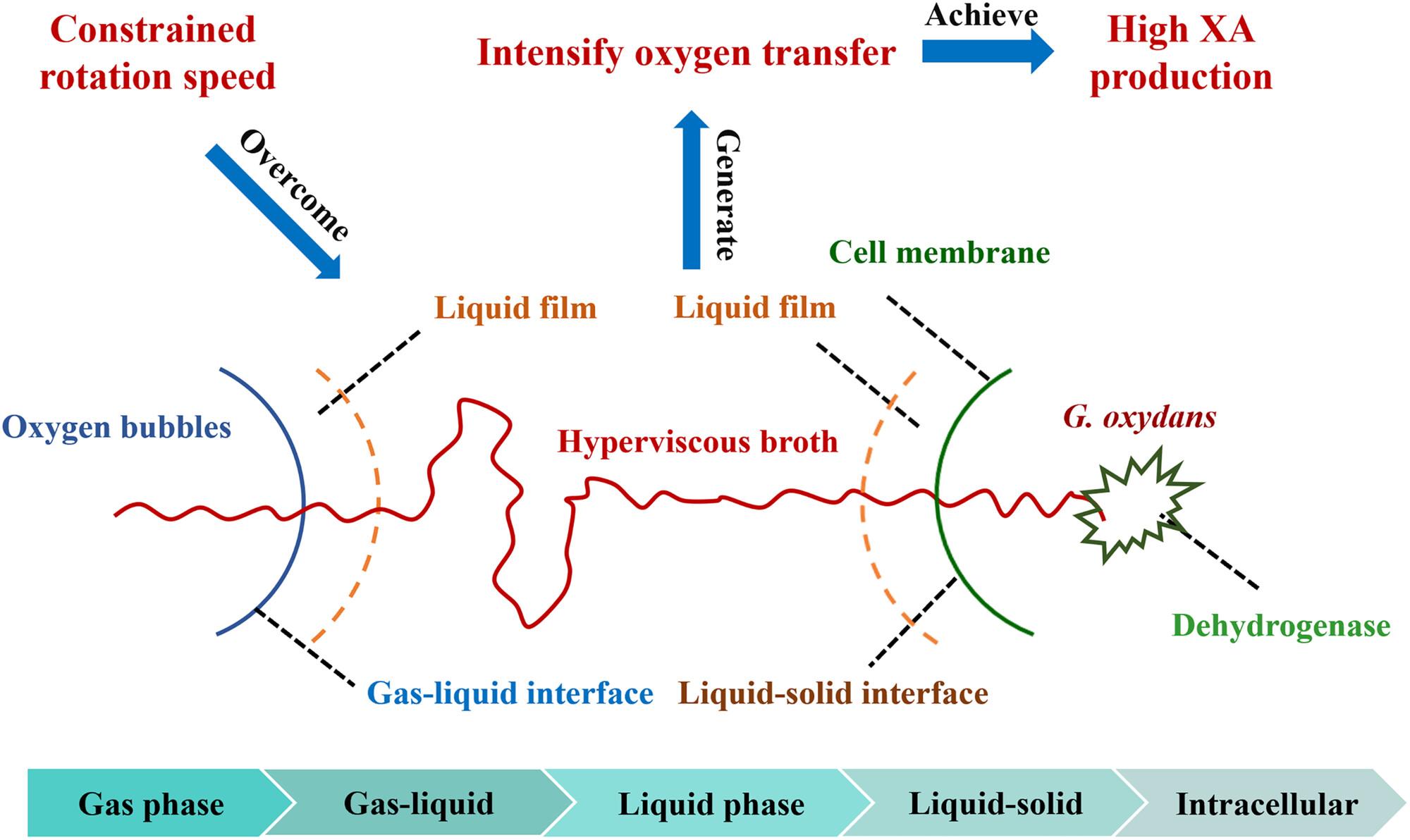
The conflict arising from high-titer products and substantial oxygen requirements in aerobic bioconversion results in high-viscosity and oxygen transfer bottlenecks in dynamically changing biosystems. Currently, in the bioproduction of xylonic acid (XA), strategies to address the oxygen transfer bottleneck predominantly focus on macro-level modifications of the bioreactor. In this study, aiming at the high-viscosity biosystem, the optimal rotational speed equation was established at the fluid level by quantitatively investigating the variations and limitations of fluid rheological characteristics, gas holdup, cell respiration rate, and volume transfer coefficient of broth under different concentrations and rotational speeds. Based on the cell respiration rate under the optimal rotation speed, the theoretical production performance was calculated, and 679.3 g/L XA was achieved with the productivity of 14.2 g/L/h by batch feeding mode. Verified using actual production under the same conditions as a control, 649.3 g/L XA was finally accumulated with a productivity of 13.5 g/L/h, which was equivalent to 95.8% of the theoretical production. The intensification strategy for oxygen transfer provided insightful ideas to overcome the stubborn obstacles of obligate aerobic catalysis. Moreover, the study offered technical assistance and application potential for the production of high-titer XA from high-viscosity sugar-rich lignocellulosic hydrolysate.
期刊介绍:
Biotechnology & Bioengineering publishes Perspectives, Articles, Reviews, Mini-Reviews, and Communications to the Editor that embrace all aspects of biotechnology. These include:
-Enzyme systems and their applications, including enzyme reactors, purification, and applied aspects of protein engineering
-Animal-cell biotechnology, including media development
-Applied aspects of cellular physiology, metabolism, and energetics
-Biocatalysis and applied enzymology, including enzyme reactors, protein engineering, and nanobiotechnology
-Biothermodynamics
-Biofuels, including biomass and renewable resource engineering
-Biomaterials, including delivery systems and materials for tissue engineering
-Bioprocess engineering, including kinetics and modeling of biological systems, transport phenomena in bioreactors, bioreactor design, monitoring, and control
-Biosensors and instrumentation
-Computational and systems biology, including bioinformatics and genomic/proteomic studies
-Environmental biotechnology, including biofilms, algal systems, and bioremediation
-Metabolic and cellular engineering
-Plant-cell biotechnology
-Spectroscopic and other analytical techniques for biotechnological applications
-Synthetic biology
-Tissue engineering, stem-cell bioengineering, regenerative medicine, gene therapy and delivery systems
The editors will consider papers for publication based on novelty, their immediate or future impact on biotechnological processes, and their contribution to the advancement of biochemical engineering science. Submission of papers dealing with routine aspects of bioprocessing, description of established equipment, and routine applications of established methodologies (e.g., control strategies, modeling, experimental methods) is discouraged. Theoretical papers will be judged based on the novelty of the approach and their potential impact, or on their novel capability to predict and elucidate experimental observations.





 京公网安备 11010802042870号
京ICP备2023020795号-1
京公网安备 11010802042870号
京ICP备2023020795号-1

 分享
分享
 求助内容:
求助内容: 应助结果提醒方式:
 扫码关注我们
