Assessment of radioisotope concentrations of 137Cs and 90Sr in the herbaceous phytocenoses plants of the Dnieper river floodplain ecosystems (northern Ukraine)
{"title":"Assessment of radioisotope concentrations of 137Cs and 90Sr in the herbaceous phytocenoses plants of the Dnieper river floodplain ecosystems (northern Ukraine)","authors":"Oleksandr Lukash , Oleksandr Yakovenko , Iryna Miroshnyk , Halina Tkaczenko , Anita Szikura , Svitlana Strilets , Natalia Kurhaluk","doi":"10.1016/j.jhazmat.2025.138406","DOIUrl":null,"url":null,"abstract":"<div><div>The experimental data on the <sup>137</sup>Cs and <sup>90</sup>Sr concentation in the herbaceous phytocenoses of the Dnieper floodplain ecosystems in northern Ukraine have been discussed. Different radionuclide contents in plants and soils of different ecosystems of the floodplain depends on the herbaceous phytocenoses proximity to the river bed: a higher content of radiocaesium has been found in plants and soils of the meadow and marsh ecosystems, which are close to the river bed, and radiostrontium in the marsh and psamophyte ecosystems. Besides the intensity of radionuclide uptake by plants has been determined as by the soil and the cenotic habitat conditions so the biological characteristics of the species. The species specificity of the <sup>137</sup>Cs and <sup>90</sup>Sr accumulation by plants and the direct dependence of the soil-to-plant transfer factor from the density of the floodplain ecosystem contamination with radionuclides have been proved. Our results testified that significant differences in the caesium and strontium distribution were observed between ecosystems, likely influenced by soil characteristics, vegetation types and biomorphs. Our data suggest that the ecosystem type played a significant role, with caesium being most abundant in ruderal ecosystems and least abundant in psamophytic ecosystems, while strontium effects were particularly high in ruderal and psamophytic ecosystems compared to meadows.</div></div>","PeriodicalId":361,"journal":{"name":"Journal of Hazardous Materials","volume":"494 ","pages":"Article 138406"},"PeriodicalIF":11.3000,"publicationDate":"2025-08-15","publicationTypes":"Journal Article","fieldsOfStudy":null,"isOpenAccess":false,"openAccessPdf":"","citationCount":"0","resultStr":null,"platform":"Semanticscholar","paperid":null,"PeriodicalName":"Journal of Hazardous Materials","FirstCategoryId":"93","ListUrlMain":"https://www.sciencedirect.com/science/article/pii/S0304389425013214","RegionNum":1,"RegionCategory":"环境科学与生态学","ArticlePicture":[],"TitleCN":null,"AbstractTextCN":null,"PMCID":null,"EPubDate":"2025/4/24 0:00:00","PubModel":"Epub","JCR":"Q1","JCRName":"ENGINEERING, ENVIRONMENTAL","Score":null,"Total":0}
引用次数: 0
Abstract
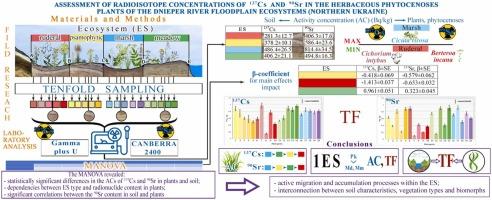
The experimental data on the 137Cs and 90Sr concentation in the herbaceous phytocenoses of the Dnieper floodplain ecosystems in northern Ukraine have been discussed. Different radionuclide contents in plants and soils of different ecosystems of the floodplain depends on the herbaceous phytocenoses proximity to the river bed: a higher content of radiocaesium has been found in plants and soils of the meadow and marsh ecosystems, which are close to the river bed, and radiostrontium in the marsh and psamophyte ecosystems. Besides the intensity of radionuclide uptake by plants has been determined as by the soil and the cenotic habitat conditions so the biological characteristics of the species. The species specificity of the 137Cs and 90Sr accumulation by plants and the direct dependence of the soil-to-plant transfer factor from the density of the floodplain ecosystem contamination with radionuclides have been proved. Our results testified that significant differences in the caesium and strontium distribution were observed between ecosystems, likely influenced by soil characteristics, vegetation types and biomorphs. Our data suggest that the ecosystem type played a significant role, with caesium being most abundant in ruderal ecosystems and least abundant in psamophytic ecosystems, while strontium effects were particularly high in ruderal and psamophytic ecosystems compared to meadows.
期刊介绍:
The Journal of Hazardous Materials serves as a global platform for promoting cutting-edge research in the field of Environmental Science and Engineering. Our publication features a wide range of articles, including full-length research papers, review articles, and perspectives, with the aim of enhancing our understanding of the dangers and risks associated with various materials concerning public health and the environment. It is important to note that the term "environmental contaminants" refers specifically to substances that pose hazardous effects through contamination, while excluding those that do not have such impacts on the environment or human health. Moreover, we emphasize the distinction between wastes and hazardous materials in order to provide further clarity on the scope of the journal. We have a keen interest in exploring specific compounds and microbial agents that have adverse effects on the environment.



 京公网安备 11010802042870号
京ICP备2023020795号-1
京公网安备 11010802042870号
京ICP备2023020795号-1

 分享
分享
 求助内容:
求助内容: 应助结果提醒方式:
 扫码关注我们
