Dan Yin , Ke Wang , Shilei Sun , Zhe Wang , Jinghui Wang , Baoguang Lu , Shijie You
{"title":"Enhanced in-situ sulfide removal via goethite-fulvic acid bio-reduction and iron-based catalysis in activated sludge recycling odor control system","authors":"Dan Yin , Ke Wang , Shilei Sun , Zhe Wang , Jinghui Wang , Baoguang Lu , Shijie You","doi":"10.1016/j.jhazmat.2025.138395","DOIUrl":null,"url":null,"abstract":"<div><div>H<sub>2</sub>S poses serious challenges in wastewater treatment plants, including unpleasant odors issues, toxicity conditions and infrastructure corrosion. In this study, we propose a novel in-situ H<sub>2</sub>S odor control process, which introduced goethite/goethite-fulvic acid (FA) bio-reduction and Fe-based catalysis into activated sludge recycling. This novel process reduced the activated sludge recycling rate from 40 % to 5 %, while increasing the sulfide removal efficiency from 52.97 % to 87.61 %. The sulfide removal capacities were 99.78 mgS/g Fe for goethite and 247.38 mgS/g Fe for goethite-FA. The bio-reduction of recycled sludge further enhanced the sulfide removal capacity to 103.43 mgS/g Fe in goethite and 337.74 mgS/g Fe for goethite-FA. Fulvic acid disrupted crystal structure, reduced electron transfer resistance and increased surface area of goethite, thereby enhancing bio-reduction efficiency and sulfide removal capacity. Moreover, aeration of inlet works further increased the sulfide removal efficiency from 12.67 % to 65.50 % in goethite sludge and from 23.73 % to 87.61 % in goethite-FA sludge. This enhancement was due to the catalytic effect of dissolved and ion-exchangeable Fe, which generated through complexation and electronegativity of recycled Fe-activated sludge. Overall, the novel H<sub>2</sub>S control process can achieve high sulfide removal efficiency while maintaining low recycling rate and operation costs.</div></div>","PeriodicalId":361,"journal":{"name":"Journal of Hazardous Materials","volume":"493 ","pages":"Article 138395"},"PeriodicalIF":11.3000,"publicationDate":"2025-08-05","publicationTypes":"Journal Article","fieldsOfStudy":null,"isOpenAccess":false,"openAccessPdf":"","citationCount":"0","resultStr":null,"platform":"Semanticscholar","paperid":null,"PeriodicalName":"Journal of Hazardous Materials","FirstCategoryId":"93","ListUrlMain":"https://www.sciencedirect.com/science/article/pii/S030438942501310X","RegionNum":1,"RegionCategory":"环境科学与生态学","ArticlePicture":[],"TitleCN":null,"AbstractTextCN":null,"PMCID":null,"EPubDate":"2025/4/23 0:00:00","PubModel":"Epub","JCR":"Q1","JCRName":"ENGINEERING, ENVIRONMENTAL","Score":null,"Total":0}
引用次数: 0
Abstract
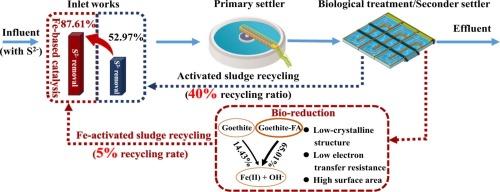
H2S poses serious challenges in wastewater treatment plants, including unpleasant odors issues, toxicity conditions and infrastructure corrosion. In this study, we propose a novel in-situ H2S odor control process, which introduced goethite/goethite-fulvic acid (FA) bio-reduction and Fe-based catalysis into activated sludge recycling. This novel process reduced the activated sludge recycling rate from 40 % to 5 %, while increasing the sulfide removal efficiency from 52.97 % to 87.61 %. The sulfide removal capacities were 99.78 mgS/g Fe for goethite and 247.38 mgS/g Fe for goethite-FA. The bio-reduction of recycled sludge further enhanced the sulfide removal capacity to 103.43 mgS/g Fe in goethite and 337.74 mgS/g Fe for goethite-FA. Fulvic acid disrupted crystal structure, reduced electron transfer resistance and increased surface area of goethite, thereby enhancing bio-reduction efficiency and sulfide removal capacity. Moreover, aeration of inlet works further increased the sulfide removal efficiency from 12.67 % to 65.50 % in goethite sludge and from 23.73 % to 87.61 % in goethite-FA sludge. This enhancement was due to the catalytic effect of dissolved and ion-exchangeable Fe, which generated through complexation and electronegativity of recycled Fe-activated sludge. Overall, the novel H2S control process can achieve high sulfide removal efficiency while maintaining low recycling rate and operation costs.
期刊介绍:
The Journal of Hazardous Materials serves as a global platform for promoting cutting-edge research in the field of Environmental Science and Engineering. Our publication features a wide range of articles, including full-length research papers, review articles, and perspectives, with the aim of enhancing our understanding of the dangers and risks associated with various materials concerning public health and the environment. It is important to note that the term "environmental contaminants" refers specifically to substances that pose hazardous effects through contamination, while excluding those that do not have such impacts on the environment or human health. Moreover, we emphasize the distinction between wastes and hazardous materials in order to provide further clarity on the scope of the journal. We have a keen interest in exploring specific compounds and microbial agents that have adverse effects on the environment.



 京公网安备 11010802042870号
京ICP备2023020795号-1
京公网安备 11010802042870号
京ICP备2023020795号-1

 分享
分享
 求助内容:
求助内容: 应助结果提醒方式:
 扫码关注我们
