Ping Tan , Zhuo Wang , Zhen Mao , Riming Hu , Jiayuan Yu , Yuhan Li
{"title":"Highly selective conversion of NO to NO3—through radical modulation over UiO-66–67-NH2 S-scheme heterojunction","authors":"Ping Tan , Zhuo Wang , Zhen Mao , Riming Hu , Jiayuan Yu , Yuhan Li","doi":"10.1016/j.jhazmat.2025.138356","DOIUrl":null,"url":null,"abstract":"<div><div>Semiconductor photocatalysis presents significant potential for reducing low concentrations of NO, yet achieving efficient and selective conversion of NO to NO<sub>3</sub><sup>—</sup>while suppressing toxic NO<sub>2</sub> release remains challenging. Here, a UiO-66–67-NH<sub>2</sub> S-scheme heterojunction, synthesized by integrating UiO-66-NH<sub>2</sub> and UiO-67-NH<sub>2</sub>, generate ·O<sub>2</sub><sup>—</sup> as the sole active species for efficient NO to NO<sub>3</sub><sup>—</sup>conversion under visible light. The photocatalytic performance evaluation indicates that the optimized UiO-66–67-NH<sub>2</sub> efficiently and selectively converts NO to NO<sub>3</sub><sup>−</sup>. The photocatalytic NO removal efficiency reaches 78 %, which is 2.2 times and 3.4 times higher than that of the individual UiO-66-NH<sub>2</sub> and UiO-67-NH<sub>2</sub>, respectively. Experimental results and DFT calculations reveal that charge redistributions within the heterojunction creates an internal electric field, facilitating effective charge separation. The selective adsorption of O<sub>2</sub> and NO at the Zr sites facilitates of ·O<sub>2</sub><sup>—</sup> generation and NO enrichment, while the -NH<sub>2</sub> sites suppress the formation of ·OH and <sup>1</sup>O<sub>2</sub>, inhibiting NO<sub>2</sub> release. The rate-determining step, reaction between *NO<sub>2</sub> and *O is energetically favored in the heterojunction, accelerating NO<sub>3</sub><sup>—</sup> formation. This study provides valuable insights into designing photocatalysts for environmental remediation by controlling reactive oxygen species and NO removal.</div></div>","PeriodicalId":361,"journal":{"name":"Journal of Hazardous Materials","volume":"493 ","pages":"Article 138356"},"PeriodicalIF":11.3000,"publicationDate":"2025-08-05","publicationTypes":"Journal Article","fieldsOfStudy":null,"isOpenAccess":false,"openAccessPdf":"","citationCount":"0","resultStr":null,"platform":"Semanticscholar","paperid":null,"PeriodicalName":"Journal of Hazardous Materials","FirstCategoryId":"93","ListUrlMain":"https://www.sciencedirect.com/science/article/pii/S0304389425012713","RegionNum":1,"RegionCategory":"环境科学与生态学","ArticlePicture":[],"TitleCN":null,"AbstractTextCN":null,"PMCID":null,"EPubDate":"2025/4/23 0:00:00","PubModel":"Epub","JCR":"Q1","JCRName":"ENGINEERING, ENVIRONMENTAL","Score":null,"Total":0}
引用次数: 0
Abstract
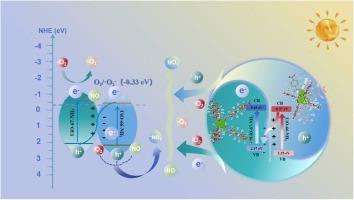
Semiconductor photocatalysis presents significant potential for reducing low concentrations of NO, yet achieving efficient and selective conversion of NO to NO3—while suppressing toxic NO2 release remains challenging. Here, a UiO-66–67-NH2 S-scheme heterojunction, synthesized by integrating UiO-66-NH2 and UiO-67-NH2, generate ·O2— as the sole active species for efficient NO to NO3—conversion under visible light. The photocatalytic performance evaluation indicates that the optimized UiO-66–67-NH2 efficiently and selectively converts NO to NO3−. The photocatalytic NO removal efficiency reaches 78 %, which is 2.2 times and 3.4 times higher than that of the individual UiO-66-NH2 and UiO-67-NH2, respectively. Experimental results and DFT calculations reveal that charge redistributions within the heterojunction creates an internal electric field, facilitating effective charge separation. The selective adsorption of O2 and NO at the Zr sites facilitates of ·O2— generation and NO enrichment, while the -NH2 sites suppress the formation of ·OH and 1O2, inhibiting NO2 release. The rate-determining step, reaction between *NO2 and *O is energetically favored in the heterojunction, accelerating NO3— formation. This study provides valuable insights into designing photocatalysts for environmental remediation by controlling reactive oxygen species and NO removal.
期刊介绍:
The Journal of Hazardous Materials serves as a global platform for promoting cutting-edge research in the field of Environmental Science and Engineering. Our publication features a wide range of articles, including full-length research papers, review articles, and perspectives, with the aim of enhancing our understanding of the dangers and risks associated with various materials concerning public health and the environment. It is important to note that the term "environmental contaminants" refers specifically to substances that pose hazardous effects through contamination, while excluding those that do not have such impacts on the environment or human health. Moreover, we emphasize the distinction between wastes and hazardous materials in order to provide further clarity on the scope of the journal. We have a keen interest in exploring specific compounds and microbial agents that have adverse effects on the environment.



 京公网安备 11010802042870号
京ICP备2023020795号-1
京公网安备 11010802042870号
京ICP备2023020795号-1

 分享
分享
 求助内容:
求助内容: 应助结果提醒方式:
 扫码关注我们
