Jing Kong , Qingjun Guo , Rongfei Wei , Ou Sha , Mingyan Mao , Suchang Yang
{"title":"Study on the migration pathway and isotopic composition of Zn in soil, plant and water in mining area","authors":"Jing Kong , Qingjun Guo , Rongfei Wei , Ou Sha , Mingyan Mao , Suchang Yang","doi":"10.1016/j.jhazmat.2025.138394","DOIUrl":null,"url":null,"abstract":"<div><div>Isotopic tracing has been widely used to identify the sources and migration processes of Zn in diverse environments. However, Zn isotope fractionation during the migration process within the mining area poses challenges to the accuracy of isotopic tracing. To address this issue, a representative Pb-Zn mining area in the karst region of southwestern China was selected as the study area, given its long-term tailings’ pollution history and the extensive spatial distribution of Zn migration. End-member samples and environmental media (soil, plants, river water and groundwater) were systematically collected, and heavy metal concentrations and isotopic signatures were analyzed. The migration pathways of Zn and associated isotopic fractionation from end members to surrounding environments were comprehensively investigated. Results indicated that tailings constitute the dominant source of Zn, with ZnS weathering being the primary driver of Zn isotopic variability in soils. Eluviation process, characterized by selective transport of soluble Zn<sup>2+</sup> enriched in heavy isotopes, was identified as the key mechanism governing Zn migration across the soil-plant-river continuum. Retention processes (adsorption by organic matter, plant uptake, and mineral interactions) exhibited minimal influence on soil Zn isotopic composition. These findings advance the understanding of Zn and Zn isotope cycling in karst ecosystems and provide a scientific basis for formulating pollution control strategies in mining areas.</div></div>","PeriodicalId":361,"journal":{"name":"Journal of Hazardous Materials","volume":"494 ","pages":"Article 138394"},"PeriodicalIF":11.3000,"publicationDate":"2025-08-15","publicationTypes":"Journal Article","fieldsOfStudy":null,"isOpenAccess":false,"openAccessPdf":"","citationCount":"0","resultStr":null,"platform":"Semanticscholar","paperid":null,"PeriodicalName":"Journal of Hazardous Materials","FirstCategoryId":"93","ListUrlMain":"https://www.sciencedirect.com/science/article/pii/S0304389425013093","RegionNum":1,"RegionCategory":"环境科学与生态学","ArticlePicture":[],"TitleCN":null,"AbstractTextCN":null,"PMCID":null,"EPubDate":"2025/4/23 0:00:00","PubModel":"Epub","JCR":"Q1","JCRName":"ENGINEERING, ENVIRONMENTAL","Score":null,"Total":0}
引用次数: 0
Abstract
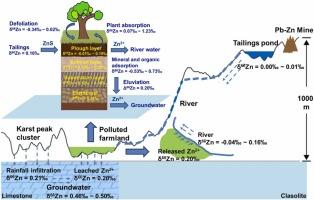
Isotopic tracing has been widely used to identify the sources and migration processes of Zn in diverse environments. However, Zn isotope fractionation during the migration process within the mining area poses challenges to the accuracy of isotopic tracing. To address this issue, a representative Pb-Zn mining area in the karst region of southwestern China was selected as the study area, given its long-term tailings’ pollution history and the extensive spatial distribution of Zn migration. End-member samples and environmental media (soil, plants, river water and groundwater) were systematically collected, and heavy metal concentrations and isotopic signatures were analyzed. The migration pathways of Zn and associated isotopic fractionation from end members to surrounding environments were comprehensively investigated. Results indicated that tailings constitute the dominant source of Zn, with ZnS weathering being the primary driver of Zn isotopic variability in soils. Eluviation process, characterized by selective transport of soluble Zn2+ enriched in heavy isotopes, was identified as the key mechanism governing Zn migration across the soil-plant-river continuum. Retention processes (adsorption by organic matter, plant uptake, and mineral interactions) exhibited minimal influence on soil Zn isotopic composition. These findings advance the understanding of Zn and Zn isotope cycling in karst ecosystems and provide a scientific basis for formulating pollution control strategies in mining areas.
期刊介绍:
The Journal of Hazardous Materials serves as a global platform for promoting cutting-edge research in the field of Environmental Science and Engineering. Our publication features a wide range of articles, including full-length research papers, review articles, and perspectives, with the aim of enhancing our understanding of the dangers and risks associated with various materials concerning public health and the environment. It is important to note that the term "environmental contaminants" refers specifically to substances that pose hazardous effects through contamination, while excluding those that do not have such impacts on the environment or human health. Moreover, we emphasize the distinction between wastes and hazardous materials in order to provide further clarity on the scope of the journal. We have a keen interest in exploring specific compounds and microbial agents that have adverse effects on the environment.



 京公网安备 11010802042870号
京ICP备2023020795号-1
京公网安备 11010802042870号
京ICP备2023020795号-1

 分享
分享
 求助内容:
求助内容: 应助结果提醒方式:
 扫码关注我们
