{"title":"Non-negligible effects of sunlight irradiation on generation of VBNC-state antibiotic resistant bacteria in natural water","authors":"Tingting Zhang , Fangyuan Cheng , Linyi Fan , Ya-nan Zhang , Jiao Qu , Willie J.G.M. Peijnenburg","doi":"10.1016/j.jhazmat.2025.138397","DOIUrl":null,"url":null,"abstract":"<div><div>The viable but non-culturable (VBNC) state antibiotic resistant bacteria (ARB) poses significant environmental risk. The mechanism by which simulated sunlight irradiation induces ARB to enter the VBNC state remains unclear. This study systematically explored the photochemical generation mechanism of VBNC-ARB in natural water. Ampicillin-resistant <em>Escherichia coli</em> (AR <em>E. coli</em>) was selected as a representative ARB. The results showed that AR <em>E. coli</em> lost cultivability under sunlight with 91.1 % of AR <em>E. coli</em> entering the VBNC state. Suwannee River fulvic acid (SRFA) slightly enhanced this effect and can induce 95.9 % of AR <em>E. coli</em> into the VBNC state. Under sunlight exposure, oxidative stress and the toxin-antitoxin (TA) system in AR <em>E. coli</em> were identified as key factors in inducing the VBNC state. This process was accompanied by a deterioration in cell membrane fluidity, upregulation of cell wall and outer membrane-related genes, and toxin-mediated inhibition of DNA replication. Importantly, AR <em>E. coli</em> retained intact antibiotic resistance genes (ARGs) and could reactivate these genes in the dark, with SRFA promoting this recovery. Therefore, VBNC-ARB remains antibiotic resistance and increases virulence expression, consequently increasing human health risks. These findings underscore the need for effective strategies to manage VBNC-ARB in environmental systems.</div></div>","PeriodicalId":361,"journal":{"name":"Journal of Hazardous Materials","volume":"493 ","pages":"Article 138397"},"PeriodicalIF":11.3000,"publicationDate":"2025-08-05","publicationTypes":"Journal Article","fieldsOfStudy":null,"isOpenAccess":false,"openAccessPdf":"","citationCount":"0","resultStr":null,"platform":"Semanticscholar","paperid":null,"PeriodicalName":"Journal of Hazardous Materials","FirstCategoryId":"93","ListUrlMain":"https://www.sciencedirect.com/science/article/pii/S0304389425013123","RegionNum":1,"RegionCategory":"环境科学与生态学","ArticlePicture":[],"TitleCN":null,"AbstractTextCN":null,"PMCID":null,"EPubDate":"2025/4/23 0:00:00","PubModel":"Epub","JCR":"Q1","JCRName":"ENGINEERING, ENVIRONMENTAL","Score":null,"Total":0}
引用次数: 0
Abstract
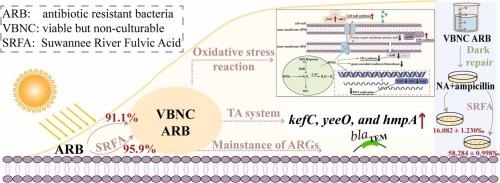
The viable but non-culturable (VBNC) state antibiotic resistant bacteria (ARB) poses significant environmental risk. The mechanism by which simulated sunlight irradiation induces ARB to enter the VBNC state remains unclear. This study systematically explored the photochemical generation mechanism of VBNC-ARB in natural water. Ampicillin-resistant Escherichia coli (AR E. coli) was selected as a representative ARB. The results showed that AR E. coli lost cultivability under sunlight with 91.1 % of AR E. coli entering the VBNC state. Suwannee River fulvic acid (SRFA) slightly enhanced this effect and can induce 95.9 % of AR E. coli into the VBNC state. Under sunlight exposure, oxidative stress and the toxin-antitoxin (TA) system in AR E. coli were identified as key factors in inducing the VBNC state. This process was accompanied by a deterioration in cell membrane fluidity, upregulation of cell wall and outer membrane-related genes, and toxin-mediated inhibition of DNA replication. Importantly, AR E. coli retained intact antibiotic resistance genes (ARGs) and could reactivate these genes in the dark, with SRFA promoting this recovery. Therefore, VBNC-ARB remains antibiotic resistance and increases virulence expression, consequently increasing human health risks. These findings underscore the need for effective strategies to manage VBNC-ARB in environmental systems.
活菌不可培养(VBNC)状态抗生素耐药菌(ARB)具有重大的环境风险。模拟阳光照射诱导ARB进入VBNC状态的机制尚不清楚。本研究系统探讨了天然水中VBNC-ARB的光化学生成机制。选择耐氨苄西林大肠杆菌(AR E. coli)作为ARB的代表。结果表明,日光下AR大肠杆菌丧失可培养性,91.1%的AR大肠杆菌进入VBNC状态。苏万尼河富里酸(SRFA)略微增强了这一作用,可使95.9%的AR大肠杆菌进入VBNC状态。在阳光照射下,氧化应激和毒素-抗毒素(TA)系统是诱导AR大肠杆菌进入VBNC状态的关键因素。这一过程伴随着细胞膜流动性的恶化,细胞壁和外膜相关基因的上调,以及毒素介导的DNA复制抑制。重要的是,AR大肠杆菌保留了完整的抗生素耐药基因(ARGs),并可以在黑暗中重新激活这些基因,SRFA促进了这种恢复。因此,VBNC-ARB保持抗生素耐药性并增加毒力表达,从而增加人类健康风险。这些发现强调了在环境系统中管理VBNC-ARB的有效战略的必要性。
期刊介绍:
The Journal of Hazardous Materials serves as a global platform for promoting cutting-edge research in the field of Environmental Science and Engineering. Our publication features a wide range of articles, including full-length research papers, review articles, and perspectives, with the aim of enhancing our understanding of the dangers and risks associated with various materials concerning public health and the environment. It is important to note that the term "environmental contaminants" refers specifically to substances that pose hazardous effects through contamination, while excluding those that do not have such impacts on the environment or human health. Moreover, we emphasize the distinction between wastes and hazardous materials in order to provide further clarity on the scope of the journal. We have a keen interest in exploring specific compounds and microbial agents that have adverse effects on the environment.



 京公网安备 11010802042870号
京ICP备2023020795号-1
京公网安备 11010802042870号
京ICP备2023020795号-1

 分享
分享
 求助内容:
求助内容: 应助结果提醒方式:
 扫码关注我们
