Reza Esmaeilzadeh, Jamasp Jhabvala, Lucas Schlenger, Mathijs van der Meer, Eric Boillat, Cyril Cayron, Amir Mohammad Jamili, Junfeng Xiao, Roland E. Logé
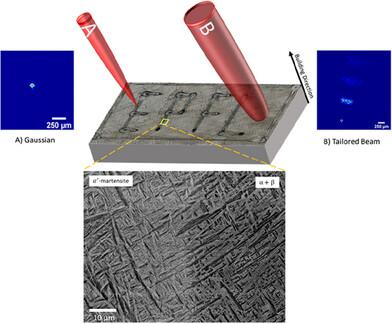
{"title":"Toward Architected Microstructures Using Advanced Laser Beam Shaping in Laser Powder Bed Fusion of Ti-6Al-4V","authors":"Reza Esmaeilzadeh, Jamasp Jhabvala, Lucas Schlenger, Mathijs van der Meer, Eric Boillat, Cyril Cayron, Amir Mohammad Jamili, Junfeng Xiao, Roland E. Logé","doi":"10.1002/adfm.202420427","DOIUrl":null,"url":null,"abstract":"<p>Laser Powder Bed Fusion (LPBF) stations mostly use lasers with a Gaussian beam intensity distribution, as it has advantages like small divergence and high ability to be focused. This distribution creates significant thermal gradients leading to high cooling rates, which promote the formation of an α’-martensitic structure in Ti-6Al-4V. While this microstructure offers high strength, it sacrifices ductility, necessitating post-processing heat treatments to decompose the α’-martensite into an α+β lamellar structure. However, these post-treatments are time-consuming, and notably transform the part microstructure in a uniform way. In this study, an advanced laser beam shaping module, based on a liquid crystals on silicon-spatial light modulator (LCoS-SLM) is employed, to customize the intensity distribution and reduce the cooling rate with appropriate processing parameters. Thermal camera monitoring, along with finite element modeling (FEM), confirmed a significant reduction in the cooling rate for the tailored beam, compared to the Gaussian profile. This technique is implemented in the LPBF process, resulting in specimens with a mixture of lamellar α+β and α’-martensitic structures site specifically. Beam shaping is thereby shown to provide new degrees of freedom for fine-tuning of microstructures at the melt pool scale, and for LPBF building of 3D architected microstructures.</p>","PeriodicalId":112,"journal":{"name":"Advanced Functional Materials","volume":"35 39","pages":""},"PeriodicalIF":19.0000,"publicationDate":"2025-04-24","publicationTypes":"Journal Article","fieldsOfStudy":null,"isOpenAccess":false,"openAccessPdf":"https://advanced.onlinelibrary.wiley.com/doi/epdf/10.1002/adfm.202420427","citationCount":"0","resultStr":null,"platform":"Semanticscholar","paperid":null,"PeriodicalName":"Advanced Functional Materials","FirstCategoryId":"88","ListUrlMain":"https://advanced.onlinelibrary.wiley.com/doi/10.1002/adfm.202420427","RegionNum":1,"RegionCategory":"材料科学","ArticlePicture":[],"TitleCN":null,"AbstractTextCN":null,"PMCID":null,"EPubDate":"","PubModel":"","JCR":"Q1","JCRName":"CHEMISTRY, MULTIDISCIPLINARY","Score":null,"Total":0}
引用次数: 0
Abstract
Laser Powder Bed Fusion (LPBF) stations mostly use lasers with a Gaussian beam intensity distribution, as it has advantages like small divergence and high ability to be focused. This distribution creates significant thermal gradients leading to high cooling rates, which promote the formation of an α’-martensitic structure in Ti-6Al-4V. While this microstructure offers high strength, it sacrifices ductility, necessitating post-processing heat treatments to decompose the α’-martensite into an α+β lamellar structure. However, these post-treatments are time-consuming, and notably transform the part microstructure in a uniform way. In this study, an advanced laser beam shaping module, based on a liquid crystals on silicon-spatial light modulator (LCoS-SLM) is employed, to customize the intensity distribution and reduce the cooling rate with appropriate processing parameters. Thermal camera monitoring, along with finite element modeling (FEM), confirmed a significant reduction in the cooling rate for the tailored beam, compared to the Gaussian profile. This technique is implemented in the LPBF process, resulting in specimens with a mixture of lamellar α+β and α’-martensitic structures site specifically. Beam shaping is thereby shown to provide new degrees of freedom for fine-tuning of microstructures at the melt pool scale, and for LPBF building of 3D architected microstructures.
期刊介绍:
Firmly established as a top-tier materials science journal, Advanced Functional Materials reports breakthrough research in all aspects of materials science, including nanotechnology, chemistry, physics, and biology every week.
Advanced Functional Materials is known for its rapid and fair peer review, quality content, and high impact, making it the first choice of the international materials science community.




 京公网安备 11010802042870号
京ICP备2023020795号-1
京公网安备 11010802042870号
京ICP备2023020795号-1

 分享
分享
 求助内容:
求助内容: 应助结果提醒方式:
 扫码关注我们
