{"title":"Single-Layer Spin-Orbit-Torque Magnetization Switching Due to Spin Berry Curvature Generated by Minute Spontaneous Atomic Displacement in a Weyl Oxide","authors":"Hiroto Horiuchi, Yasufumi Araki, Yuki K. Wakabayashi, Jun'ichi Ieda, Michihiko Yamanouchi, Yukio Sato, Shingo Kaneta-Takada, Yoshitaka Taniyasu, Hideki Yamamoto, Yoshiharu Krockenberger, Masaaki Tanaka, Shinobu Ohya","doi":"10.1002/adma.202416091","DOIUrl":null,"url":null,"abstract":"<p>Spin Berry curvature characterizes the band topology as the spin counterpart of Berry curvature and is crucial in generating novel spintronics functionalities. By breaking the crystalline inversion symmetry, the spin Berry curvature is expected to be significantly enhanced; this enhancement will increase the intrinsic spin Hall effect in ferromagnetic materials and, thus, the spin–orbit torques (SOTs). However, this intriguing approach is not applied to devices; generally, the spin Hall effect in ferromagnet/heavy-metal <i>bilayer</i> is used for SOT magnetization switching. Here, SOT-induced partial magnetization switching is demonstrated in a <i>single</i> layer of a single-crystalline Weyl oxide SrRuO<sub>3</sub> (SRO) with a small current density of ≈3.1 × 10<sup>6</sup> A cm<sup>−2</sup>. Detailed analysis of the crystal structure in the seemingly perfect periodic lattice of the SRO film reveals barely discernible oxygen octahedral rotations with angles of ≈5° near the interface with a substrate. Tight-binding calculations indicate that a large spin Hall conductivity is induced around small gaps generated at band crossings by the synergy of inherent spin‒orbit coupling and band inversion due to the rotations, causing magnetization reversal. The results indicate that a minute atomic displacement in single-crystal films can induce strong intrinsic SOTs that are useful for spin-orbitronics devices.</p>","PeriodicalId":114,"journal":{"name":"Advanced Materials","volume":"37 26","pages":""},"PeriodicalIF":26.8000,"publicationDate":"2025-04-24","publicationTypes":"Journal Article","fieldsOfStudy":null,"isOpenAccess":false,"openAccessPdf":"https://onlinelibrary.wiley.com/doi/epdf/10.1002/adma.202416091","citationCount":"0","resultStr":null,"platform":"Semanticscholar","paperid":null,"PeriodicalName":"Advanced Materials","FirstCategoryId":"88","ListUrlMain":"https://advanced.onlinelibrary.wiley.com/doi/10.1002/adma.202416091","RegionNum":1,"RegionCategory":"材料科学","ArticlePicture":[],"TitleCN":null,"AbstractTextCN":null,"PMCID":null,"EPubDate":"","PubModel":"","JCR":"Q1","JCRName":"CHEMISTRY, MULTIDISCIPLINARY","Score":null,"Total":0}
引用次数: 0
Abstract
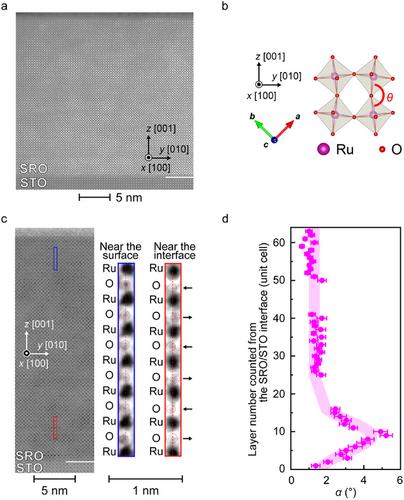
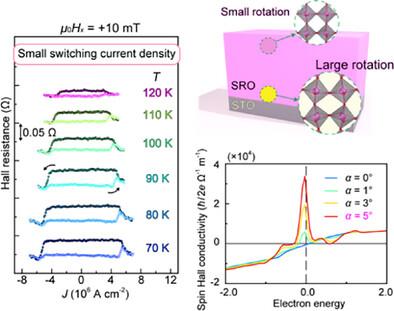
Spin Berry curvature characterizes the band topology as the spin counterpart of Berry curvature and is crucial in generating novel spintronics functionalities. By breaking the crystalline inversion symmetry, the spin Berry curvature is expected to be significantly enhanced; this enhancement will increase the intrinsic spin Hall effect in ferromagnetic materials and, thus, the spin–orbit torques (SOTs). However, this intriguing approach is not applied to devices; generally, the spin Hall effect in ferromagnet/heavy-metal bilayer is used for SOT magnetization switching. Here, SOT-induced partial magnetization switching is demonstrated in a single layer of a single-crystalline Weyl oxide SrRuO3 (SRO) with a small current density of ≈3.1 × 10⁶ A cm−2. Detailed analysis of the crystal structure in the seemingly perfect periodic lattice of the SRO film reveals barely discernible oxygen octahedral rotations with angles of ≈5° near the interface with a substrate. Tight-binding calculations indicate that a large spin Hall conductivity is induced around small gaps generated at band crossings by the synergy of inherent spin‒orbit coupling and band inversion due to the rotations, causing magnetization reversal. The results indicate that a minute atomic displacement in single-crystal films can induce strong intrinsic SOTs that are useful for spin-orbitronics devices.
自旋贝里曲率表征了贝里曲率的自旋对应带拓扑结构,是产生新型自旋电子学功能的关键。通过打破晶体反转对称性,自旋贝里曲率有望得到显著增强;这种增强将提高铁磁材料的固有自旋霍尔效应,从而提高自旋轨道转矩(SOT)。然而,这种引人入胜的方法并未应用于设备;通常,铁磁体/重金属双层材料中的自旋霍尔效应被用于 SOT 磁化切换。本文在单晶韦尔氧化物 SrRuO3(SRO)的单层中,以≈3.1 × 10⁶ A cm-2 的小电流密度演示了 SOT 诱导的部分磁化切换。通过对 SRO 薄膜看似完美的周期性晶格中的晶体结构进行详细分析,发现在与基底的界面附近几乎看不出角度≈5°的氧八面体旋转。紧密结合计算表明,由于固有的自旋轨道耦合和旋转导致的带反转的协同作用,在带交叉处产生的小间隙周围会诱发巨大的自旋霍尔电导率,从而引起磁化反转。研究结果表明,单晶薄膜中微小的原子位移就能诱导出很强的本征自旋霍尔电导,可用于自旋轨道电子器件。
期刊介绍:
Advanced Materials, one of the world's most prestigious journals and the foundation of the Advanced portfolio, is the home of choice for best-in-class materials science for more than 30 years. Following this fast-growing and interdisciplinary field, we are considering and publishing the most important discoveries on any and all materials from materials scientists, chemists, physicists, engineers as well as health and life scientists and bringing you the latest results and trends in modern materials-related research every week.





 京公网安备 11010802042870号
京ICP备2023020795号-1
京公网安备 11010802042870号
京ICP备2023020795号-1

 分享
分享
 求助内容:
求助内容: 应助结果提醒方式:
 扫码关注我们
