Qi Zhang, Liang Tao, Shuting Ma, Xu Jiang, Jie Xu, Jianwei Su, Jian Kang, Huajie Yin, Shan Chen
{"title":"Hypophosphorous Acid Additive Engineering for Efficient Cu2AgBiI6 Solar Cells","authors":"Qi Zhang, Liang Tao, Shuting Ma, Xu Jiang, Jie Xu, Jianwei Su, Jian Kang, Huajie Yin, Shan Chen","doi":"10.1002/adfm.202504863","DOIUrl":null,"url":null,"abstract":"<p>Perovskite solar cells have demonstrated significant performance advancements over the past decade, characterized by their low-cost fabrication and compatibility with both rigid and flexible substrates. Despite their potential, challenges such as long-term instability and the toxicity of lead in high-performance devices hinder their commercialization. Recently, the perovskite-inspired material Cu<sub>2</sub>AgBiI<sub>6</sub> (CABI) is explored as a light absorber due to its promising optoelectronic properties. However, its wide bandgap and difficulties in producing high-quality films limit its photovoltaic performance. In this study, hypophosphorous acid (H<sub>3</sub>PO<sub>2</sub>) is introduced to the CABI precursor solution, generating in situ silver nanoparticles that enhance light absorption through localized surface plasmon resonance. The incorporation of H<sub>3</sub>PO<sub>2</sub> improved the crystallinity and surface morphology of CABI films while reducing defect states. Solvent vapor annealing is further employed to optimize the film quality. As a result, the optimal CABI solar cell achieved a power conversion efficiency of 2.22%, a fourfold increase over the pristine film (0.55%). Additionally, the CABI device demonstrated an efficiency of 5.66% under 1000 lux 6000 K indoor illumination, showcasing its potential for powering Internet of Things devices. This strategy is further validated in the CuAgBiI<sub>5</sub> system, offering a pathway to enhance the performance of perovskite-inspired solar cells.</p>","PeriodicalId":112,"journal":{"name":"Advanced Functional Materials","volume":"35 40","pages":""},"PeriodicalIF":19.0000,"publicationDate":"2025-04-24","publicationTypes":"Journal Article","fieldsOfStudy":null,"isOpenAccess":false,"openAccessPdf":"","citationCount":"0","resultStr":null,"platform":"Semanticscholar","paperid":null,"PeriodicalName":"Advanced Functional Materials","FirstCategoryId":"88","ListUrlMain":"https://advanced.onlinelibrary.wiley.com/doi/10.1002/adfm.202504863","RegionNum":1,"RegionCategory":"材料科学","ArticlePicture":[],"TitleCN":null,"AbstractTextCN":null,"PMCID":null,"EPubDate":"","PubModel":"","JCR":"Q1","JCRName":"CHEMISTRY, MULTIDISCIPLINARY","Score":null,"Total":0}
引用次数: 0
Abstract
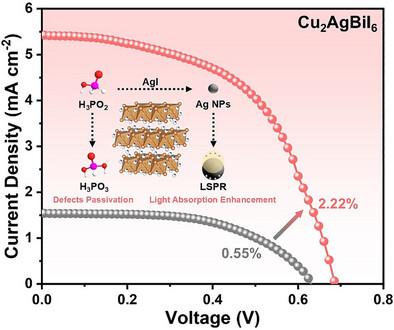
Perovskite solar cells have demonstrated significant performance advancements over the past decade, characterized by their low-cost fabrication and compatibility with both rigid and flexible substrates. Despite their potential, challenges such as long-term instability and the toxicity of lead in high-performance devices hinder their commercialization. Recently, the perovskite-inspired material Cu2AgBiI6 (CABI) is explored as a light absorber due to its promising optoelectronic properties. However, its wide bandgap and difficulties in producing high-quality films limit its photovoltaic performance. In this study, hypophosphorous acid (H3PO2) is introduced to the CABI precursor solution, generating in situ silver nanoparticles that enhance light absorption through localized surface plasmon resonance. The incorporation of H3PO2 improved the crystallinity and surface morphology of CABI films while reducing defect states. Solvent vapor annealing is further employed to optimize the film quality. As a result, the optimal CABI solar cell achieved a power conversion efficiency of 2.22%, a fourfold increase over the pristine film (0.55%). Additionally, the CABI device demonstrated an efficiency of 5.66% under 1000 lux 6000 K indoor illumination, showcasing its potential for powering Internet of Things devices. This strategy is further validated in the CuAgBiI5 system, offering a pathway to enhance the performance of perovskite-inspired solar cells.
期刊介绍:
Firmly established as a top-tier materials science journal, Advanced Functional Materials reports breakthrough research in all aspects of materials science, including nanotechnology, chemistry, physics, and biology every week.
Advanced Functional Materials is known for its rapid and fair peer review, quality content, and high impact, making it the first choice of the international materials science community.




 京公网安备 11010802042870号
京ICP备2023020795号-1
京公网安备 11010802042870号
京ICP备2023020795号-1

 分享
分享
 求助内容:
求助内容: 应助结果提醒方式:
 扫码关注我们
