Peng Peng, Yi Peng, Fuguo Liu, Shuai Long, Cheng Zhang, Aitao Tang, Jia She, Jianyue Zhang, Fusheng Pan
{"title":"Bayesian optimization and explainable machine learning for High-dimensional multi-objective optimization of biodegradable magnesium alloys","authors":"Peng Peng, Yi Peng, Fuguo Liu, Shuai Long, Cheng Zhang, Aitao Tang, Jia She, Jianyue Zhang, Fusheng Pan","doi":"10.1016/j.jmst.2025.02.059","DOIUrl":null,"url":null,"abstract":"Designing compositions and processing of biodegradable magnesium (Mg) alloys to synergistically enhance mechanical properties and corrosion resistance using conventional trial-and-error method is a challenging task. This study presents a Bayesian optimization (BO)-based multi-objective framework integrated with explainable machine learning (ML) to efficiently explore and optimize the high-dimensional design space of biodegradable Mg alloys. Using ultimate tensile strength (UTS), elongation (EL) and corrosion potential (<em>E</em><sub>corr</sub>) as objective properties, the framework balances these conflicting objectives and identifies optimal solutions. A novel biodegradable Mg alloy (Mg-4.6Zn-0.3Y-0.2Mn-0.1Nd-0.1Gd, wt.%) was successfully designed, demonstrating a UTS of 320 MPa, EL of 22% and <em>E</em><sub>corr</sub> of −1.60 V (tested in 37°C simulated body fluid). Compared to JDBM, the UTS has increased by 13 MPa, the EL has improved by 6.1%, and the <em>E</em><sub>corr</sub> has risen by 0.02 V. The experimental results presented close agreement with predicted values, validating the proposed framework. The Shapley Additive Explanation method was employed to interpret the ML models, revealing extrusion temperature and Zn content as key parameters driving the optimization design. The strategy provided in this study is universal and offers a potential approach for addressing high-dimensional multi-objective optimization challenges in material development.","PeriodicalId":16154,"journal":{"name":"Journal of Materials Science & Technology","volume":"14 1","pages":""},"PeriodicalIF":14.3000,"publicationDate":"2025-04-23","publicationTypes":"Journal Article","fieldsOfStudy":null,"isOpenAccess":false,"openAccessPdf":"","citationCount":"0","resultStr":null,"platform":"Semanticscholar","paperid":null,"PeriodicalName":"Journal of Materials Science & Technology","FirstCategoryId":"88","ListUrlMain":"https://doi.org/10.1016/j.jmst.2025.02.059","RegionNum":1,"RegionCategory":"材料科学","ArticlePicture":[],"TitleCN":null,"AbstractTextCN":null,"PMCID":null,"EPubDate":"","PubModel":"","JCR":"Q1","JCRName":"MATERIALS SCIENCE, MULTIDISCIPLINARY","Score":null,"Total":0}
引用次数: 0
Abstract
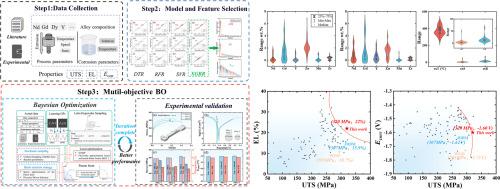
Designing compositions and processing of biodegradable magnesium (Mg) alloys to synergistically enhance mechanical properties and corrosion resistance using conventional trial-and-error method is a challenging task. This study presents a Bayesian optimization (BO)-based multi-objective framework integrated with explainable machine learning (ML) to efficiently explore and optimize the high-dimensional design space of biodegradable Mg alloys. Using ultimate tensile strength (UTS), elongation (EL) and corrosion potential (Ecorr) as objective properties, the framework balances these conflicting objectives and identifies optimal solutions. A novel biodegradable Mg alloy (Mg-4.6Zn-0.3Y-0.2Mn-0.1Nd-0.1Gd, wt.%) was successfully designed, demonstrating a UTS of 320 MPa, EL of 22% and Ecorr of −1.60 V (tested in 37°C simulated body fluid). Compared to JDBM, the UTS has increased by 13 MPa, the EL has improved by 6.1%, and the Ecorr has risen by 0.02 V. The experimental results presented close agreement with predicted values, validating the proposed framework. The Shapley Additive Explanation method was employed to interpret the ML models, revealing extrusion temperature and Zn content as key parameters driving the optimization design. The strategy provided in this study is universal and offers a potential approach for addressing high-dimensional multi-objective optimization challenges in material development.
期刊介绍:
Journal of Materials Science & Technology strives to promote global collaboration in the field of materials science and technology. It primarily publishes original research papers, invited review articles, letters, research notes, and summaries of scientific achievements. The journal covers a wide range of materials science and technology topics, including metallic materials, inorganic nonmetallic materials, and composite materials.



 京公网安备 11010802042870号
京ICP备2023020795号-1
京公网安备 11010802042870号
京ICP备2023020795号-1

 分享
分享
 求助内容:
求助内容: 应助结果提醒方式:
 扫码关注我们
