Yiye Fan, Jiaxin Yao, Wan Liu, Lebin Wang, Jing Yang, Xiaoyan Zheng, Junfeng Hui, Daidi Fan
{"title":"3D printed composite scaffold accelerates bone regeneration by modulating immunity and promoting angiogenesis","authors":"Yiye Fan, Jiaxin Yao, Wan Liu, Lebin Wang, Jing Yang, Xiaoyan Zheng, Junfeng Hui, Daidi Fan","doi":"10.1016/j.jmst.2025.03.041","DOIUrl":null,"url":null,"abstract":"Treating critical-size bone defects remains a significant clinical challenge, due to the complexity of achieving adequate immunomodulation, angiogenesis, osteogenic differentiation and matrix mineralization. Successful bone repair requires an orchestrated response in these areas to promote tissue integration and regeneration effectively. In this study, we designed and fabricated a customized, bioactive porous GDM/CeHA@CA scaffold through 3D printing and subsequent UV crosslinking techniques. The scaffold integrating Mn<sup>2+</sup>-chelated deferoxamine (DFO)-grafted gelatin methacryloyl (GDM) with citric acid-modified cerium-doped hydroxyapatite nanowires (CeHA@CA). The controlled Mn<sup>2+</sup> release from the scaffold strongly modulated macrophages polarization toward the anti-inflammatory M2 phenotype by down-regulating the MAPK signaling pathway and up-regulating the MnSOD signaling pathway. Macrophages maintain the stability of the bone microenvironment and prevent excessive inflammatory responses through immunomodulatory responses, and immunomodulated M2 macrophages promote angiogenesis and osteoblast differentiation by secreting growth factors VEGF and TGF-β. Scaffold degradation also led to the sustained release of covalently bound DFO, along with increased endogenous VEGF levels, promoted robust vascular remodeling. Additionally, the release of Ce<sup>3+/4+</sup>, as well as Ca<sup>2+</sup> and PO<sub>4</sub><sup>3−</sup> from CeHA@CA nanowires, in combination with elevated endogenous TGF-β, further boosted osteogenesis. Therefore, GDM/CeHA@CA scaffolds are able to promote angiogenesis and osteogenic differentiation not only through direct degradation, but also indirectly through immunomodulation. Through these synergistic mechanisms of immunomodulation, angiogenesis, osteogenic differentiation and matrix mineralization, the GDM/CeHA@CA scaffold successfully accelerated the repair of the critical-size tibial bone defect in rabbits within 12 weeks. In conclusion, the 3D printed GDM/CeHA@CA composite scaffold provided a highly effective therapeutic strategy for rapid bone defects repair, making it a viable candidate for clinical applications in bone regeneration.","PeriodicalId":16154,"journal":{"name":"Journal of Materials Science & Technology","volume":"7 1","pages":""},"PeriodicalIF":14.3000,"publicationDate":"2025-04-23","publicationTypes":"Journal Article","fieldsOfStudy":null,"isOpenAccess":false,"openAccessPdf":"","citationCount":"0","resultStr":null,"platform":"Semanticscholar","paperid":null,"PeriodicalName":"Journal of Materials Science & Technology","FirstCategoryId":"88","ListUrlMain":"https://doi.org/10.1016/j.jmst.2025.03.041","RegionNum":1,"RegionCategory":"材料科学","ArticlePicture":[],"TitleCN":null,"AbstractTextCN":null,"PMCID":null,"EPubDate":"","PubModel":"","JCR":"Q1","JCRName":"MATERIALS SCIENCE, MULTIDISCIPLINARY","Score":null,"Total":0}
引用次数: 0
Abstract
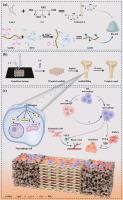
Treating critical-size bone defects remains a significant clinical challenge, due to the complexity of achieving adequate immunomodulation, angiogenesis, osteogenic differentiation and matrix mineralization. Successful bone repair requires an orchestrated response in these areas to promote tissue integration and regeneration effectively. In this study, we designed and fabricated a customized, bioactive porous GDM/CeHA@CA scaffold through 3D printing and subsequent UV crosslinking techniques. The scaffold integrating Mn2+-chelated deferoxamine (DFO)-grafted gelatin methacryloyl (GDM) with citric acid-modified cerium-doped hydroxyapatite nanowires (CeHA@CA). The controlled Mn2+ release from the scaffold strongly modulated macrophages polarization toward the anti-inflammatory M2 phenotype by down-regulating the MAPK signaling pathway and up-regulating the MnSOD signaling pathway. Macrophages maintain the stability of the bone microenvironment and prevent excessive inflammatory responses through immunomodulatory responses, and immunomodulated M2 macrophages promote angiogenesis and osteoblast differentiation by secreting growth factors VEGF and TGF-β. Scaffold degradation also led to the sustained release of covalently bound DFO, along with increased endogenous VEGF levels, promoted robust vascular remodeling. Additionally, the release of Ce3+/4+, as well as Ca2+ and PO43− from CeHA@CA nanowires, in combination with elevated endogenous TGF-β, further boosted osteogenesis. Therefore, GDM/CeHA@CA scaffolds are able to promote angiogenesis and osteogenic differentiation not only through direct degradation, but also indirectly through immunomodulation. Through these synergistic mechanisms of immunomodulation, angiogenesis, osteogenic differentiation and matrix mineralization, the GDM/CeHA@CA scaffold successfully accelerated the repair of the critical-size tibial bone defect in rabbits within 12 weeks. In conclusion, the 3D printed GDM/CeHA@CA composite scaffold provided a highly effective therapeutic strategy for rapid bone defects repair, making it a viable candidate for clinical applications in bone regeneration.
期刊介绍:
Journal of Materials Science & Technology strives to promote global collaboration in the field of materials science and technology. It primarily publishes original research papers, invited review articles, letters, research notes, and summaries of scientific achievements. The journal covers a wide range of materials science and technology topics, including metallic materials, inorganic nonmetallic materials, and composite materials.



 京公网安备 11010802042870号
京ICP备2023020795号-1
京公网安备 11010802042870号
京ICP备2023020795号-1

 分享
分享
 求助内容:
求助内容: 应助结果提醒方式:
 扫码关注我们
