{"title":"One-Step Low-Temperature Synthesis of Metastable ε-Iron Carbide Nanoparticles with Unique Catalytic Properties Beyond Conventional Iron Catalysts","authors":"Yuma Hirayama, Akira Miura, Motoaki Hirayama, Hiroyuki Nakamura, Koji Fujita, Hiroshi Kageyama, Sho Yamaguchi, Tomoo Mizugaki, Takato Mitsudome","doi":"10.1002/smll.202412217","DOIUrl":null,"url":null,"abstract":"<p><i>ε</i>-Iron carbide has garnered increasing interest for its superior magnetic characteristics and catalytic performance compared to other iron carbides. However, its metastable nature has posed significant challenges for synthesis, often requiring ultrahigh pressure, multistep processes, complex reaction condition control, and highly toxic reagents. Consequently, the properties of <i>ε</i>-iron carbide remain largely unexplored. A simplified synthesis method for <i>ε</i>-iron carbide can accelerate the exploration of new functionalities. In this study, a novel one-step selective synthesis method for <i>ε</i>-iron carbide nanoparticles under mild conditions via a wet-chemical approach is presented. In this method, Fe<sub>3</sub>(CO)<sub>12</sub>, cetyltrimethylammonium bromide (CTAB), and bis(pinacolato)diboron (B<sub>2</sub>pin<sub>2</sub>) are added to hexadecylamine and reacted at 220 °C—a simple process that eliminates the need for extreme pressures and toxic substances. Detailed investigations elucidate the crucial roles of CTAB and B<sub>2</sub>pin<sub>2</sub> in facilitating the selective formation of <i>ε</i>-iron carbide. This accessible and efficient synthesis process for <i>ε</i>-iron carbide can further enable the discovery of unprecedented catalytic properties in the reductive amination of benzaldehyde, distinct from those of conventional iron nanoparticle catalysts. Density functional theory calculations reveal insights into the electronic states responsible for the distinct activity of the <i>ε</i>-iron carbide nanoparticles.</p>","PeriodicalId":228,"journal":{"name":"Small","volume":"21 27","pages":""},"PeriodicalIF":12.1000,"publicationDate":"2025-04-24","publicationTypes":"Journal Article","fieldsOfStudy":null,"isOpenAccess":false,"openAccessPdf":"https://onlinelibrary.wiley.com/doi/epdf/10.1002/smll.202412217","citationCount":"0","resultStr":null,"platform":"Semanticscholar","paperid":null,"PeriodicalName":"Small","FirstCategoryId":"88","ListUrlMain":"https://onlinelibrary.wiley.com/doi/10.1002/smll.202412217","RegionNum":2,"RegionCategory":"材料科学","ArticlePicture":[],"TitleCN":null,"AbstractTextCN":null,"PMCID":null,"EPubDate":"","PubModel":"","JCR":"Q1","JCRName":"CHEMISTRY, MULTIDISCIPLINARY","Score":null,"Total":0}
引用次数: 0
Abstract
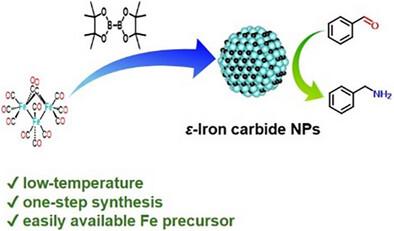
ε-Iron carbide has garnered increasing interest for its superior magnetic characteristics and catalytic performance compared to other iron carbides. However, its metastable nature has posed significant challenges for synthesis, often requiring ultrahigh pressure, multistep processes, complex reaction condition control, and highly toxic reagents. Consequently, the properties of ε-iron carbide remain largely unexplored. A simplified synthesis method for ε-iron carbide can accelerate the exploration of new functionalities. In this study, a novel one-step selective synthesis method for ε-iron carbide nanoparticles under mild conditions via a wet-chemical approach is presented. In this method, Fe3(CO)12, cetyltrimethylammonium bromide (CTAB), and bis(pinacolato)diboron (B2pin2) are added to hexadecylamine and reacted at 220 °C—a simple process that eliminates the need for extreme pressures and toxic substances. Detailed investigations elucidate the crucial roles of CTAB and B2pin2 in facilitating the selective formation of ε-iron carbide. This accessible and efficient synthesis process for ε-iron carbide can further enable the discovery of unprecedented catalytic properties in the reductive amination of benzaldehyde, distinct from those of conventional iron nanoparticle catalysts. Density functional theory calculations reveal insights into the electronic states responsible for the distinct activity of the ε-iron carbide nanoparticles.
期刊介绍:
Small serves as an exceptional platform for both experimental and theoretical studies in fundamental and applied interdisciplinary research at the nano- and microscale. The journal offers a compelling mix of peer-reviewed Research Articles, Reviews, Perspectives, and Comments.
With a remarkable 2022 Journal Impact Factor of 13.3 (Journal Citation Reports from Clarivate Analytics, 2023), Small remains among the top multidisciplinary journals, covering a wide range of topics at the interface of materials science, chemistry, physics, engineering, medicine, and biology.
Small's readership includes biochemists, biologists, biomedical scientists, chemists, engineers, information technologists, materials scientists, physicists, and theoreticians alike.





 京公网安备 11010802042870号
京ICP备2023020795号-1
京公网安备 11010802042870号
京ICP备2023020795号-1

 分享
分享
 求助内容:
求助内容: 应助结果提醒方式:
 扫码关注我们
