{"title":"Port Cleaner Trucks and Environmental Justice in the Greater New York Area","authors":"Yeonkyeong Gina Park, H. Oliver Gao","doi":"10.1016/j.scitotenv.2025.179396","DOIUrl":null,"url":null,"abstract":"<div><div>This paper examines local air pollution levels in disadvantaged neighborhoods near ports after the adoption of cleaner diesel trucks under the Port Drayage Truck Replacement Programs (TRPs). Using annual air pollutant data and census demographics at the tract level, we estimate changes in air quality through a Difference-in-Differences-in-Differences (DDD) model. Our findings indicate that the impact of TRPs was mixed: near-port Black/African American communities were likely worse off, while near-port Hispanic/Latinos saw improvements. Since 2010, air quality improvements in Greater New York (GNY) were 4.5% greater than in near-port communities. Black-majority tracts near ports experienced 6.4% higher NO<sub>2</sub> than Black-majority tracts in GNY. Within near-port areas, Black-majority tracts had 2.7% higher NO<sub>2</sub> than non-Black-majority tracts. The relative gap between Black and non-Black populations in near-port areas widened by about 2% compared to GNY. Conversely, near-port Hispanic-majority tracts had NO<sub>2</sub> levels similar to GNY Black-majority and near-port non-Hispanic-majority areas, with the relative gap between Hispanic and non-Hispanic populations in near-port areas narrowing by 4% compared to GNY. These disparities highlight the disproportionate benefits and drawbacks of TRPs, underscoring the need for more targeted interventions. To address these inequities, we recommend an integrated policy approach, including interstate collaboration to standardize truck regulations, stricter on-road emission controls in near-port areas, and accelerated adoption of clean technologies like electric and hydrogen fuel cell vehicles. These actions could reduce environmental health disparities and promote environmental justice by addressing the systemic vulnerabilities of near-port communities.</div></div>","PeriodicalId":422,"journal":{"name":"Science of the Total Environment","volume":"979 ","pages":"Article 179396"},"PeriodicalIF":8.0000,"publicationDate":"2025-06-01","publicationTypes":"Journal Article","fieldsOfStudy":null,"isOpenAccess":false,"openAccessPdf":"","citationCount":"0","resultStr":null,"platform":"Semanticscholar","paperid":null,"PeriodicalName":"Science of the Total Environment","FirstCategoryId":"93","ListUrlMain":"https://www.sciencedirect.com/science/article/pii/S0048969725010332","RegionNum":1,"RegionCategory":"环境科学与生态学","ArticlePicture":[],"TitleCN":null,"AbstractTextCN":null,"PMCID":null,"EPubDate":"2025/4/24 0:00:00","PubModel":"Epub","JCR":"Q1","JCRName":"ENVIRONMENTAL SCIENCES","Score":null,"Total":0}
引用次数: 0
Abstract
This paper examines local air pollution levels in disadvantaged neighborhoods near ports after the adoption of cleaner diesel trucks under the Port Drayage Truck Replacement Programs (TRPs). Using annual air pollutant data and census demographics at the tract level, we estimate changes in air quality through a Difference-in-Differences-in-Differences (DDD) model. Our findings indicate that the impact of TRPs was mixed: near-port Black/African American communities were likely worse off, while near-port Hispanic/Latinos saw improvements. Since 2010, air quality improvements in Greater New York (GNY) were 4.5% greater than in near-port communities. Black-majority tracts near ports experienced 6.4% higher NO2 than Black-majority tracts in GNY. Within near-port areas, Black-majority tracts had 2.7% higher NO2 than non-Black-majority tracts. The relative gap between Black and non-Black populations in near-port areas widened by about 2% compared to GNY. Conversely, near-port Hispanic-majority tracts had NO2 levels similar to GNY Black-majority and near-port non-Hispanic-majority areas, with the relative gap between Hispanic and non-Hispanic populations in near-port areas narrowing by 4% compared to GNY. These disparities highlight the disproportionate benefits and drawbacks of TRPs, underscoring the need for more targeted interventions. To address these inequities, we recommend an integrated policy approach, including interstate collaboration to standardize truck regulations, stricter on-road emission controls in near-port areas, and accelerated adoption of clean technologies like electric and hydrogen fuel cell vehicles. These actions could reduce environmental health disparities and promote environmental justice by addressing the systemic vulnerabilities of near-port communities.
期刊介绍:
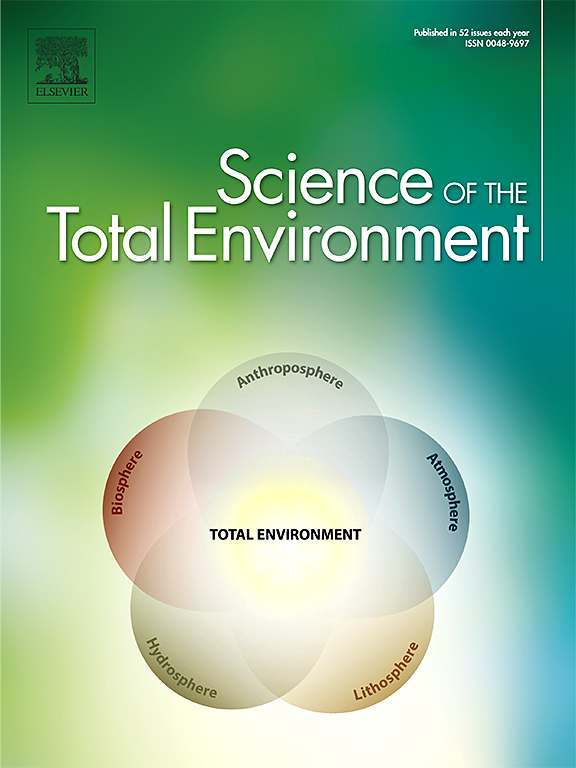
The Science of the Total Environment is an international journal dedicated to scientific research on the environment and its interaction with humanity. It covers a wide range of disciplines and seeks to publish innovative, hypothesis-driven, and impactful research that explores the entire environment, including the atmosphere, lithosphere, hydrosphere, biosphere, and anthroposphere.
The journal's updated Aims & Scope emphasizes the importance of interdisciplinary environmental research with broad impact. Priority is given to studies that advance fundamental understanding and explore the interconnectedness of multiple environmental spheres. Field studies are preferred, while laboratory experiments must demonstrate significant methodological advancements or mechanistic insights with direct relevance to the environment.





 京公网安备 11010802042870号
京ICP备2023020795号-1
京公网安备 11010802042870号
京ICP备2023020795号-1

 分享
分享
 求助内容:
求助内容: 应助结果提醒方式:
 扫码关注我们
