Zachary M. Shephard , Trevor F. Partridge , Sheila F. Murphy , Michelle A. Walvoord , Brian A. Ebel
{"title":"A review of post-wildfire adaptations of surface-water-quality models: Synthesis, gaps, and opportunities","authors":"Zachary M. Shephard , Trevor F. Partridge , Sheila F. Murphy , Michelle A. Walvoord , Brian A. Ebel","doi":"10.1016/j.scitotenv.2025.179435","DOIUrl":null,"url":null,"abstract":"<div><div>As wildfires increasingly affect water-supply watersheds, the demand for models to predict water-quality responses is increasing. This work reviews and synthesizes existing post-wildfire applications of water-quality models in the context of geographic and ecohydrological distribution, hydrologic and water-quality response process representation, model parameterization, model and input data scales, model calibration data availability, as well as calibration and performance evaluation approaches. Emphasis is placed on models that simulate water-quality output, rather than sediment and erosional response as the primary focus. Here, identified gaps and opportunities to advance the post-wildfire application of water-quality models include: 1. applying models in under-represented geographic and ecohydrologic regions, 2. simulating multiple streamflow generation mechanisms, including groundwater, with an emphasis on shifting dominant flow pathways as the landscape recovers following wildfire, 3. adding studies that include the simulation of metals, 4. incorporating more biogeochemical and in-stream processes to model applications, 5. applying finer spatial and temporal resolution of precipitation data input as well as finer spatial resolution hydrologic response units, 6. implementing fully distributed grid or element models or finer resolution response units to capture burn severity heterogeneity, 7. collecting enhanced water-quality data for model calibration and validation, 8. conducting model-intercomparison studies, and 9. developing model parameter value guidance in post-wildfire applications. These identified gaps and opportunities may assist users in deciding on key processes and approaches to consider in modeling post-wildfire water-quality conditions.</div></div>","PeriodicalId":422,"journal":{"name":"Science of the Total Environment","volume":"979 ","pages":"Article 179435"},"PeriodicalIF":8.0000,"publicationDate":"2025-06-01","publicationTypes":"Journal Article","fieldsOfStudy":null,"isOpenAccess":false,"openAccessPdf":"","citationCount":"0","resultStr":null,"platform":"Semanticscholar","paperid":null,"PeriodicalName":"Science of the Total Environment","FirstCategoryId":"93","ListUrlMain":"https://www.sciencedirect.com/science/article/pii/S0048969725010721","RegionNum":1,"RegionCategory":"环境科学与生态学","ArticlePicture":[],"TitleCN":null,"AbstractTextCN":null,"PMCID":null,"EPubDate":"2025/4/24 0:00:00","PubModel":"Epub","JCR":"Q1","JCRName":"ENVIRONMENTAL SCIENCES","Score":null,"Total":0}
引用次数: 0
Abstract
As wildfires increasingly affect water-supply watersheds, the demand for models to predict water-quality responses is increasing. This work reviews and synthesizes existing post-wildfire applications of water-quality models in the context of geographic and ecohydrological distribution, hydrologic and water-quality response process representation, model parameterization, model and input data scales, model calibration data availability, as well as calibration and performance evaluation approaches. Emphasis is placed on models that simulate water-quality output, rather than sediment and erosional response as the primary focus. Here, identified gaps and opportunities to advance the post-wildfire application of water-quality models include: 1. applying models in under-represented geographic and ecohydrologic regions, 2. simulating multiple streamflow generation mechanisms, including groundwater, with an emphasis on shifting dominant flow pathways as the landscape recovers following wildfire, 3. adding studies that include the simulation of metals, 4. incorporating more biogeochemical and in-stream processes to model applications, 5. applying finer spatial and temporal resolution of precipitation data input as well as finer spatial resolution hydrologic response units, 6. implementing fully distributed grid or element models or finer resolution response units to capture burn severity heterogeneity, 7. collecting enhanced water-quality data for model calibration and validation, 8. conducting model-intercomparison studies, and 9. developing model parameter value guidance in post-wildfire applications. These identified gaps and opportunities may assist users in deciding on key processes and approaches to consider in modeling post-wildfire water-quality conditions.
期刊介绍:
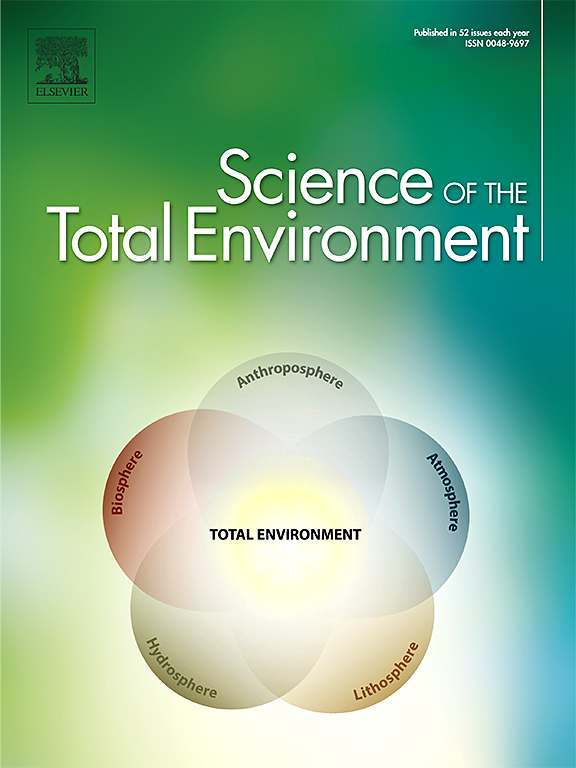
The Science of the Total Environment is an international journal dedicated to scientific research on the environment and its interaction with humanity. It covers a wide range of disciplines and seeks to publish innovative, hypothesis-driven, and impactful research that explores the entire environment, including the atmosphere, lithosphere, hydrosphere, biosphere, and anthroposphere.
The journal's updated Aims & Scope emphasizes the importance of interdisciplinary environmental research with broad impact. Priority is given to studies that advance fundamental understanding and explore the interconnectedness of multiple environmental spheres. Field studies are preferred, while laboratory experiments must demonstrate significant methodological advancements or mechanistic insights with direct relevance to the environment.




 京公网安备 11010802042870号
京ICP备2023020795号-1
京公网安备 11010802042870号
京ICP备2023020795号-1

 分享
分享
 求助内容:
求助内容: 应助结果提醒方式:
 扫码关注我们
